
 Apple Podcasts
 Spotify
 YouTube
  RSS Feed
 Mental Health Advocate Who's Willing To Share His Path with Jonathan Kemp | 240
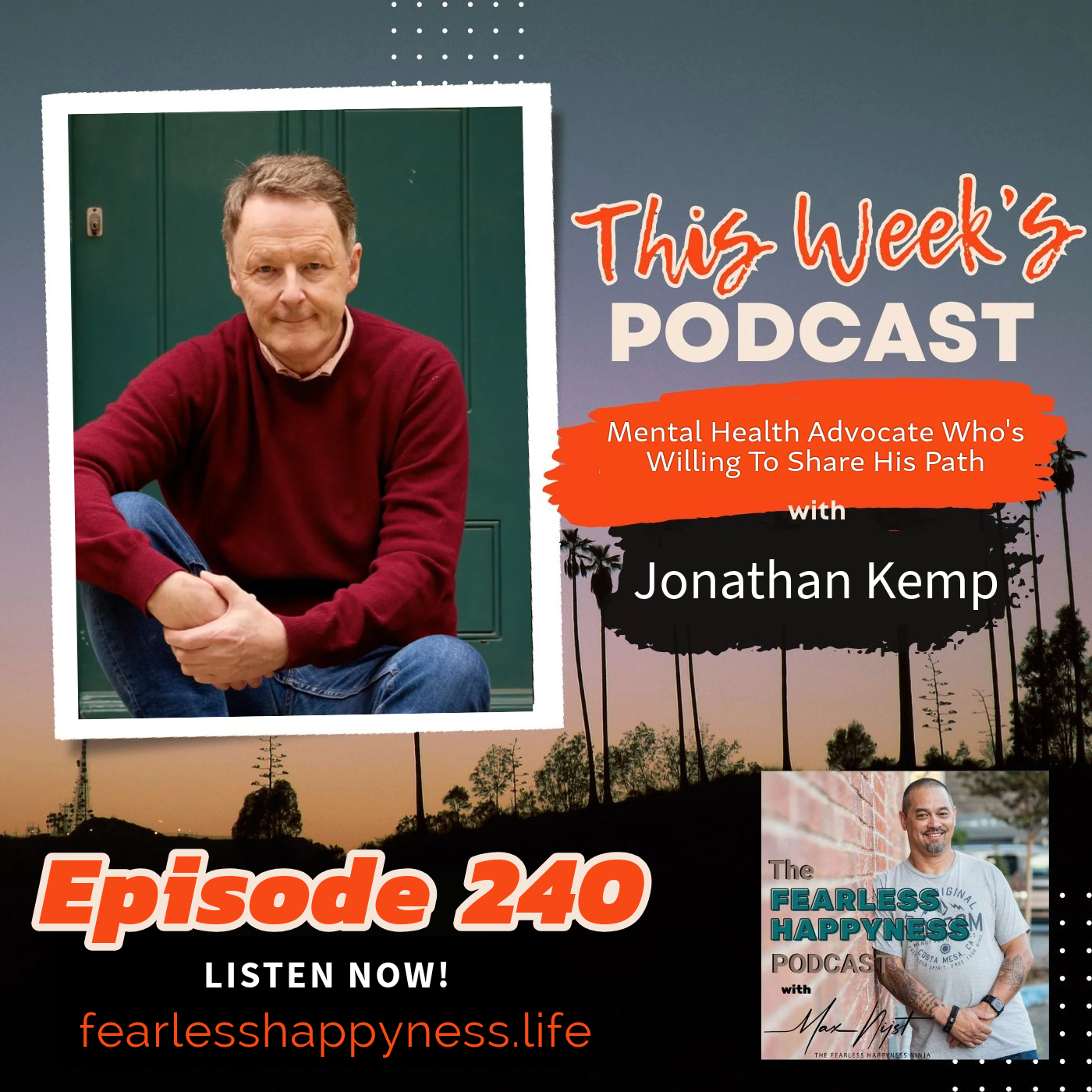
In this episode of the Fearless Happiness Podcast, host Max interviews Jonathan Kemp, who shares his personal journey through mental health challenges, including bipolar disorder, addiction, and dyslexia. Jonathan discusses the importance of seeking help, the impact of COVID-19 on mental health, and the process of writing his memoir to help others. He emphasizes the significance of community support and professional guidance in overcoming mental health struggles, and offers valuable insights on finding the right treatment and maintaining a healthy mindset.
For more from Jonathan:
For More From Sober Coach/Substance Abuse Counselor Max Njist, visit
speaker-0: Welcome to the Fearless Happiness Podcast, where we showcase phenomenal individuals who have overcome serious traumas, life obstacles and challenges to find their own path to fearless happiness. Listen as Max Naste invites guests from all around the world to share their experiences and spread strength, hope and faith. This is the Fearless Happiness Podcast and this is Max Naste.
speaker-1: All right, everybody. Good morning, good afternoon, or good evening, wherever you are in this world. This is Max from the Fearless Happiest Podcast. And again, I have another very special and amazing guest joining me from central London out in the UK. So grateful you're here, Jonathan. But what I like to do is have you introduce yourself to my audience, like who you are, what it is you do, and then you and I are gonna, like I like to say, rock and roll.
speaker-0: Sounds perfect and thank you very much for having me. â So I'm, â as you said, I'm based in the UK and â I've done various things, but my most recent project is that I've just written a memoir on my experience with mental health. And â it's an inspirational journey through my experiences with bipolar disorder, depression, addiction and dyslexia. And â the book's made up of two parts really. One is my memoir and then the second part is my analysis of what worked and what didn't work. And â the overall objective for me was to put my knowledge and experience â out in the public sphere to help other people.
speaker-1: love that, right? Because I mean, I know I'm not the only one, but you see it in the world, whatever they're trying to do, but there is a lot of mental health issues going on in this world, whether it's self-induced because someone's in their addiction or they truly have a mental health issue and need that professional help. So let's go back and talk about that journey a little bit, Jonathan, about like where it all started, what happened and then We'll get into your book and how you help people overcome that stuff because I can relate to you because I went through and still have some stuff I deal with today. But like you, I I sought the help. I figured out what works for me. And now like you, I get to bring people like you, wonderful gentlemen like you on the show to share their experience so they can give others hope out there that might be gone. I'm all alone. I don't know what to do. Because then you and I know there was probably a time where, you know, I know you and me went, how do I do this? I have nobody. Because, you know, in our heads, we're like, â gosh, no one's going to want to help me, you know?
speaker-0: Yes, absolutely. So I first realized that something was wrong at a very early age, probably around the age of six or seven. just life wasn't appealing. I had moments where I wish I had a different family. I wish I was born in different country. I wish I wasn't born at all. You know, for me, that was just the sort of, just the way things were. And, I also struggled with, â relationships with friends and looking back now, I also had the, â the start of a problem with, â you know, mood swings. I was very quick to, you know, my moods would change really quickly and I couldn't really understand why. â So it started at a very early age for me.
speaker-1: mean, to recognize that something was off at that early age, right? And is great. If you think about it, but at the same time, it's not so great because at that young age, you're going like, what's wrong with me? Like, why? Right? And I mean, I've had those feelings where I'm like, I don't belong to this family. I wish I had another one. My friends don't get me. I don't even get me. What do I do? And it's a slow an arduous journey, don't you think? Like when you're trying to figure that out. But as you were getting older and you recognize, OK, maybe there's something mentally going on with me. Did you ask for help or did help show up and you go, OK, I'm starting to understand what I need to do now.
speaker-0: It was a very, well as you intimated earlier on, for all of us and for me in particular, it was a very slow journey. â Interestingly, you said something very interesting about, know, did I realize that it was a mental problem? I knew there was something wrong with my brain, would I have described it as a mental problem? Probably not then. I don't think I had the language to really describe it. â But I was very, very aware that things were more of an effort than they should have been. I was also struggling at school with studying. â I had real problems trying to remember information, I had problems in exams.
speaker-1: Right.
speaker-0: and the combination of two things I felt, you know, an outsider. And it got worse. â And I tried all sorts of things. So I was determined to sort it out myself. And I had a variety of different careers. And it wasn't until I was about 39. and I reached another fork in the road which I'd been at it a few times where it was either we're going to call it a day or I have to do something different and this do something different was do something that I fought against for years which was go and see a â therapist actually.
speaker-1: Right, to see, can relate, because yeah, I mean, at an early age, we know something's not right, but like you said, we don't have the wherewithal to go, â maybe I have a chemical imbalance going on in my brain. But we know something's off, and you like me, like it took me later on to figure out, well, it took me five years of being sober to go into a serious depression where I'm like, something's not right. Like why do I, and, and you probably went through it in your life at some point where everything was fine, right? Everything was great, but you felt like I don't want to be here anymore. I mean, because you said you've, struggled with bipolar too, right? Depression and bipolar too is more of the depressive side of bipolar, correct? Correct. And then addiction, you throw that on top of it, right? Those and You you mentioned you had dyslexia. That right there has to be frustrating, right? Because you have to learn to do things, when it comes to like schoolwork and reading and stuff, to do it a totally different way than everybody else. I mean, that could stir the pot even more, don't you think? And right, I know it took me till I was 32 to finally go, there's something has to change. You know what I mean? But I'm glad the change happened and I'm glad you sought to help because you know, think and correct me if I'm wrong, but I think 99.9 % of the people on this planet could use some form of therapy just to help them overcome some whatever challenges they're going through instead of just going I'm gonna do it on my own, right? Because I know I tried that it didn't work out very well half the time but I got better when I sought the help and then I surrounded myself with like-minded people. Does that make sense?
speaker-0: It makes complete sense. And the way I think about it now that, you know, if we want to become physically fit, then it's a natural course is to go and, you know, seek out a physical coach trainer who can sort of give you the right exercises to, to increase your physical strength or physical stamina. Right. And for me, the brain is exactly the same. If we want to for our brain to operate as well as it can, having an external professional who understands about whatever aspect of the brain we want to work on â makes an enormous difference because they have the knowledge and experience â and the external insight that we don't have.
speaker-1: And I think it's important that you said that, right? Because like I said, I can only use my experience. And when I was going through that depression, I thought I could fix it. And when I realized it was only getting worse, luckily I had a sponsor or a mentor and I said, hey, this is what's going on, right? Like, what do I do? And he says, â well, you know, in the â big book, it says even us alcoholics need outside help. So. You know, he looked at me like, you know what that means. I have to go to my doctor and tell them what's going on. Right. And I'm glad I listened to him because as you know, if we try. I know for me, I'll just let me say my experience when I try to do it on my own, it only got worse because I didn't know. I'm not a professional. Like, how am I going to fix something that I don't? I understand it's there, but I don't know how to fix it. Right. It's like me, here's my experience. I try to fix a car and I'm not a good mechanic. So it'd be like, I'll go fix your car, honey, right? But I have no idea what I'm doing. And I might be one of those people where you see the cars put back together, but there's all these extra parts laying around, right? But that experience also can be very, it can teach us a lot, right? When we do go ask for help. And what did, so what else did that process look like?
speaker-0: So I think there are sort of two aspects for me of asking for help. the first and or two aspects and two stages. So the first stage was me trying all sorts of things that I thought might help. And in a sense, I was asking for help. So, you know, I belong to various 12 step fellowships. â I worked through the steps, you know, with, with a fine tooth comb. I tried religion. tried physical exercise. tried different diets. I tried primeval chanting. I tried, you know, â what you call them motivational gurus. Right. Right. And, â yeah, and just sheer willpower. You know, I remember numerous times my head would be hurting. I had this expression, I'm off my head. And that's the way I used to describe what was going on in my head. And I was a, I was a police officer of 12 years. And I remember lots of times just going down to the gents, closing the door, sitting on the top of the toilet seat, and then just thinking, right, I'm not going to think this anymore. I'm not going to think that anymore. This is what I'm going to do when this thought comes in my mind. And I'd sit there and think, right, OK, I've got it. Open the door. And within seconds, was all back again.
speaker-1: bruh.
speaker-0: So that's sort of stage one of asking for help, which was basically, you know, Jonathan, what, what solutions have you got? And, â you know, I, I just ended up in â a really poor, poor mental state and, â it was literally, there was a fork in the road, you know, either I'm going to call it, call this a day, call it a day, or I'm going to get help. And so the second stage was then. getting help from medical professionals and I started off seeing therapists. persuaded me, one therapist in particular persuaded me to see a psychiatrist. The psychiatrist after a year managed to persuade me to take medication. â I then actually realized that the problems I had were way beyond anything I could sort out. So I actually got a loan and went to a mental health facility in the U S in Arizona for four weeks. â and so for the next 20 years, I, you know, followed medical advice from medical professionals, sometimes more than others. Sometimes I decided to come off my meds because, I thought that was the right thing to do. â it wasn't. â and actually the, another huge learning curve for me was COVID enormous.
speaker-1: That time period, as you know, has created a lot of mental health issues for people around the world. And like you talked about the 12 steps and everybody, this is not like a push for any 12 step program, but I like what you said though, right? You worked the steps and I'm sure in your time you ran around those. â old timers that say, if you take medicine, right, you're not sober. Well, they're not a doctor. And I always used to get in arguments and say, look, their brain chemistry is off, right? Or mine is off. And who are you to say they're not sober because they're taking a med prescribed by a doctor to help that brain chemistry so that they are not crawling out of their skin or like you say, thinking this is it. I might as well just end it all. Right? Because there's, I mean, there's, there's pros and cons to everything. I, and I get, not everybody likes the 12 steps, but I don't know about you, but for me, it's been a lifesaver. That's why I have 22 years sober. â it's my foundation for other things that I have explored and found to, you know, better myself and my mental health, obviously in this world. And, and it's like you, there's times where I thought I don't need to do this. I'm fine. Right? Like you said, that was, and I don't, can laugh, you and I, cause we've been through that experience, but we laugh cause we go, no, that was not a, right? We should always seek professional help. And you know, like when I did finally come off my antidepressant, right? I did go to my doctor and he said, okay, this is how you need to do that. So you don't basically go into withdrawals or, you know, because I've had that happen where I've, in between jobs, right? You know, sometimes you have to wait a period before you can get your medication because and you know, you're like barely holding on like, â this really why did I do this, you know, or whatever. But also thank you for your service as a police officer. I mean, that alone, as you know, can cause a lot of if men and women who do that, if they don't take care of themselves could cause a lot of mental health issues because the things you see on a daily basis, like, because most of the officers I know that I have dealt with or met or know, or firemen, first responders, right? They all deal with some form of PTSD, which is another mental health issue is right. It's not just people that go to war or that are in the military. mean, it's, there's all of us have some form of PTSD, I believe, but, you know, but thank God, you know, there's, there's men like you, Jonathan, right? Like, We did our trial by fire, but â you you sought the help. when did you realize like our, let me put it this way. So what worked best for you? So you could give the audience an idea when you finally found that the one thing, or maybe it was two or three things that you put together that helped you feel like, okay, I'm ready to go now. Does that make sense? Like I feel like I can. function in this world, right? And now go help others do the same.
speaker-0: As I mentioned, â the whole experience of COVID, I think, was another sort of â inflection point. So when COVID started, I thought, well, this is going to be easy. I know what shit feels like. And so, you know, bring it on. Can't be any worse than what I've been through. â I was wrong. What I hadn't realized was the importance of social interaction and social connection. So that was one thing and that disappeared overnight. The other thing which I hadn't fully understood or appreciated was my main coping mechanism, which was working that also disappeared overnight because I do training and coaching and it literally just stopped. â And so the combination of those two things meant that, you know, I was all my sort of historic coping mechanisms, you know, being the jolly person saying hello to everyone, going around talking to everyone, which I'm very, very good at all that was removed. I went back actually to trying to do things myself. So I was monitoring my moods like five times a day. I was like recording everything I did, just trying to look for anything that would, you know, just make a little switch. Right. and over that period, I think I had about three or four bipolar highs and then crashes. And on the last one, I was just, I was finished. I think it's the nearest and the closest that I've been to really saying, This is it. I'm not carrying, I'm not prepared to carry on anymore. â And I realized how close I was and I'd started writing the book and I'd written the chapter and this comes on to the points of what helps and I'd written part of the chapter, which I call an emergency action plan. So what, what to do when things go south. and I couldn't remember what was on it. So one of the things that happens when I have a bipolar crash, it's literally like my brain stops working. It's extraordinary. And I have this sort of sandstorm screaming around inside my head. â Anyway, I looked on my laptop, I found it and number one was to be prepared to be open minded and willing. And I remember when I wrote that as number one, I winced because when I'm struggling, all I want to do is go and sit in a corner and, â know, disappear. Number two was to, â go and get professional medical help. And number three was to do what they said. And. And so I thought, right. You know, if I'm not going to call it a day, I'm going to do exactly what I've written here. And that's what I did. And, â I was advised to change my medication, which I did. â it had stopped working maybe five, 10 years previously, but I just didn't want to change. And I had a really rocky time changing medication and that's quite normal because there's no exact science. So what work might work for you and work perfectly might have a completely different effect on me. And that's quite normal. And the, and the other normal thing is, you know, it'll take. probably six to 12 weeks to have any idea if you're on the right medication or heading in the right direction. And I would say, so I changed medication about March and then by about August, September, it was like a complete miracle. It was no longer an effort to think. It was no longer an effort to breathe, to move, to be. It was just like a complete and utter miracle. And, â that was nearly three years ago. And it's my sort of mental health. I mean, I've had a few ups and downs. but they're within the normal parameters of life. â Yeah, it's been absolutely incredible. So for me, because I have specific mental illnesses, know, the bipolar type two, the depression, â the addiction is something I'm sort of have to be careful of across the board. â but because of the specific mental illness in terms of the bipolar disorder type two, have to take medication. Yeah. â and that's the only thing that's worked and that is like the foundation stone. And then once that's worked, then there are all the other things that really help. And in fact, number one, after that is sleep getting for me, it's about eight hours sleep a night.
speaker-1: See, that's if everybody's paying attention, that's like for everybody, it's important that you get enough sleep, right? But if there's something you struggle with, sleep's that much more important, right? Because as you know, with bipolar, right, you can have the highs and you don't sleep for days. Like that's where, you know, people might mistake it for drug use, right? And you're not on, but it's the same. I've seen, I have many friends who who struggle with their bipolar. And I have a friend who's 34, 35 years sober who struggled with it. She never would relapse, but when she would have her, you know, her breaks, whatever you want to call them, like the high, like, it would remind me of when I was addicted to meth, right? The highs, that kind of high. And then the depression is like when I don't have it and I'm laying in bed and I'm so depressed because I can't move. And Jonathan's smiling. Right? Because he understands that. it's, and you're right, right? That's why I tell people, like, I don't try to, I've been a substance abuse counselor, but, know, and I thank God they have the doctors to diagnose and the psychiatrist for, you know, or whatever for the medications. Cause I'm not going to tell anyone, but I know for me, like you said, like when they first put me on, let's say Prozac. That was the first medication. It actually made me worse and I couldn't, after like two weeks, I had to tell my doctor, my psychiatrist, like, sorry doc, this is not, it's making me worse. And so she goes, okay, okay. And then, but then when we found the right medication, right after that, I could think clearly, I could go about my day and work without having to struggle. â It actually helped with my like, my ADD, right, where I could focus on what I had to do instead of going from one topic to the next. And people looking at me like, slow down, Max, like we're over here still, you know, but, but you're right. But that's where the professionals come in, right? And we, you and I can share our stories, but if you heard Jonathan, right, it's like he had to listen to the professional and he said, okay, maybe you need to change this. And that's why for me, when I spoke to my doctor about coming off, I had been on it so long, it wasn't working. wasn't. For me, it wasn't I wasn't having like high highs or low lows. I was just flat and my family would tell me Max, you're just kind of there. You know, you're not happy, but you're not sad. And that was when it clicked for me. Like, OK, I can come off this. I'm going to do it the right way. But like you said at one point, like. diet had to change for me, I had to start exercising. And that's been my medication is, you know, trying to take care of myself physically and mentally through diet and exercise. And I really haven't had any issues since I've been off for almost five years now. But, but like you said, everybody, not doctors. It's an individual thing that is discussed with you and your professional, whether it's your doctor, psychiatrist, or therapist or psychologist. But we just want to bring this out because we want you to understand it. Jonathan's here to say you're not alone. He's gone through it and this is what he did. So let's talk about your book, Jonathan. And right, you kind of gave a little bit, but like talk more about what's in your book so that people have a better understanding. So when they go get it, they're like, I'm going to read this book because it's going to help me.
speaker-0: Yeah, so I wanted to, â the reason I wrote the book was because, â again, during COVID, I sort of realized that my greatest wealth, you know, wasn't financial, wasn't status. It was actually my knowledge and understanding of mental health. So I had 20 plus years of trying to do it myself. 20 plus years of following medical advice, sometimes more than others.
speaker-1: Right.
speaker-0: that, you know, that has a huge value. â the other thing that I realized was that by nature, and I think it's accentuated why I don't, I know it's accentuated by the sort of by the bipolar, the hyper, the hyper mania side of, â my mind is I'm also highly analytical and, â you know, I've really thought through, you know, what can I do? How can I improve it? And so I thought to myself, well, actually all that analysis has a value as well. know, So I identified, for example, I identified about 14 things. call them foundation stones. Um, and it'll be different for everyone, but I thought to myself, I thought to myself, what, things do I have? And it turned out to be about 14. And then I put them in order of priority, but I also learned from the fellowships of.
speaker-1: You love
speaker-0: You know, what works for one person doesn't necessarily work for anyone else. So I clearly, I clearly put that at the beginning. â but what I wanted to do is to help those people who want to try and jump learning curve to jump the learning curve. â And so that was the book. took two years to write. â And I had it edited by a male editor, female editor, had a sensitivity check done, because I wanted it to be a sort of helpful read for people of different generations, different genders. â And I was really keen for that. And it was published two weeks ago.
speaker-1: Oh, wow. So it's fresh out there, everybody. So we'll get it out and get that in a few, right. There's nothing. And I can't help it because you're a fellow 12 step, right? There's, there's nothing like one. Struggling person, let's say, right. So everybody can relate helping another struggling person, right? Cause that's where the connection happens. And you said that earlier, right. Which I, you know, this is. It's my humble opinion, right? But we need more connection in the world, right? And nothing has taught me better about connection than my meetings, right? Like being in a room full of people. Okay, for instance, right? If me and Jonathan, Jonathan and I went to a meeting, right? We got to know each other. I'm not going to look at Jonathan and go, â he used to be a cop. I can't talk to him. And he wouldn't look at me and go. â he's an ex-felon. I can't talk to him either. Right? We get to know each other. We're going to hug each other when we see ourselves in a meeting. We're going laugh. We're going to have coffee together. I don't smoke anymore, but maybe back in the day I would have had a cigarette with you or whoever, you know what I mean? But you get what I'm saying, right? All of us need to get back to that oneness, right? And I'm so glad that you mentioned that connection thing because a lot of my recent guests have talked about how the world And we're not just talking people with mental health issues or physical issues, right? Like we as a society, â the human race need to get back to connecting with one another, right? Cause that's what makes the world. If you think about go round is I could go to England and now I have a new friend named Jonathan and you know, we're going to go have coffee or whatever together. And we're going to talk about the podcast. We're going to talk about life. And we'll get it because we'll understand we both have different backgrounds, but I love that saying, right? We're usually people that would not mix, but you get us in a meeting and we're all hugging and talking and laughing and connecting. And that's my hope for the world, right? That's why I love having guests like yourself who shares that experience, right? You said it, 20 years of doing it on your own and it didn't work, but 20 years of finding the right people, the right help and now you get to live like we say, know, happy, joyous and free, you know, and the best part is now you get to turn that into helping others, right, which you can't put a price on that when someone is going to read your book, Jonathan, and then they email you and say, Jonathan, you know, like you helped save my life. Like, thank you for writing this book because I thought I was all alone, right? And that's what I love about â connecting with other people from various, you know, they're, cause I don't always want to have to grab a pill because I have a pain in my shoulder or like you said, out of having a bad day, right? That doesn't mean I'm going back downhill, but it means I have people I can talk to. I have books I can read, right? Like Jonathan's book, which I'll be getting myself and, â this medium where I can bring Jonathan on and he could share his story. So as you're progressing, See, because I love it, right? I could sit here and talk to you probably all day about the 12 staffs, about your journey with meds and, you know, your mental health issues and addiction. Because as you and I know addiction and mental health all kind of like one creates the other as at least it's been my experience, right? either people that struggle with mental health issues and find that, you know, self medication, whatever, whether it's alcohol, drugs, whatever, or, you know, they have the addiction and that's the only, you know what I mean? That's like sometimes it's implanted in us from the stories we're told from when we were little kids to, you know, even generations before us, right? As they've proven that. addiction is in our DNA and a lot of us could be prone to it. But then we also have those other stories where they go the opposite way and they never, right? Because mom and dad or grandpa, grandma. â So in this journey, as you wrote your book, that had to be exciting, right? Because I did the same, I wrote a book about my journey from addiction into recovery and was, a lot of it was That was my medicine to share my journey. that, because I'm you and I, right? We're it's it's we're not the only ones that have been through this. But if if our stories can help just one person, we've done our job. Right. Because I love my favorite quote. Jonathan is from Jesse Jackson. And I hear it in the meetings a lot is like the only time you should ever look down on someone is when you're helping them up. And. You know, my greatest experiences about have been the men and women who have put their hand out to me when I thought like I didn't deserve it. And, but I'm here today with you. So we know the benefits, right? And mean, even if it's in our literature that says, right, even normal people could benefit from these steps, right? It's like personal development on steroids, I think, right? because you don't have to do it alone. You get someone to run through that with you. So as you were writing this book, what did that support look like for you? If you wanna talk about that, because I know I couldn't have done it without support. And I think the best comes out of us when we have that support.
speaker-0: Yeah, so there's, before I go on to that, there's something that you've talked quite a bit about and it's reminded me, I mean, I learned a lot of things from being in 12 step fellowships and I carry those forward and a big one is helping others. You know, by helping others, I feel better. â And it's, yeah, it's like a sort of perfect synergy. And then sort of following on from that, the other thing I realized is, you know, where one has like a mental, mental illness.
speaker-1: Bye.
speaker-0: It can be used to positive effect. Right. And particularly if you're in a good place. So for example, I went to Vietnam about two years ago and I wasn't, I'd started writing the book and I wasn't sure whether to talk about it, you know, with the local people I met, cause they'd think, you know, what's this mad Westerner talking about? And I thought, I thought sod it. So, â and to my amazement, almost it was like, You know, when you, or I found when I go to another country, it's a bit like there's a glass wall between you and all the people from that country, whether it's China or wherever. Right. And what I found in Vietnam was when I started talking about mental health, that glass wall just disappeared. And most people either talked about issues that they'd had. or that their family had or their friends. Two people recommended me to go and speak to friends of theirs whose children were bipolar. And they said pre-COVID, no one talked about mental health. It was like brushed under the carpet. And now post-COVID, they were hungry for information. â So that was like another sort of, okay, let's get this book done, Jonathan moment.
speaker-1: I love that you said that, right? Because in the Asian culture, right? You don't discuss things like that. Like that's a taboo. Like you don't talk about any mental health issues there, like nothing. But so that's the good thing that COVID brought out is now people want to talk about, right? Like now they don't feel alone because it was something, I guess because it happened worldwide.
speaker-0: Truly not. not.
speaker-1: people are opening their minds, right? And like you said, that's where I learned and I still practice, you know, the open-mindedness from the 12-step programs and being willing to do something different if my way is not working, right? And just from watching people that have come before me, right? Like when I, you know, I can tell you my first experience, like my first couple of weeks in meetings, right? Someone took a 10-year chip and I'm like, they're lying. There are no one on this earth taking a 10 year chip. There, I can't even say so for five minutes and you're telling me you're taking 10 years without anything. Right. But when you listen and you go, â it can be done. It's like a game changer. Right. When you learn that willingness and that keep the mind open. Right. Because I think when that happens, you get to do what Jonathan did is go somewhere else, talk to people that normally don't talk about it. And they. They've opened their mind and now he's got a book out that's going to help other people, right? That don't have access to maybe good medical, right? They can read his book and go, â this is how he did it. Then go search for, right? So they can do it the right way. Because like you said, Jonathan, beats experience is our best teacher, I think in my 57 years on this earth. I learned better when I've experienced something, because then I could go, â that didn't work, but that worked so I can try this, right? but, even in my own recovery, you know, many times I must've done, â that didn't work. And then I go tell my sponsor and he just smiled at me like, I told you it wouldn't work, but I was going to let you do it anyway. but I, I, I appreciate like guys like you and the wisdom of like my sponsor and the men. who pushed me to do things, right? But we're always going to be like, well, we're not going to tell you to do it because you're going to do what you need to do anyway. That's how you're going to learn. And, but I also liked the ones who didn't take my excuses that would not take my excuses, right? Or I wouldn't be sitting here with you. â so your book just came out, right? So now I'm going to ask you some of the questions that I love to ask that are some of my favorite questions. I guess I don't. I wouldn't say it here on air. Like I always joke with my guests, right? I don't send out a lot of questions because â as I'm getting older, my CRS is getting worse and I don't want to be in the middle of a great conversation with Jonathan and go, Hey Jonathan, can you hold on one moment? Cause I forgot what I was going to ask you. need to get my notes. So, but what I like to ask is normally I have my background, but It doesn't work on this right now, but I'm figuring that out. But I'm going to start with fearless. What does fearless mean to you today, Jonathan? And how does that show up in your life on a daily basis?
speaker-0: I fearless for me is the willingness to ask for help when needed. And that's probably the thing that I find most difficult to do. for example, starting on January the 1st, I'm going to do a nine month charity walk, starting in the north of Scotland, going through Scotland, England, Wales, and then the length of Ireland. And â I've been thinking about it the last few weeks and I think, Jonathan, you must be nuts, mate. I mean, this is like truly bonkers. â But I'm going to do it. And the fearless element for me of this project is being open that I am finding it a challenge. Even planning it is a challenge. â And I need help.
speaker-1: That is, what are they, that's a big, that's a big deal. That's, know, but that, imagine how many people you're gonna help along the way when you get to like stop for a moment and have those conversations with people and you know what I mean? You're gonna touch a lot of life, right? And you're gonna touch a lot of lives, Jonathan. So thank you for that. That's awesome. So I'm gonna ask you about happiness. So knowing I put, Normally you could see it, but you can't. But I put a Y in happiness as you saw when you registered, Knowing I put a Y in happiness, what does happiness mean to you today and how does that show up in your life on a daily basis?
speaker-0: Yeah, so happiness for me is just feeling comfortable within myself where I am at any given point. â Whether I'm with someone or I'm not with someone, it's just feeling calm, feeling comfortable and being able to appreciate where I am that I've â in good health, thankfully. â Yeah, it's really simple.
speaker-1: I love it. I love it. Well, this has been an amazing time for me. And I know everybody out there listening to your story is like, cool. I don't feel alone, especially after COVID. think, I think there, I mean, how do I put this? And this is my opinion. Yes, there was a lot of negative things that came out of COVID. But one thing that Jonathan talks about. I think that is a positive as people started talking about their mental health more instead of holding it in and you know, like you've seen many times, â I'm fine. And you look at them, you're like, really Max? You're right. Like, no, I'm fine. And then, you know, the people would tell me, you know what fine stands for? Wow. This has been an amazing time. Okay. So I want to ask you, Jonathan, right? If people want to work with you or find your book. or support you in some way for your walk, how do they get a hold of you?
speaker-0: â the easiest way is through, I have a website, Jonathan Kemp.com and on that website, there are details of the book, some free downloads and also there'll be details of the walk as well. So I'm sort of figuring out things as I go along, but what I want to do is enable people to be able to follow me. and also on the website, there are the, my sort of social media channels, which I intend to use when I'm walking because I'm going to document and film and take photographs.
speaker-1: â I think that should be a must because that's going to be one awesome walk. And I don't know the map because I can't see it in front of me. So Scotland is above and then you're going to work your way down from Scotland through England and then down into Ireland. Wow. And you're going to see some amazing country along the way, at least from what I've seen in movies and on TV.
speaker-0: Yeah, I mean the thing that people ask me is why on earth am I starting on the 1st of January in the most northern part of the UK, which is the Shetland Islands. And a friend of mine, I was having lunch with him today and he said, I'm just going to check what the average weather is in the Shetland Islands on the 1st of January. And it didn't look too promising. It's going to be very cold and either very wet or very snowy and very windy. â But the reason I chose that and decided to do it because that reflects mental health. know, sometimes it's just really tough and sometimes it's literally just putting one foot front of the other.
speaker-1: I love it. That was so true, right? What a way to start. Wow. I didn't even think about that, but you're, you're absolutely correct, right? Cause when you're going through something, it's not all as they say, peaches and creams and unicorns. Cause you know, like you said, it could be wet, cold, windy, rainy. You're going to experience it all. So Well, one, I'm going to say make sure you're safe and you have everything that you need, right? And we'll all be supporting you. We'll get this out. So when that time comes, we'll all be rooting for you on this walk and supporting you on, like you said, every step of the way from the first step to your last. Again, thank you. This has been a great time. Thank you for spending it with me, especially you being in the UK. And I know the time difference because I have like family in Europe, know, in Holland and my brothers in Spain. And I always, we always have to coordinate the right times, right? So it's not too late for him or too early for me, but I appreciate and I'm grateful that you're here today, but you're not quite off the hook just yet, Jonathan. Now I get to ask you my favorite question that I ask of all my guests. And it goes like this. So Jonathan, what is the one piece of advice you could give my audience to help them grow as human beings and become better people?
speaker-0: I would say. If things aren't right with your brain or with your mind, or if you're struggling, is to ask for help and seek professional medical help where you can. I love it. In essence, to treat your brain as you would treat your body. So if you had something wrong with your leg, you wouldn't meditate for six months. You know, you would, at some point, even men would eventually go and see a doctor and say, listen, I've got this really bad pain, et cetera, et cetera. Right. And so as to treat the brain and one's head and one's mind as one treats one's body. And if it's not working, get help.
speaker-1: There you go. Brian, because you and I know that asking for help is actually a sign of strength, not a weakness. So I love it. I love it. a great time here, Jonathan, with you today. And I'm very grateful that you honored me with your presence and shared so much value with my audience. It was a great time. So you heard them, everybody. If Jonathan made you think, if Jonathan taught you something, if Jonathan made you smile, and my famous, if Jonathan made you go, â I like that. Please go to iTunes and leave a five star review so more people can find the podcast and join us over on YouTube and go like and subscribe. We'd appreciate it. Wherever you are, good morning, good afternoon or good evening. This is Max from the Fearless Happiness Podcast. Until next time.
speaker-0: Are you tired of being weighed down by life's traumas and struggles? Join the Fearless Happiness Lifestyle and let us guide you toward a brighter future. Explore our past podcast episodes and get a copy of the Fearless Happiness book to ignite your inner strength. If you or someone you love is battling addiction or facing challenges related to unresolved trauma, know that we are here for you. Visit maxnaste.org, M-A-X-N-I-J-S-T dot O-R-G, and take the first steps toward finding your fearless happiness. Thank you for listening. This has been a production of Fearless Happiness.


