
 Apple Podcasts
 Spotify
 YouTube
  RSS Feed
 PsyD Who Bridges Ancient Modalities & Western Psychology with Dr. Jeff McNairy | 242
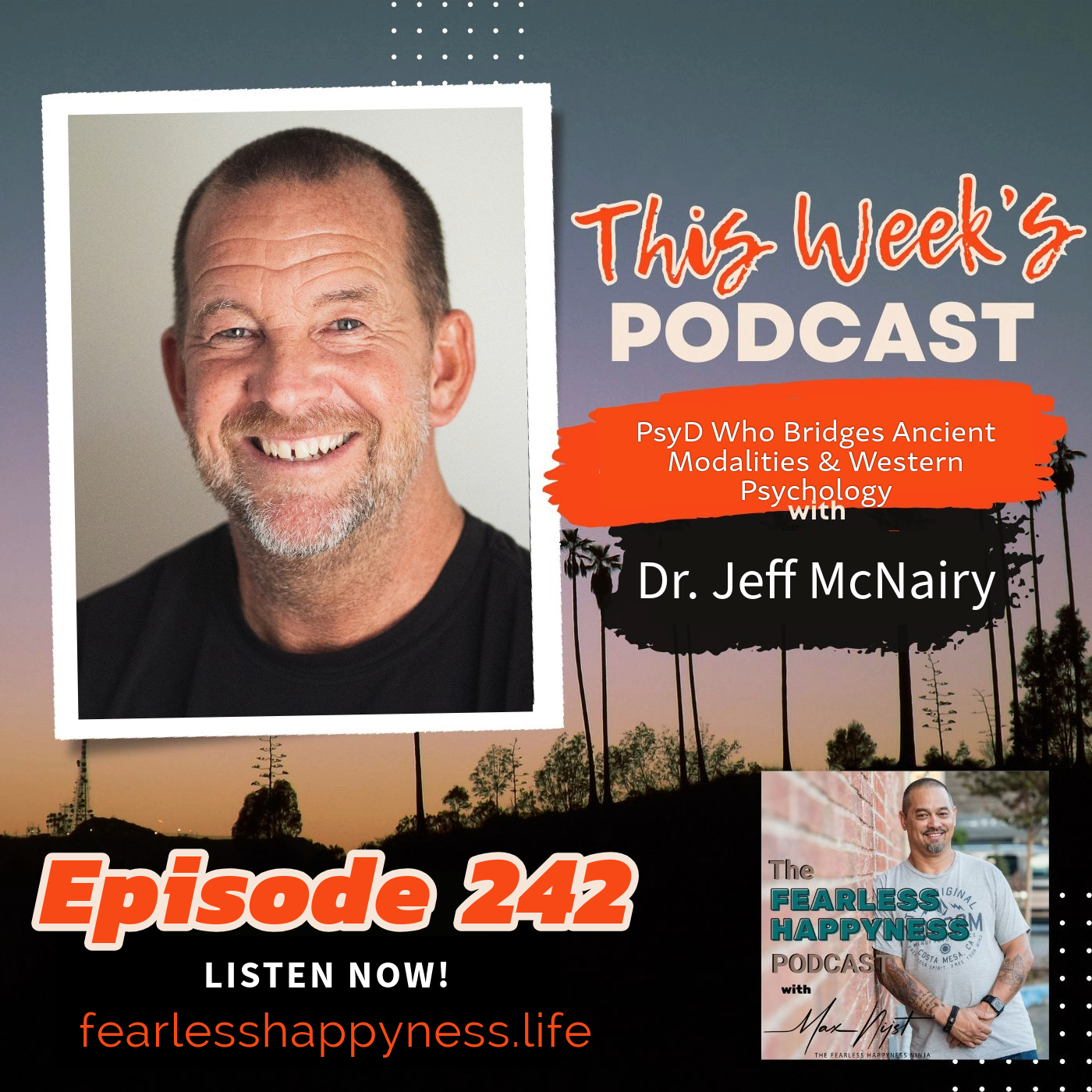
Join Max and Dr. Jeff McNairy as they explore innovative approaches to healing trauma, addiction, and mental health through plant medicine, holistic therapies, and personal stories of transformation. Discover how self-awareness, alternative treatments, and fearless pursuit of purpose can lead to profound life changes.
For more from Dr. McNairy:
For More From Sober Coach/Substance Abuse Counselor Max Njist, visit
speaker-0: Welcome to the Fearless Happiness Podcast, where we showcase phenomenal individuals who have overcome serious traumas, life obstacles and challenges to find their own path to fearless happiness. Listen as Max Naste invites guests from all around the world to share their experiences and spread strength, hope and faith. This is the Fearless Happiness Podcast and this is Max Naste.
speaker-1: All right, everybody. Good morning, good afternoon, or good evening, wherever you are in this world. This is Max from the Fearless Happiness Podcast, coming back to you again today with another special and amazing guest. I know I say it all the time. I tell my audience all the time my guests are special and amazing, but here's where, you know, here's my rebut is because they proved me right every time, right? So. Today we have Dr. McNary with us everybody. But what I like to do Dr. McNary is have you introduce yourself to my audience like who you are, what it is you do, and then you and I are gonna rock and
speaker-0: Sounds great. Thanks for having me. I'm really excited to speak with you about all the things we're doing in the company I'm working. So I'm a doctorate level psychologist and I have a master's degree in public health. I'm from Los Angeles, California. I went to UCLA and go Bruins, you know? â
speaker-1: That's it. We gotta cut this out. I'm just kidding.
speaker-0: You must be a USC fan.
speaker-1: You know what? I have been since I can, I don't know how it started, Dr. McNary, but I have been, I'll admit it. I have been a USC fan for years.
speaker-0: Well, a lot of people are, especially in Orange County.
speaker-1: Right. I'm not in Orange County anymore. Everybody goes, why aren't you a San Diego state or any San Diego Padre? I go, I'm still an Orange County boy at heart.
speaker-0: There you go, there you go, I'm with ya. I'm in San Diego right now as a matter of fact. That's right, I'm out in Palway.
speaker-1: I love for neighbors. I love I'm in Fallbrook. â yeah. We just gave our cities away everybody. right. But if you're looking out the window, like probably Dr. McNary and I, it's a gorgeous day today. It's summer. Yeah. So for you guys that are still in the cold back East, I'm sorry, but we're having a gorgeous day today.
speaker-0: Beautiful it feels like It's beautiful. It's typical California weather. Yay. That's okay. So I've been in Costa Rica for 10 years and I'm just up here in San Diego visiting some family. what I do is I run a spiritual retreat center called Rhythmia. But before I got into that, I was running a bunch of facilities in Los Angeles. I was running a pretty famous rehab.
speaker-1: Right. Sorry for interrupting.
speaker-0: called Passages, I was the administrative director for about eight years. And I worked at the UCLA Med Center. I also worked in a psychiatric hospital called Los Encinas, which is out in Pasadena, pretty well known place. â
speaker-1: With, â isn't Dr. Drew associated with that place as well?
speaker-0: Yes, he was at one time and then he split and went to the Pasadena Recovery Center just down the road. That's right. And so, Dr. Drew is a great guy. He's been to our facility in Costa Rica and he was doing a lot of clinical supervision for the interns there when I was in my postdoc. So my whole deal was that I went into healthcare looking to try to change the system in some way. because as I moved through my degrees and moved through my education, I saw that the clients I was working with, whether it was addiction, trauma, or acute mental health issues, people were not getting healed. They were just becoming stable, and then they were maybe doing okay, but they weren't really resolving the underlying issues that were leading to the addiction or leading to the painful emotional stuff. So. What I did is I went on a quest to try to figure out alternative methods to try to work with people that have addictions or that have trauma. And I was big with the veteran community as well, military vets, and just trying to figure out how can we help people heal in a way that empowers them.
speaker-1: You know, this is, I don't believe in coincidences, right? Cause I've had, think a couple of guests, past guests who went to your place in Costa Rica to, to resolve and to resolve some trauma, right? And speak very highly of your. And, and yeah, well, just be prepared. You and I are going to have a conversation after this, right? For sure. But.
speaker-0: Yeah.
speaker-1: See, I love that, you know, that's what I got my bachelor's in is psychology. And now at 58, I'm debating whether I should go back and get my master's in psychology or you know what I mean?
speaker-0: Yeah, I can give you some pointers too on that because getting a master's you can still do counseling and you don't have to go and take a six year PhD thing. there's a couple of strategies.
speaker-1: Perfect. But see, and you're a man after my own heart, right? Because I'm a veteran and I've always, â always wanted, you know, in my work as an addiction counselor, always wanted to help veterans, right? Being a fellow veteran and seeing what some of these, I didn't go, you know, I got out like I think it was right before, â Desert storm, right? Desert storm, think was in 90 or 91. I got out, you know, I hurt my ankle for the third time and they were like, you're gone. We can't use you anymore, you're gone. But, you know, which led into my own addiction story and all that good stuff. But it's just, you know, I live right five minutes from the back gate of Camp Pendleton, right? And I see a lot of military guys and I see guys that have gotten out, right? And wandering, not.
speaker-0: Yeah.
speaker-1: They're not homeless, but you could see it in their eyes. okay, it's almost, and I've likened this to the prison, right? Like prison where you get out these days. Here's your gate money. Good luck. Don't come back. Right. It's like the military you get out, right? Yeah. Good luck. They don't give you gate money, but I hear they're, they're trying to prepare guys for civilian life. But see, like when I got out in 1989, I thought because I joined the Navy and I was a veteran, right? Like all the commercials. don't know. Remember you, I don't know if you remember like when the Navy had that commercial. It's not just a job. It's an adventure, right? And they would show all these cool things happening on the
speaker-0: I'm 56 so we're in the same age range. So I remember those ads. They were really cool ads. It made you want to like get into it.
speaker-1: You Yeah. And then remember at that time, Top Gun came out, right? I'm going to go be, you know, I'm not a very good student at that time, but I go, I'm going to be a pilot, right? Cause if Tom Cruise can do it, I can do it. Right. Well, I got a rude awakening, right? I ended up doing something totally different, but you get what I'm saying, right? So I've always wanted it's, you know, I don't know how to go about it, but I will figure it out. Right. And this is one of my platforms. I love having veterans and. individuals like yourself that are out help, not just veterans, but helping people. Like you say, get to that root cause, right? Because we know, and I'm not trying to take this over here, but we know that like doctors are taught to treat the symptoms, right? It's unfortunate, right? But what I like about
speaker-0: Absolutely.
speaker-1: you know, the field you got into and I got into, right? We want to know how the brain ticks, right? We don't just want a medicine that says, okay, we're going to shut this part of your brain off so you can feel better. And then you'd be on your merry way, right? Because, because then like you and I know we see people surviving, not thriving, right? Because, and some of the medicines, obviously, you know, I've been off my medication, my depression medication for over five years now and I feel better. I feel better than ever. Right. But
speaker-0: way. That's great.
speaker-1: So let's talk about those challenges that you've experienced that led you into the field that you are, and then creating that retreat that you do to help people really address the underlying causes of trauma, whether it's emotional, physical, sexual, whatever the case may be, because you can't just touch the surface and expect someone to be, okay, I'm cured, I'm good. I have someone very near and dear to me that I mean, They've worked, they're working through it, let's say, but I know it still affects them because they don't sleep well at night. It's not a safe place for them and they haven't really dealt with that issue. sure.
speaker-0: You know, veterans have a unique sort of circumstance that's really interesting to look at when they come home with their PTS. And a big part of that, as we call post-traumatic stress, we take off the D because we don't consider it a disorder anymore. We just consider it a set of symptoms that they've been going through. It's a condition that's temporary, hopefully. And so what happens is when you're in a war or in a battle, and this, can liken this to people that are not in the military. But when you're in that moment of fighting and trying to survive, your emotions get in the way of survival. Because if you have emotions during a fight, you're over in the Middle East or somewhere in the world, and you're scared and you're worried and you have empathy or you have doubt or any of these emotional things, that's going to get you killed. And so you have to learn how to dissociate from those emotions. And part of boot camp, the soldiers don't always know this part of it. But part of it is not just only the learning how to shoot the guns and do the exercises and all that in tactics. It's also about dissociation because when you take those commands and you're on a mission, you got to get your emotions out of the way. And then the battle ends or that mission ends. You come back to base camp. You're supposed to connect again with those emotions, but doesn't happen. People don't do that. And they just go out on another mission. And so then They've been locked into this dissociative place, which is a fight or flight response. Right. They get home and they're still in that space of dissociation. And then what happens is drugs and alcohol, they think initially will help them sort of connect again and come back to each other. Like the self and the sort of dissociated part merge, but it obviously it doesn't work that way. And then the addiction can develop. so with veterans in particular, we have to help them resolve those un dealt with emotions from the battle. So those are shoved into the amygdala. And so for people that have trauma, maybe from childhood, abuse, neglect, abandonment, whatever, they've also been in a war of a different type, and they've shoved those emotions into the amygdala too. And they've been sitting there brewing for their whole life. And they're starting to influence their behavior. And that's why they're depressed, have anxiety, have all kinds of different issues. And so what I looked at in my years of study and working with people is I said, we got to address what's stored up in the amygdala. We have to release that and bring it out. So that was kind of my quest when I started off studying medical anthropology. I was studying cultural components of healthcare and I focused on Latin America because I was just, I spoke fluent Spanish. I lived in Chile for a while in South America. And I grew up in East Los Angeles, so I was around a lot of Latino families all the time. My family is all fluent in Spanish. So it was kind of a natural thing for me to go work in Latin American studies. And I saw that there is these indigenous ways to look at health and healing. And I was just fascinated by it. So I applied for a doctorate in medical anthropology. I got into Berkeley and I was going to go to Berkeley, but I thought to myself, know, if I'm going to be an academic person, because I didn't come from an academic background with my family, we're blue collar. My grandfather was a â lumberjack. like, and my dad, my dad had a cool job. My dad was a marine biologist, but that was the one guy that finally did some sort of education. But the rest of my family were like electricians and blue collar guys, construction. And so I was like, I don't know if I want to do this academic thing and become a tenured professor. So what I said, I told Berkeley, put me on the one year deferment and I'm going to go to UCLA because I was from LA and I'm going to â do research in medical anthropology. So I did that for a year with Dr. Carol Browner, who's a famous medical anthropologist. And I studied Latin American women's prenatal diagnostic screening procedures and the cultural side of all that stuff. And I saw that, wow, this is incredible. I love this field. Reproductive health is really interesting. However, I don't see myself committed to this sort of lifestyle for the next rest of my life because my professors and the people I was working with, that was their entire life. Like none of them had kids. If they were even married, they just, their other spouse was also a PhD researcher. It just kind of wasn't my vibe, you know? Like I like to surf and I like to do martial arts and I just have these other interests, you know, growing up in LA and stuff. So I like music, you know, going to concerts. So I like, I just don't see myself doing this. So my professor, Dr. Browner said, why don't you get a master's degree in public health at UCLA? Because it's more hands-on. There's some tangible stuff you can do. work for the county. So I said, cool. So I applied. got in and I studied health policy and program development. So what that means is that I would go into a clinic, get hired as a director, and then open up different programs, get grant funding, and just manage the whole operation. So because I was already in reproductive health, I got hired at the UCLA OBGYN department and I started running the outpatient clinics and getting grant funding and managing all the staff. But I saw that if I'm going to manage MDs, nurse practitioners, and healthcare workers, I should probably have a medical degree to get the respect I needed. Because I was a kid, I was in my mid-twenties running these clinics and all the people were doctors and stuff. they were cool, but I just saw the future. I should probably get a degree in medicine. So I went back to UCLA, took all my pre-medical sciences, all the chemistry and bio and physics and all that. And then I applied to medical school and I got into the UCLA Charles Drew program, which was two years in MLK hospital in Watts and two years in Westwood. We call that Killer King, right? Martin Luther King Hospital at one time had all military doctors going to residency through there because there was so many gunshot wounds that they were learning how to.
speaker-1: Yeah.
speaker-0: treat people in battle. So it's pretty interesting place. But when I was getting ready to go to medical school, my OBGYN â staff, the medical doctors, they came up to me and they said, hey man, congratulations. You got into UCLA, whatever. I was like, yeah, yeah, it's pretty cool. And they said, if you're smart, you'll get out of the field now while you can. I was like, wait a minute, dude, what?
speaker-1: Yeah, explain that one to me.
speaker-0: Yeah, was like, what are you talking about? Man, I've been dedicating all this money and my time and I've been grinding the MCAT. What are you talking about? And they said, look, we like what we're doing in the field. However, the malpractice insurance for OB-GYNs is half a million a year. Holy. One out of three deliveries of babies sue us for malpractice and managed care in California was really starting to take hold back then in the mid 90s. Right. we have to talk to some bachelor's level dude on the other phone that's with the insurance company to get clearance to do any sort of advanced procedure and it's a nightmare. And they said, we're in debt and this sucks and you should just get out of it because we're all trying to get out of it too, but we're trapped. So I really took that to heart. I had seen warning signs of that in my career so far. So I said, you know what, I think you're right. And I scrapped the whole medical school thing and I went to work for the Department of Health in Hawaii. And I have some family over there. and some connections on Oahu and in Kauai. So I worked for the Department of Health on Oahu and I worked with Native Hawaiian kids who were struggling with addiction, trauma, and I was doing the health program development for them. And I was using the cultural stuff that I learned in medical anthropology to help the kids connect with their roots and become grounded and do cultural practices and kind of get that self-esteem sort of â identity back. in the Hawaiian language back and all these different things. I worked for different schools down there too. And that's when I saw this is my thing. I want to get a doctorate in psychology. So I went back to the mainland, was back in LA, got my doctorate, and I was doing a bunch of internships that you have to do. then at the end, I was in my postdoc and I got hired to run Passages Malibu. So during my postdoc, I was running that facility. It was a 45-bed facility in Malibu, high-end place. I never worked in high end before ever. So was kind of weird to be honest. Very expensive rehab. But you know what's funny is that Skid Row free, you know, Salvation Army rehab and then Passages Malibu, a hundred grand a month to go there. Same outcome, same outcome data. Three to five percent stay sober mostly, but it's 12 to 15 % on the high end stay sober. So the same exact numbers. So I was like blown away by that, dude. I was like, wait a minute.
speaker-1: See, I want everybody to understand that, right? Like addiction doesn't matter if you come... Like I heard from a speaker in a meeting when I first got sober, this lady loved her to death, right? She went to the same meeting, but I got to hear her speak one night. She goes, whether you come from Park Place or Park Bench, right? Like this disease does not, you know, it doesn't care, right? That's right. It doesn't look at you all. Well, they came from, you know, the fortune 500. So I'm going to get them well quick. And this guy, well, since he's been homeless and drinking out of a paper bag, you know, behind the 7-Eleven, we're going to let him suffer a little bit. Yeah. Right. And you know, and that's awesome. I hope the audience is paying attention, right? Cause it doesn't matter where you come from. know what I mean? Like I know people that got sober, you know, that went to those kinds of places and have struggled for a long time. I know people got sober at, you know,
speaker-0: It doesn't matter.
speaker-1: Skid Row, literally drinking and doing his dope out of a cardboard box and is over 22, 23 years sober now. but, but that's what I love. You know, like gentlemen, like yourself that really is trying to help in any case, right? Whether it's addiction or trauma or PTSD, you know, it's, yeah.
speaker-0: Amazing. . It interesting, you something that was kind of cool that I got because when I before I got to Passages, I was working at I did a one year internship at this place called Chabad and it was that's an Orthodox Jewish organization in West LA, but they have a rehab and it's a men's only rehab and I worked in that for a year and that was that was low income underserved, but it was also Orthodox. So people from Israel would come in New York and different parts of the world. But we had county beds that were available at the time. I think it was Prop 86. And so we were working with guys whose sons were homeless or just straight out of jail on probation.
speaker-1: Are you thinking about Prop 36?
speaker-0: 36 prop 36. Yeah, we have 36 beds Those were my favorite guys the prop 36 guys there. I learned so much from them. It was incredible So I saw like that level of care then I saw passages level of care and what I saw was the difference really Was it passages because there was so expensive they had to kind of justify the cost and so aside from it being in like a luxury setting or whatever and Whatever amazing food what they had to do is they had to have different types of therapy So they had spiritual counseling, they had a primary psychologist, marriage and family, they had body work, they had acupuncture and all kinds of Chinese medicine in addition to Western medicine. Like all these services that I found were very helpful to people, even though maybe it wasn't like landing necessarily on people, because we all know the first two weeks of rehab, you're detoxing anyway, so. Right. Or if not longer. So, but I got turned on to these sort of alternative. ways to look at health and healing. And at that point, I've been there almost eight years and this dude came in as a client named Jerry Powell and he's our little preview, he's the CEO of Rhythmia right now where I work now. at the time he was a really hardcore addict. had, Demerol was his main drug of choice. And Demerol as we know is a surgical based opiate. It's an IV drug for when you go under in surgery. So he had 165 plastic surgery centers that he owned and was managing. That's how he had access to these types of meds. So he was a drinker, alcohol, cocaine, totally out of control lifestyle, lived in a mansion, like just this crate, he had all the cars, all this stuff that the world would tell you should make you happy. And we all know, right, and I know from your podcasts and probably your own experience, we all know that those material things don't make you happy, right? They just don't. Not at all. Not at all. So this dude was so brutal to work with that his treatment team of 12 people came to me in my office and said, if you don't kick this dude out of here, we quit. I was like, wait a minute. I've never heard that before. Like, what are you talking about? And they said, he's oppositional. He's not ready. He's rallying the other guests against the program. Nobody's showing up to groups. I'm like, yo, I'm not kicking a dude out of here for being difficult. This is a rehab, right? It is difficult. They were really upset about it. And I said, look, I'll work with Jerry myself. You guys just keep your caseload, just continue on with the other people. So that's where I started, that's where I met him. And so I worked with him for two months inpatient and he did really well. He actually cut his Demerol addiction. He never went back to it. When he discharged, I worked with him in my practice for five years. And during that time, he was still doing cocaine. He thought he went to rehab just for the Demerol, not the cocaine, not the alcohol.
speaker-1: Right. That's not my problem. Right. I can handle my sustain, right?
speaker-0: It's the Dem-Roller! It was all the problem. His wife divorced him during that time. His kids didn't want to talk to him. His life was a mess. He was in Malibu living crazy. He moved from Pennsylvania to Malibu. He had this bachelor pad. He was the man in Malibu, like driving on the PCH all fast with his Lamborghini, just this out of control madman, right? So I worked with this dude. I was just like trying everything. I was trying like holistic stuff. I was trying Western medicine stuff, trying meds, groups. go to 12 step meeting. There's a really good 12 step meeting in the palisades. I would take him there and just like nothing worked, nothing worked. And then he got suicidal because he had been suicidal a couple of times. He just thought, yo, I'm spending so much money on this whole recovery thing. I haven't gotten any better. I'm depressed. I I'm going to end it. So I was like trying to scramble and figure out what to do. And one of our aftercare therapists who had some training and some shamanic work, but I didn't really know what, because we would just refer people to her. And she was like one of the many people in aftercare that we talked with. She challenged him to go to Costa Rica and try a plant medicine called iboga. And we all know we've all heard of iboga before, and it helps some people with opiate addiction, but also just psychosomatic and lifestyle things. And it gives people sort of a, can help some, not everybody, but it can help some people get back on their feet and kind of get past difficult things. So he had nothing to lose. So he just went down to Costa Rica and that's where he had his whole sort of awakening with a shaman from the Congo, this very real well-known shaman. He was living in Costa Rica at the time and they had this crazy experience that helped him really get on the right path. And that's where I was made aware of there's these plants. that you can use if you meet medical criteria and it's the right sort of option for you, which is not, again, it's not for everybody. Right. And that's where we learned about Ayahuasca and Iboga and San Pedro and all these other things. So I went down there with them about a month after that. This was in July of 2014. And I had my own experience with the Iboga. And it was just like this amazing, really cool experience. Because it was done with intention. It was done in a setting that had a focus. And we liked that part about it. So it was like, was helpful. And Jerry and I said, you know, at that point we were thinking, you know, we want to open a place that would be safe and clean and have doctors and be medically licensed because the house we were at up in the jungle was dirty. There was no medical care. It was kind of like wild, to be honest. Most people wouldn't go for it, in other words. So we wanted to have a place that was actually safe. And so that's how we started looking for a property for Rhythmia. That's kind of the background story.
speaker-1: I love it. I love it. Right. And I have to kind of do a disclaimer, right? Like, â you know, this is our opinion here, right? We're not pushing this on anybody. Right. Absolutely. But what I do push is pay attention, right? Because if this stuff, if, you know, because I've heard, I have a friend that owns a place in Mexico, right? That I had, well, my friend now, he shared his journey. like couldn't get sober to save his life, right? Went through 30 treatment centers, right? And nothing worked. And then he met this guy, went to Mexico and then he's been sober now for two years. And amazing, right? Shares. And, you know, and I want everybody to understand, right? This is all done under medical supervision, right? It's not like we don't sit in a circle, right? And pass a pipe around, right? Like it has to be done. you know, under strict supervision, right? Because, there's, know, and Dr. McNary will tell you all that, but I have to say that, right? Because I know it's not legal in the United States, but I like presenting options to people that, you know, like you said, your friend, you know, your CEO, I'd love to have him here and share his story one day, right? But, you know, I've met people like that too, where it's like, man, this person does not want, they just don't get it. And it's going to be sad because I'm going to have to, you know, watch this person not make it. Right. Cause in my shoot almost 17 years of doing this and you and I, like I've seen more not make it than be successful, but the ones that do make it. Right. Like I try to learn from that. Like what did I do to help them? Right. And which I now learned that, you know, I'm just a guide on their journey.
speaker-0: Thank Well, you know, in my career, before plant medicine and before arrhythmia, I was seeing death and illness and suicide and tragedy constantly with my client base. And whether that was in the psychiatric hospital or in the rehab or post, know, relapse and things like that. And I was like, there's gotta be other tools aside from the traditional ones, you know? And I think in the 12-step community, it really depends on the person. and it also depends on the sponsor and also kind of like their vibe on things because, you know, we all know there's kind of a range in the 12 step sort of system. there's really orthodox people that would never in a million years do it. And that's totally okay. Like my grandpa was one of those guys, he's super orthodox, 12 step, it helped him, it was amazing. But there's other people that kind of like, it's a little bit more open to it. It's really a personal choice. I'm a fan of just having options. It's kind of like when I worked at the... there'll be GYN clinics for so long at UCLA, people would think that we were doing â invasive procedures for women's reproductive stuff and we were not. We were just talking about options and laying out the framework for people to make their own decisions. So that's, think is what, you know, this is about with plant medicine and just alternative healing methods.
speaker-1: And it should be like that with anything, right? Having options that you can make an educated and informed decision on, that's good for you, right? Because I can't, like say if Dr. McNary was struggling, right? I can't say, you got to do it this way, Dr. McNary, or I can't work with you and then find somebody else. mean, that kind of stuff turns people off and then you go, well, I might as well just keep going then.
speaker-0: You It was funny at the rehab and also at Rhythmia, there was the therapist that had, there was two types of therapists and at Rhythmia there's two types of staff. At the rehab there was people that worked there that had their own addiction history. And then there was ones that didn't have an addiction history. And there was pros and cons to both types of staff, but the ones that had the addiction history, it was tempting for them to kind of make the clients do it their way. And sometimes that was okay, it worked, but other times it didn't allow the patient to have their own journey and their own experiences. So, but it also holds people accountable. And so there's pros and cons to having both sort of staffing, you know, strategies. But I think what happened for me is that, you know, I had my own breakthrough with the plant medicine. And then we evolved from Ebola into Ayahuasca and because Ebola is really strong and it requires a lot of medical intervention. And it's not something you could have like a really big group for in my experience. And it's a one to one ratio with shaman to person. because you're being guided. And so it wasn't practical for like a business thing to have a lot of people get healed. I mean, there's great clinics like those ones in Mexico. I know a few as well. They're really, really amazing. But we wanted to have a place. that could treat a lot of people and help a lot of people go through the same sort of awakening that Jerry Powell, our CEO, had. And so the whole program is based on sort of like what he went through. It's a week long program and it has all these different things that we do. So I've seen 22,600 people through the doors. And I've also learned that, like I said earlier, this protocol is not for everybody. It's for people that feel the calling to it. It's for people that feel that they've hit a dead end. is for people that just can't quite get it together, it could be for them. And also there's medical requirements prior to coming too. So it's like you have to meet in the apex to have this happen.
speaker-1: Excuse me. Right. And I'm glad you made that clear, right? Because, you know, if anybody's thinking about this, right, they're going to put you through an assessment, right, to see if you even qualify, right? Totally. And I love that there's options, right? Because I've talked to people who've done the ketamine route that has helped their PTSD or trauma. I've talked to people who've done the ayahuasca route, right? Which they loved because they've never had to look back and never touch the drug or, you know, or wake up with night terrors ever again, right? That's right. And... You know, and then the iboga, right? Like I've, you know, from friends that I've talked to, right? Like it really has helped veterans with their PTSD, right? That have come back from wartime and cannot, you know, sleep. know, there's other modalities like, as you know, EMDR, right? I've worked with a vet one time and it was sad, right? Because he goes like, I maybe get two hours of sleep because I can't sleep, right? I'm either afraid to go to sleep or when I do, I have everything that, you know, all the night terrors come back. the things I've seen and you know, he would describe to me, he goes, your fellow bet, I'm gonna tell you what it was like out there, right? â And I'm like, â shoot, I might have to get some therapy after listening to this, right? But he struggled,
speaker-0: you You have secondary trauma from even listening to the stories.
speaker-1: And you know what, you're right. And I think I do. And thank God that, you know, I have my outlet, which I'm a 12 step or everybody. They all know the audience, right? That worked for me, right? Totally. And it's worked for millions of people for almost a hundred years. I'm like Dr. McNary, right? Whatever works for you, do it, but do the work. Don't just say I'm going to do it and then go, well, it didn't work. And then you get out. Well, did you go to Dr. McNary? No, I didn't. I didn't want to do it. Right? Well, no wonder it didn't work. Right? But what I'm getting at is.
speaker-0: Yes, sir.
speaker-1: You know, this is when EMDR was really kicking in, right? Yeah. And our clinical director and therapist, it always suggests to him, you go talk to her. She has this thing called EMDR. I'm telling you it's going to help, right? And I don't want to do it, right? Like I don't want to do it. Right. So, you he ended up graduating the program, came to work, you know, as volunteer. And then he got hired as a support staff. And then I left that place. And then like a year and a half later, I get a text, Max, I can sleep now. I actually took you up on it. I hit her up. I've been doing EMDR and I can actually sleep. Right. But see, that's like one of those options that he had. Right.
speaker-0: Amazing. Yep. EMDR is really powerful for something.
speaker-1: Very powerful, right? Because you, as you know, in your studies and what you do, you know that EMDR, what it does is it takes all that stuff that your brain stores in your body, right? And that's right. Re-compartmentalize it where it could be, right? So you know, cause I know like my stress, when I stress, mine's my lower back. So I know that's where my trauma is stored. It's always my lower back. Cause then it's like, God, man, I feel like someone walked up behind me and kicked me in the back. What am I stressing out over today, right?
speaker-0: Yeah. That's good. You have that psychosomatic trigger to know, because a lot of people don't know and they might have like, maybe they hold it in their shoulders or they have irritable bowel syndrome, or they just get the flu periodically or strep throat actually is a common thing for stress as well, you know?
speaker-1: Well, this is the benefit of doing what I do, right? I always hung out with like gentlemen like yourself, right? And pick their brains. And so I could, I could better understand what my body was going through. Cause you know, I could tell you what happened to me in the last nine years and you'll go, yeah, you got some trouble going on, right? Totally. But this is not about me, right? I just want people to, I love giving people choices, right? Whether they've, you know, listened to you or, and I are not, at least it's out there and they know there's another. choice they get to make that can benefit them and their families. Because me, ultimately, when it comes to addiction, I want people to fully heal. I want them to, you know, get clean and sober and stay clean and sober. But I also want them to lead a healthy, fulfilling life and not just, you know, do the surface stuff and where... No, and we don't want them living in that fight or flight, you know, all the time, right? Because we know, and that's...
speaker-0: Yeah. don't want him white-knuckling.
speaker-1: Why I did what I did and got off my medication and decided to do some more holistic stuff like meditation, breath work, right? Working out and going, you know what I mean? Cause I don't want to be the guy that's, I got to reach for a pill to make me feel better. Right? I did that in my addiction with other things. I want to that. Right? So that's why I feel blessed that you're here. Right?
speaker-0: Your buddy, you know, your buddy was likely hypervigilant. That's why he was unable to sleep.
speaker-1: absolutely hypervigilant, right? Because the things he described when he was in Afghanistan, you had to be, right? You didn't know sometimes who friend or foe was, right? When it comes to where they were at and the things he saw happen to children, you know what I mean? All that stuff, it's it's brutal, right?
speaker-0: Hypervigilance becomes a tool for survival.
speaker-1: Right. And I was like that. Okay. Dr. McNair, I was like that when I first got sober. Right. Like, Like say I'm talking to you, you're mean, you're like standing face to face. Right. And I do this, look behind you. Right. I look totally. And people go, Max, what are you doing? Like I'm right here, dude. remember, look me in the eyes. And I'm, I am, but I got to like once in a while, I got to check and make sure, you know, and I found out that was because of the things I went through when I was on the street. Right.
speaker-0: There's no secrets for you. There's no sneak attack. You're aware. You're on it. You're also probably really good at reading people. So you meet somebody new, you can tell this is a good person. This is a cool dude. Or you're like, there's something shady, something sketchy. I don't like this guy. I don't know what's up. So like you're very aware, right? That's something that we teach people how to navigate at Rhythmia. We go through those sort of steps with people because if you are naturally reading your environment in a hypervigilant manner, you're picking up on a lot of emotional projection from those people or from those environments. And then you're holding it. And a lifetime of doing this, holding all this emotional projection, it leads to a point where you're flooded and you're maxed out and you can't absorb anymore. And then what happens is when you're flooded, you start to look to how do I get some relief? And you don't even know really what's going on so much. I start to isolate. You start to use drugs and alcohol for some. You start to become irritable very easily, have a short fuse, and you just don't feel the energy for the things you used to like to do. And so all of those things are signs that you're flooded and you're maxed out with this emotional baggage. So the key is to get it off and then learn how to manage it. that's a big, a lot of the vets are this way for sure. And then people that, you know, had to take care of themselves as children have developed this awareness. Because you think about a kid who's five or six, if they're being abused, neglected, abandoned, whatever, what tools do they really have to try to navigate their world? Well, they're not empowered enough to even talk about how they're feeling. They're just, they're in kindergarten and they're not strong enough to fight the neighbor who's a man or whatever, right? So they have to use a tool to understand their environment because they feel like they're alone. And that tool is a dissociative experience where they unplug from themselves. then they pull in the energy and the vibe of some people around them and they feel who someone is. Because if you can feel who someone is, you know who someone is. Like it's diagnostically accurate. It just becomes a compass that they use in their whole life. And it very much serves them very well. They go into sales jobs and they just kill it. They go into real estate, they do awesome. They go into healthcare. They're the best doctors, nurses, therapists, coaches. They're amazing, but they are holding the bag. for everybody that they've ever dealt with. And that's where they burn out, have drug and alcohol issues, and vets become hypervigilant during the war. If they didn't already have that trait from childhood, they might have already brought it into the war, â service. this is all of these tools that we teach people now are just to empower them to make their own choices.
speaker-1: Right. And I love that, right? Cause that leads me into my next question, right? Like someone comes to you say, Hey, Dr. McNary, right? I heard you on Max's podcast, the Fearless Happiness podcast. I think it's for me, right? And they go through the assessment phase and stuff and they're a fit, right? What would a client expect or a patient expect once they got to arrhythmia?
speaker-0: So when they get to Rhythmia, they arrive on a Saturday or a Sunday. We pick them up from the airport in our shuttles. We bring them to Rhythmia and we take them right away down to the clinic. So we have an urgent care clinic on site that's staffed by four medical doctors, 12 nurses, paramedics, all medical team. And we have a chart that we've already opened on that client because on their intake through the phone, the sales associate went over all the medical requirements. And so they've already met the medical criteria. So what we do with the on-site people is we just review the chart. Okay, it looks like you got off your SSRIs three months ago. Are you still off of them? Yes, et cetera. And we heard you have a high blood pressure. Let's check your vitals. So we do a triage. We do a clinical interview, a mental status exam, just to make sure everybody's feeling good, ready to go, and that they've stuck with the off the meds thing, depending on what those meds were. And then after that, We let them go and they have a breathwork session that evening on Saturday and Sunday at 5.30 in the afternoon. And then the next day, Monday, classes on how to use the ayahuasca in the most beneficial way, how to set intentions and what to expect in there because most everybody's pretty nervous because first time people is kind of what we cater to. First time plant medicine people. So nobody's really like some veteran of all this, I know what I'm doing. We're all first time people. So we hand hold the guests through the whole week that they have four ayahuasca sessions in the evening, Monday, Tuesday, Wednesday, Thursday. And during that time there's integration, there's classes, there's groups, there's one-on-one coaching. There's all kinds of other cool stuff like a spa with body work massage and there's hydrocholonic cleanse appointments. They get two of those. And there's like, it's mind, body, spirit approach, super healthy food, like really, really Zen, you know, gardens and area on the property. It's a Macaw sanctuary. have nests of Macaws sanctioned by the bird, like people, know, Costa Rica. And it's just this beautiful area that's near the beach. It's about one kilometer off the ocean near Nicaragua. It's about an hour and a half south of Nicaragua. And it's just beautiful. And so it's just this really cool place they can unwind. and go deep in their own process.
speaker-1: And I think that's what any of us are trying to heal from any type of trauma or addiction or whatever, right? We need a safe place to just fully let go and dig in, right? Because you've been there like passages or, you know, whether it's passages or Hogue hospital or whatever, right? Sometimes it's like, don't know, not that they don't make you feel safe, but I think that you're, I'm going through this, right? So I'm not really, cause you know, then you get someone like me in the beginning, right? Who came from jail or right? Or say someone who's on a court card or you know what I mean? A nudge from the judge, right? And we have that attitude like, I'm not talking to Dr. McNary. I'll tell him this, but you're definitely not gonna know that, right? Because one, I don't snitch, especially on myself. So why would I do this, right? But that's, you know, the mentality that I've had to deal with a lot of the time, right? Where...
speaker-0: Yeah.
speaker-1: You know, you get the street mentality or jail mentality or someone straight out of prison, right? And you know that that's PTSD causing right there, right? Totally. Things they see in prison and do to survive. And that's another soft spot in my heart is wanting to help people come out of prison, right? That really want to get and stay sober because
speaker-0: That's right.
speaker-1: Man, let me tell you, I can tell you a quick story, right? I was the secretary of a meeting, right? A speaker meeting and I was in charge of getting guests. So I got this guest at the time he was 17 years sober and he got sober with a buddy, his best friend or whatever, they became best friends in prison on a level four yard, right? And if you know anything about prison in California, that's the hardest of the hardest right there. And they made a decision one day, right? We're tired of this lifestyle, right? I know we ain't going anywhere because they got life in prison, right? But we might as well do something positive for the rest of our lives. his story was him and his buddy went to a meeting and they got sober in prison, right? And then something happened and they ended up getting paroled, right? they... Wow. And him and his buddy, right? Start a reconstructive, like remodel business, right? Yeah.
speaker-0: Yeah.
speaker-1: And they're from Southern California, right? And they said, you know, and they were telling, he's telling the story. goes, yeah, me and my buddy were at the Santa Ana court house, right? Where I got the life sentence. He goes, and we got to do this judge's, you know, chambers. We're remodeling it for him. Right? So they get in the elevator, they go up to the floor they need to get to. And he says, him and his buddy walk out and they look and straight ahead is the door to get into the judge's chambers. Right? And they look up at the name. And they say they looked at each other and they just started laughing like, and it was the judge that gave them the life sentence. And he said, you know, we just looked at each other and he said, I wish he could see us now. Right.
speaker-0: Gosh, incredible.
speaker-1: He still stayed sober, right? But he was 17. I mean, that kind of story.
speaker-0: Dude, that gives me the, the, I got the chicken skin right now. Yeah.
speaker-1: Well, that's kind of like part of my story at three years sober, right? When I got into working in treatment, right? I was a support staff and I was at a place called Cornerstone of Southern California. Yeah. Dr. Stone's an amazing man. He would have me take him to the airport when him and his wife would go out and be fishing, right? Like at four in the morning, three in the morning. then he would give me a tip and I was like, no, doctor, I can't take that. And he goes, if you don't take this, I'm going to fire you.
speaker-0: cornerstone. Got it. Yep. kind of too.
speaker-1: I can't argue with the main boss, right? So, okay. Right. But anyway, I love that place, right? And I was at court in my, where I had got sentenced to a year in a treatment facility sober living, right? And I'm, had a court liaison and I'm walking through the halls and lo and behold, I see the judge that sent me to that place. Three years sober. So I grabbed the lady who's our legal liaison, right? I go, Hey, can you get me in there? And I wanted to go thank this judge. go, I've paid all my fines. I'm off probation. I should be good to go. she goes, Judge Larsh. I know him very well. Yeah. I'll get you in there. Right. We go in there and I'm sitting down and she asked if she can go see the judge come up to the bench and she walks up and they're shooting this shit like, you know, cause they're good friends and she comes back and he goes, Hey, young man, I hear you want to address the court. said, yes, sir. So I go up there and I go, your honor, and you could, it was full, right? You could, and I go, three years ago, you sent me to a place for a year. And you said, if I messed up a millimeter, you'd send me to prison. I said, I'm here before you. I get emotional still, I'm here before you with three years sobered. If my kids were here, they would hug you and thank you for giving their daddy back.
speaker-0: Amazing. Wow.
speaker-1: You could hear a pin drop, Dr. McNair. And he just sat there for a minute and he goes, wow. He goes, no one's ever thanked me before. And I go, well, I'm glad I'm the first. Thank you again.
speaker-0: love it. That's what life's about right there.
speaker-1: Absolutely, right? He goes, probably sent 5,000 people to prison since your time. mean, sorry, I don't remember you because that's a long time ago. I go, I go, I remember you and I go, thank you for giving me that third chance. And I would find out later that guy never gave third chances. Why he gave me a third chance. Because he put me on PC 1000. He put me on Prop 36. And then
speaker-0: Yup, yup. Riot.
speaker-1: When I got up to there, when I was in jail the last time, said, well, don't, you know, have a prop 36, your honor. said, don't I get another chance? He goes, when you go on the run, you don't, lose those chances. You ain't getting no chance. I'll deal with you later. Right. And that's another story, but.
speaker-0: That's amazing. Those are the kind of stories I never get bored of hearing. I love hearing that because it gives me hope working on the other side of the aisle, meaning that I'm providing services. And I just know that there's hope in it because sometimes it's easy to see like get burned out in the field and get discouraged because there's a lot of suffering that we see and we witness with our clients. But to see a breakthrough story like that and to hear a success, it's the best. I live for those moments. Like I live for that.
speaker-1: Well, I'm telling you as a recovering alcoholic and an addict, right? I'm telling you, Dr. McNary, the work you're doing, you got people that want to come and say thank you for saving their lives. I guarantee it. That's awesome. going to happen for you, right? I think, you know, the work we get to do, as I like to say, is special work, right? And because you're right, the success rates aren't that great. And we deal with death all the time or sadness. Right? We hear a day in and day out.
speaker-0: Yeah, I love that.
speaker-1: but like you and I, we're smiling and laughing, having a, you know, we're, because we know we're providing a service that can actually help someone, right? And that's why I've stuck around for 17 years and never got burned out. One, I take care of myself and I try to do my best to take care of me, right? If I take care of me, then I can take care of other people. It's the whole, my audience has heard, the whole oxygen analogy.
speaker-0: on the planet.
speaker-1: On a plane, right? Yeah. I have to take care it. Because if I don't do that, even in my personal life, I don't take care of me. How am going to take care of my wife and my kids and my grandkids and right.
speaker-0: It's such a huge, important part of anybody who takes care of anyone. You have to take care of yourself. It's very important.
speaker-1: But I'm like you and I love your philosophy too of mind, body and spirit. In my private practice, that's what I work on. Cause I don't tell them you got to go to a meeting or you got to do this. I go, well, this is your recovery. Let's figure out what that looks like for you. But we are going to work on mind, body and spirit. And so they can't go, well, I'm not going to do 12 steps. go, I never mentioned it. Never mentioned it. Right? Like, come on, keep an open mind. Let's you want to have a good life. Let's figure this out. Right?
speaker-0: Yes, right? Yes. That's right.
speaker-1: But you know, like this has been, you know, I know you and I could sit here for hours and just have this talk. But I'm going to ask you the questions, right? That I do remember that I was teasing so much about before the podcast, right? And we're going to start with fearless, right? Like going through what you've been through in your life and your own challenges and even with studying and trying to figure out what you want to do, you know, to before arrhythmia. Like what does fearless mean to you, Dr. McNary, and how does that show up in your life on a daily basis?
speaker-0: I think it means having the courage to do what is right for yourself and what you feel is your purpose. So when you're when you're fearless, that means that you're committed. And that means that nobody is going to stop you from achieving what you're here on this planet to do. When I was in my my schooling and some of my jobs, the professors would ask me like, what is your goal? What is your future? And I had these like, really wild answers, know, I'm gonna run a place that's gonna change blah, blah, know, these big things, right? And then the professors would just kind of like, half of them would just kind of laugh and dismiss it and think it was ridiculous. But the other half were like really stoked about it. And they loved it. And they said, that's the energy we like, you know, but there was always opposition towards the actual healing of people within healthcare, which sounds shocking. But you get used to hearing as a clinician, hey, you got rent to pay, you got student loans to pay, you gotta pay your secretary front staff, you gotta keep people in treatment for you to like make, and they need 10 years of therapy for sure, if not more. And I just never liked that. I never bought into that. I thought if people like therapy and they wanna do it, then that's one thing, of course. But I don't want to be â a clinician that keeps people in this hamster wheel. So I think. I've got a lot of â opposition to that. I would end treatment with people. graduated from whatever we were doing. And I was like so happy and stoked for them. But that brought a lot of critique on me. And especially with this world of plant medicine, all the psychology cohorts that I knew in LA, they thought I went off the rails. â That I'm crazy. What am I doing? Because this was 10 years ago. And a lot was different then. Now things are shifting to be more accepting, but to me, fearless is just having the courage and the will to move forward against opposition.
speaker-1: love it, right? Because you and I probably have encountered so much opposite in our careers or what we do. I know I have, and I'm sure you have like five times, 10 times more than I have, right? Because when you're a pioneer, everybody's going to look at you like you're crazy. What are you talking about? know what Totally. So I love that. I hope you paid attention to everybody. That leads me into the next question. And you see I put a Y in happiness, right?
speaker-0: â yeah.
speaker-1: Yeah, I did that on purpose. And I always like to say it wasn't a misspelling because I did it on purpose. Knowing I put a Y in happiness. What does happiness mean to you today and how does that show up in your life on a daily basis?
speaker-0: So, you know, it's interesting is that as a dad, I can easily find happiness within my family and my kids and my wife. However, a lot of people don't have kids or a wife or a spouse or a partner. So I have happiness in a couple of different categories. I think for me, the core of happiness is self-awareness and knowledge of who you are as a person and accepting all of you, whether there's a dark part or a dysfunctional part. or the loving part, have to forgive yourself because we all have flaws, we all have things we're working on. I want to know what my flaws are so I can accept them and move forward past them. So I think true happiness is just knowing who you are and accepting who you are and working on what you can with the knowledge of who you are and then to get an outcome that is grounded and merged back with your soul. To me, that's what happiness is.
speaker-1: I love it. I love it, man. That was awesome. Well, this is, like I said, this has been an amazing time. I've had so much fun. I've learned so much from you. I always get such a win-win for me. Right. Like I feel like a spoiled child, right. Because I get to have these awesome conversations and, know, and learn something in the process and gain a new friend in the process, which is even a bigger plus, right?
speaker-0: I love that you're doing these podcasts because it's just such a great platform to like showcase different philosophies and things and how cool I'm jealous you get to meet so many cool people. It's great. What a a cool gig you got going.
speaker-1: I love it. Thank you. Thank you for that. But â what I was going to ask you now then is before I go, because my CRS, like I said, goes and comes when it feels like. But if people want to get a hold of you, Dr. McNary, they want to look more into arrhythmia or, you know, ask you questions and just get to know the process of what that might look like for them. How do they get a hold of you?
speaker-0: So there's a couple different ways, probably the easiest ways to go to the internet and type in Rhythmia or Rhythmia Life Advancement Center, either one. And up will come our website and there's an 800 number on there. They can call our sales room and get questions answered. You can also go through the website and there's a lot of cool information on there. We also have a scholarship form to fill out because we believe that if somebody wants to come to Rhythmia but just can't afford it, that we still want them to be able to come. We've given out over a million dollars in the past couple years on full ride scholarships to Rhythmia. We just had a press release about it last month. â also we have an Instagram page and a Facebook page. I have an Instagram page where you can ask me questions specifically, and it's Dr. Jeff McNary. It's really easy to find and it has a blue check and so you know it's me. And â I'm happy to talk to people and I do webinars. Rhythmia based webinars every other Thursday where I go into questions and I talk about the program in detail So that you can find out how to get into those webinars from our website
speaker-1: I love it. Well, like one, thank you again for doing me the honor of being here. This was an amazing time. You're helping so many people and you know, for me, this is like a gift, right? Like I got to have you here. So I will cherish this forever. â I love this, right? But you're not quite off the hook just yet, right? Because now I get to ask you my favorite question.
speaker-0: feel the same way. Thank you.
speaker-1: that I ask of all my guests. I always save the best for last and it goes like this, Dr. McNary. So Dr. McNary, what is the one piece of advice you could give my audience to help them grow as human beings and become better people?
speaker-0: What I would give as that advice to grow as human beings and to become better people is this. All of us have a desire to help others. However, you cannot heal the world or heal others or support other people until you've healed and supported yourself. If you're an empathic person, which all of us have empathy in some way or another, but those of us that have a lot of this empathic energy, You have to be able to turn that on you and work with yourself first and learn how to heal yourself. And that's we taught we touched on this a little bit in this podcast. And there's the quote for the Hippocrates oath for medical doctors, doctor heal thyself first. And so that is very, very key. It's like the oxygen analogy on the airplane. Put it on yourself first, then put it on your kids. And if you do not heal yourself, nothing will change in the world because we're we're we're speaking to an audience that doesn't, that we cannot connect to because we're not connected to ourselves. So self-connection leads to true empathy for other people. Now, what's interesting, I'll wrap it up with this. How can I feel empathy for somebody in the world if I don't love myself first? So I have to love myself and then I can feel the vibe of other people and I do not want them to suffer. I don't want them to be in harm's way. I want them to realize their full potential because it affects me if they don't. So self-love, empathy for self, and then connection to other people. And that's how the world evolves and shifts for the better.
speaker-1: I love it. Yeah, wow, that was good.
speaker-0: I love it. love it.
speaker-1: You heard that every day. Stalk that in because that was, that was as they call it fire. And it is because it was so, it's so true, right? If we're not connected to ourselves, how it's like that old saying, right? How can I love someone if I don't love myself? That's right. And that's why there's a big, in meaning 12 step, right? Let us love you till you can love yourself. Right. And sometimes we need that. Right. And then we learn to love ourselves. And that's when we get to stay sober and then. 100 % for our staffs and then help somebody else. Right. that's, that's where the magic is, right? Giving away what was so freely given to me. Right. And I love it. This has been a great time, Dr. McNary. Thank you so much for being here. an awesome time. Right. So you heard them everybody. If Dr. McNary made you think, especially if Dr. McNary taught you something, if he made you smile and my famous, if Dr. McNary made you go, hmm.
speaker-0: Thanks for watching. I like
speaker-1: Please go to iTunes and leave a five-star review so more people can find this podcast and join us on my new YouTube channel where you can actually see and hear Dr. McNary and I have this freaking awesome conversation. So again, good morning, good afternoon or good evening, wherever you are in this world. This is Max from the Fearless Happiness Podcast. Until next time.
speaker-0: Are you tired of being weighed down by life's traumas and struggles? Join the Fearless Happiness lifestyle and let us guide you toward a brighter future. Explore our past podcast episodes and get a copy of the Fearless Happiness book to ignite your inner strength. If you or someone you love is battling addiction or facing challenges related to unresolved trauma, know that we are here for you. Visit maxnaste.org. M-A-X-N-I-J-S-T dot O-R-G and take the first steps toward finding your fearless happiness. Thank you for listening. This has been a production of Fearless Happiness.


