
 Apple Podcasts
 Spotify
 YouTube
  RSS Feed
 A Functional Doctor Who Knows Your Body Can Heal From The Inside Out with Dr. Liz Graves | 263
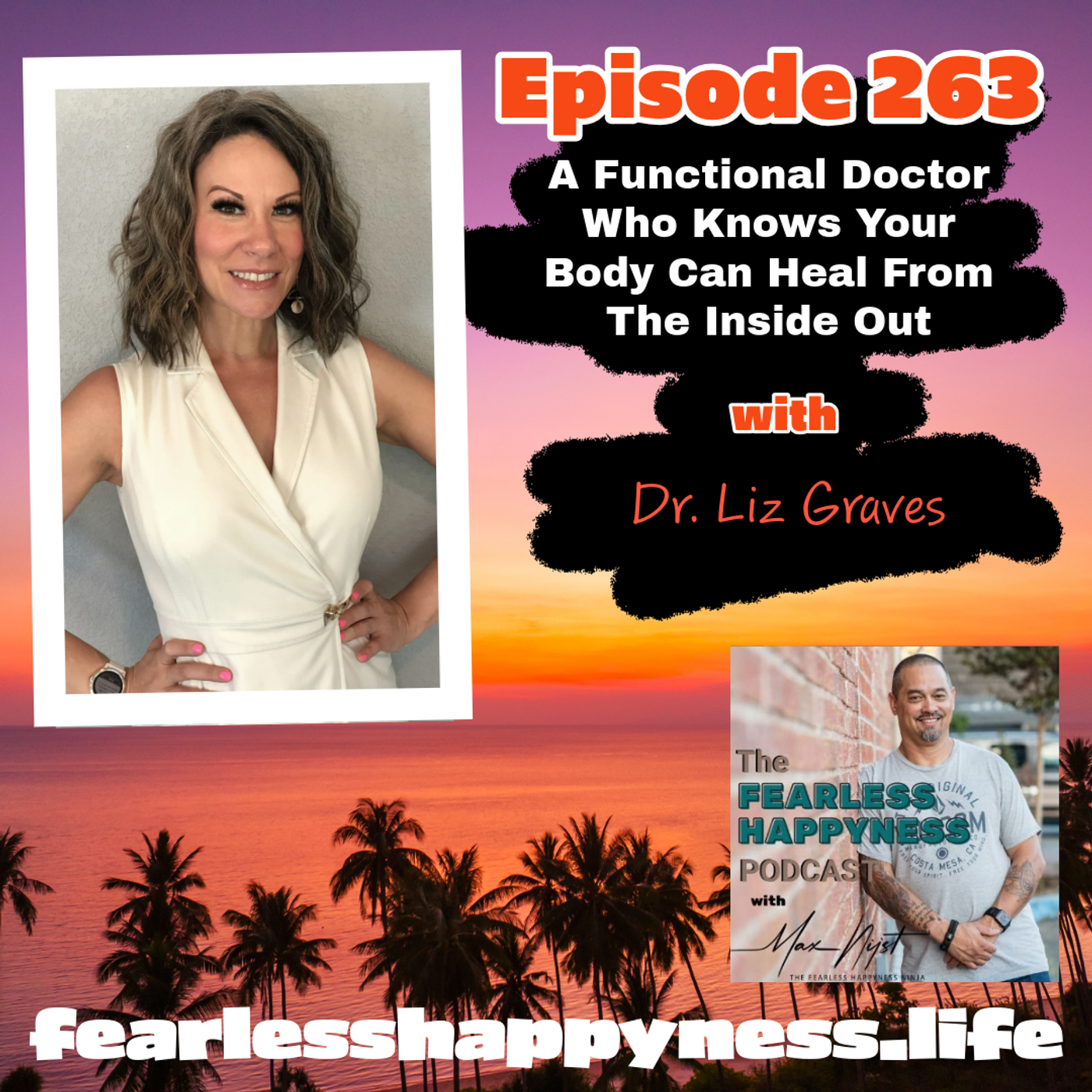
Join Max Nijst and Dr. Liz Graves as they explore the transformative power of functional medicine, nutrition, and holistic health. Discover practical tips for improving metabolic health, overcoming addiction, and living fearlessly with faith and gratitude.
For more from Dr. Graves:
For More From Sober Coach/Substance Abuse Counselor Max Njist, visit MaxNijst.org
Max Nijst: Welcome to the Fearless Happiness Podcast, where we showcase phenomenal individuals who have overcome serious traumas, life obstacles, and challenges to find their own path to fearless happiness. Listen as Max Naist invites guests from all around the world to share their experiences and spread strength, hope, and faith. This is the Fearless Happiness Podcast. And this is Max Naist. All right, everybody. Good morning, good afternoon, or good evening, wherever you are in this world. This is Max from the Fearless Happiness Podcast, coming to you today with another special and amazing guest. I know I say it all the time, but as I say, and they've proven me right every time, you know, my guests always prove me right. So today we have Dr. Graves with us. But what Dr. Graves, what I like to do is have you introduce yourself to my audience, like who you are, what it is you do, and then you and I. like I like to say are gonna rock and roll. Awesome. Well thanks Max for having me. I'm super excited to to get to chat with you. â you're welcome to call Dr. Liz. That's what most people refer to me as. And I am, I started off as a chiropractor, but I've moved more into functional health. And my specialty is using food to heal the body. I focus a lot on metabolic health, a lot on weight loss, a lot on root cause. So I always talk about using food, occasionally supplements. Sometimes just focusing on where the body is not being supported to get that resolution on why the body's not healing. So that's a little bit about me. I love it. Dr. Liz, this is like I always think, you know, I always say this and people probably go, here he goes again. So why God is on time one more time again, right? Because hopefully you and I can have a little conversation after, right? Because I've had a lot of guests now. At least lately that are into the functional medicine or the functional health space, which I'm liking a lot more than your regular medicine, right? Because a lot of people are. Well, because I mean I've been on both ends, right? Well, here's a pill, right? Here's a pill. It'll make you feel better. Obviously it doesn't, right? And Well, and there's a time and place. You know, I'm not yeah, I'm not that chiropractor or that wellness person that's like, never take pharmaceuticals. You know, there's a time and place where we need emergency medicine. Thank God we live in America where we have access to it. â but it's not fixing the problem. And that's where a lot of those questions start to come up. Right. And see, and I that's why I'm glad you're here, right? Because I've watched some documentaries â and even I think it was Aristotle or one of those way back when that says Food is your â should be your medicine, right? Like what you put what basically what he was saying is like what you put in your body is gonna heal your body, right? Mm-hmm. And and I think of course you know and I know, like I know when I eat like crap, I feel like crap. But when I eat healthy and you know, I'm exercising and do other right, then I feel like my body's, you know, on point, like it's doing what it's supposed to do. Right, but we all know like when we binge and go have like ice cream at Baskin Robins or we go get a f fat, juicy burger from In and Out or whatever. Even though In and Out's supposed to be fresh, right? But you know what I mean. Like you still food. Right. It's still fast food, right? Processed food. Right. And they do throw it on a grill where all the grease gets into that stuff, right? But I that's why it's probably so good. But you know, anyway. But you know what I mean? Like there is Like for type two diabetes, like a type two diabetic like myself, I have been getting taught by guests like yourself, you gotta watch what you eat. Like it's you can reverse this, but you're gonna have to do some work in the food area along with exercise to to reverse it. Right. But you know, stubborn me sometimes likes to go and go get a Starbucks or you know, which I I five, I've got a lot of that stubbornness in me, and I gotta learn my lessons the hard way. I don't know about you, but I I always joke, I'm like God is real good with me. Like he knows I'm real hard headed and he'll keep teaching me that lesson. Yeah, you said it, right? Like he it will keep showing up until he goes or she goes, right? Whatever you want to call that power greater than ourselves says, okay, they finally learned it after, you know, so many times. Like and God's up there and like you said, he's probably going, I got all the time in the world. I want to see how long it takes this person. Right. But, you know, I have in my self in my defense, right, have cut back on Starbucks. Quite a bit, right? But I'm not gonna say, I'm gonna go quit Starbucks because every time I see it, then it's like especially when I got family members like my wife who loves Starbucks, right? And she but she gets the healthier, you know, the no sugar. I go, Well, what's the use then? It's like having a I always say it's like having a a light beer or a diet soda, right? And and we're finding out that less some of those diet stuffs are worse than the regular. But anyway. Yeah. Right. So let's talk about some of those challenges that you have faced in your journey here on Earth. Right. Like that have led you to where you are today. Like talk about anything in your personal life and give examples of like where you said, I want to help people change their lives by doing this. Right. Because I know I've gone to chiropractors and, you know, I went to this one in town. And when the fur and I hadn't gone in a long time, but when he did it, it was like â relief. Right. But he was sure to tell me you need to change certain things too, or you're gonna keep doing this over and it's not gonna help. Right. So yeah. Let's talk about that because I want to hear about your journey and those challenges that have shaped who you are today. Absolutely. So I would say I have I I am not one of those of have had a lot of obstacles or, you know, big big moments that brought me into healthcare. I I don't have, you know, a lot of trauma in the past or things like that. But I've had a servant's heart. I I was born with a servant's heart to just to serve and to see how I could help others around me. And that's really what called me into chiropractic. I always say, you know, chiropractic is a calling. You don't just wake up and unless you're like a second or third generation chiro, you don't you don't know about chiropractic growing up most of the time. It's one of those things where â I started working in a chiropractic office and I saw all these people coming in with bags of medication. â you know, bags and bags, like, you know, those gallon Ziploc bags of medication. And I saw them start getting adjusted, cleaning up the way they were eating, being more active because they could. And then throwing, we had a had a like a five gallon water jug in there where they would throw their medication because they didn't need it anymore. And I fell in love with chiropractic and the philosophy that the body heals from the inside out. That our bodies are meant to heal. They're not like a car or a machine that breaks down and needs the place the parts replaced. We have this innate intelligence in our body that we are supposed to heal. We are supposed to recover. And so that philosophy of the body's meant to heal from the inside out was something that I didn't grow up with in my family. I had â my grandfather was one of the best pediatricians in the world, in my opinion. It might be totally biased. He also had a servant's heart. He was a, you know, he worked, you know, volunteer at Triners and Did amazing things, but I grew up very medically. You know, if if you were sick, you got antibiotics. I had tubes in my ears by the age I was â by the age of three. â I I was somebody that had allergies. And so twice a year, every year I was on antibiotics. And then I got into chiropractic and I saw, wait, I started getting adjusted, my allergies went away. â I had sciatic pain as a teenager. That went away. Those weren't the things that called me into chiropractic. It was seeing kids on the spectrum that were nonverbal. start to talk and smile for the first time. It was seeing, you know, that mom that had been suffering with migraines for decades. Migraines go away and not need the meds anymore. It was those things that really gave me that desire to do something scary, which was to go become a doctor. Cause I did not grow up wanting to be a doctor. So that was kind of that like, you know, if I had to have something like it was big or scary, that was something. That was not on my radar to be a doctor. It was not on my radar to be a healthcare practitioner. â it was more â a calling to serve and to help people, save people from just the pain and suffering we can get in when we're chasing symptoms. Right. And that â but I love how you've moved on. Well, not moved on, but do functional medicine as well, right? Because like it's I liken it to what I do, you know, in my career as a substance abuse counselor, right? I don't just try to Okay, well tell me what's bothering you today, right? We'll work like you really have to dig to the root of the problem, right? To â slowly, you know, help build â skills that you know you don't go back to using drugs or alcohol, right? Like â you know, like I always call my sponsor â Yoda, right? He's my wise Yoda, right? Because he he knew â like he's been my sponsor for over 22 years, right? So it's like and I've seen all types It just like you've seen all types of doctors or whatever, right? There's the ones that kick you in the butt and they think they gotta be like the drill sergeant. We joke in the office, the hug or the hammer. Which do you need today? There you go. Exactly. See, but the but the good ones like yourself know when the hammer's needed or hey, you need a hug. Come here, let me hug you. Like then you're like, â okay, I c I can l right because we know if if you're not good at doing that, right, you're gonna shut down your patient or your client. And and they're it's And then it's gonna be like the peanuts cartoon. All they're gonna hear is and they're like, I didn't hear a thing he said. I don't know what he's gonna teach you, but I didn't learn a thing, right? â and I've learned from him, like he would suggest, sometimes very strongly, but not yelling. But it was always like, and I I realize it now, it's like, I'm gonna tell you what to, you know, how to do this, but I'm gonna let you do it. And whatever happens, it's your journey, and I'm gonna be here when you're done, right? Because I think you and I know, right? Sometimes we learn â learn best when we go through those challenges. â yeah, we learn the best lessons when we stumble and fall and have to pick ourselves back up because those those are the lessons that stick. Exactly, right? And in in health, that's I think important for all of us, right? And thank God there's people like yourself who really have that servant heart to do right the work that you do so you could truly help someone. Like you said, like someone with a n say a nonverbal â child, right? Autistic child, you do your work and all of a sudden they're trying to speak again, right? Like I'm sure you've gotten those big hugs back, like, â my God, Dr. Liz, you know, you're such a and you know, so in that journey, right? Like cause I know, well, how do I say this, right? Like I didn't go seek out to be a substance abuse counselor, right? Because I did not like the way I went through it. I had to go through those hard lessons I just right if I would have chose. But as I stayed sober and realized that's this is what I want to do, right? And like I said, I had a wise person to kind of guide me, because I remember at thirty days, I'll I'll tell you something funny, right? I'm like, I'm gonna be a counselor. And he goes, â no, you're not. No. I'll tell you when, right? And he literally did it in that manner where I was like, â okay. All right. I'll just and I 'cause I had made him a promise and God, right? I'm like, you keep me sober, I'll do whatever I have to. Whatever work is required, God, I will do it. I promise if you keep me sober, right? So when he said no, I'm like, Okay. â Okay. And I waited two years, which I'm glad I did 'cause I got to do that that tough inside work, you know, on myself and And do all that stuff. So, like in your journey, right? Like when you decided, right? Cause I think â chiropractic's wonderful. I don't care what anybody says, right? Cause I like I said, the first time I had it done after, you know, when I look back, when I hurt my hip and back in a football game when I was a â volunteer fireman, we were gonna play â the police. They had an all-star team, right? They called it the North Star North South All-Star. Cop team. They made like 60 guys on there, so I'm like, â my God. But the week before I got hurt, right? And I never took care of it. And someone always suggested you should go to a chiropractor. You're probably out of whack. Yeah. And now I'm still suffering for that all these years later. Yeah. I wish I'd have listened. But but as you it started in your journey, you know, when, like you said, like you kind of you weren't like, My grandpa's a chiropractor, my dad's a grandpa, you know, whatever, right? Like how was that journey when you started learning about it? Like 'cause I know it's very interesting to me when you guys when you chiropractors do what you do. It's like, you know, and I you know it's funny, it's because I'm I don't know if you've seen YouTube, right? They have the animal â yeah. â there's this guy I'm obsessed with that is he's in, I wanna say like the Netherlands. And he adjusts all sorts of animals. I mean like tigers and bears and like he does a lot on dogs and cats too. But yes, yes. There's a lot of chiropractic on on Instagram. You can go down some some real long rabbit holes just watching watching people and animals and kids get adjusted. Well, I love it, right? Because I'm like that one of those animals where like, no, you're not gonna touch me and then they get these googly eyes like So talk about that right in this journey that led you not only chiropractic, but then what got kind of go lead us into what led you into functional medicine. â absolutely. So with chiropractic, I pra I was full time in practice for about a decade and again loved it. I saw lots of families, lots of pediatric patients. I never had one of those kind of I didn't do any like, you know, personal injury or or those kind of things. And there's some great clinics that do that, but My jam was always, you know, get people healthy, get get the kids when they're young so that they don't go through all these problems and come in as stiff adults. And â so I did that for almost a decade and I traveled a lot of different places. I actually I I worked and volunteered in Africa for six months, â setting â starting up a helping some a group of chiropractors start a chiropractic hospital there. So I had a lot, a lot of fun doing it, saw a lot of transformations. â in my practice, I always taught. nutrition and â mindset and movement because you know you can't just do one thing and be healthy. It's kind of like if you eat perfect but everything else is going wrong, you're not going to be healthy. And if, you know, you're exercising but you have a bad diet, you know, you're not going to have good health. So in my chiropractic practice, it was a well-rounded environment where I would do workshops on on other things. And getting into this whole nutrition and functional medicine just ended up being more of what what people need right now. So I think everybody should get their nervous system pack checked. I think everybody should go to a chiropractor to have it evaluated. However, we're in a world right now where our bodies are overwhelmed. It's so hard to eat real food. Processed food is just the easy thing to grab. And we've got so many health conditions as a result of it. And we're chasing symptoms. And so that's where things really started to shift for me. And this would have been about 10 years ago now, where there were just more and more of a need for help with nutrition and weight loss and diabetes and heart disease and how it related to how people are eating and fueling their body. And so I just started seeing more and more of that and less of the chiropractic. And then it just kept on going to the point now where I have a virtual practice really. I I mean I still have a brick and mortar if people want to meet in person, but 90% of my patients, it's a virtual â program â you know, I work with them, you know, one on one all over the country. And it's been really, really wonderful and, you know, helping people, you know, get off cholesterol meds or reverse their type two diabetes or â get off their blood pressure medication because what we're eating impacts our health, impacts our weight. And so it's been it's been a real blessing. And I I do also I love the freedom of being able to do things virtually. You know, I can I can work for manywhere now. Right. And you can help so many more people, right? That's the big thing is yeah, you know, when you're in a brick and mortar and you have certain number of people you can see in a day, it's different. And so I do one on one. I have some group courses that I do. And so it really makes the knowledge I have more accessible to more people, which was my goal. I love it. 'Cause you may have two new ones where you're my wife and I, right? Because I think â you know, there's things I need to change, right? And I need to learn how I hate to say it to cook for myself. Yes, I can cook the basics, right? Like I ta help take care of my mother-in-law who's ninety-four with Alzheimer's. So I cook her breakfast and her lunch, right? And I usually start my day early. So I try to fast, right? Cause I don't like getting up, right? Cause I found that when I would get up and eat my four and then throughout the day, four or five meals, of course, my my sugar's high all day long, right? But I know when I fast. And then, you know, at the end of the fast, I'd try to have something healthy. It's not as bad. And I still need to bring it down, obviously. But right. I mean Yeah. And I I'm curious, do you see this a lot in the people that you work with? Because what I what I know about people in recovery or coming off of addictions is that most of the time because whatever you're giving up, whether it's alcohol or drugs or whatever else. you tend to find something that is a safer, healthier version than what you were doing. And for most people, it ends up being sugar. Like most alcoholics end up completely addicted to sugar because they're trying to still stimulate that same pathway in their brain that they're no longer getting from the alcohol or the drug. So I I personally, I don't know if you notice that a lot with people that you work with, but that's something I notice a lot with the people that I work with, especially if there's addiction in the past. There's a lot of sugar addiction in the present. And we're guilty of that as facilities. Let me tell you. Like I've worked in facilities, right? And the snacks I see now I agree with you. It's like, yeah, we're part of the problem, right? It's, you know, we want to make them happy, of course, and stay, right? So we get all the sugary stuff they want. And right. So they have, of course. That's how I was in you know, in the beginning. It's like I didn't think about, you know, eating healthy. It was like, ooh, I get to eat sugar again, right? Like I Right, 'cause when you get incarcerated, I mean I've never been to prison, but I did go to jail, like and you had to have money to get the good stuff, right? Whatever. Right. So if you're only bar, you had to work for it. Right. Hey, if if if you know, you only got what they gave you for food, right? Like if you wanted any candies and stuff, you had to hope somebody put money on your books, right? And you know, the last time I was in there I jokingly say that. My â it was funny, but my mom came to visit one time and I'm â thanks for putting money on my books. Mom, I got this and that she goes, That's not my money, that's your money. I never put my money on your books. Right. But I I remember that's what I would do. And even in my addiction, like I got there were certain sugary things I would just I would go af that's, you know, was strawberry quick, nest quick or whatever that was. Then a sugary donut, right? Cause I knew I did I needed energy and then but I didn't realize that it was actually gonna play against me later. But you know what I mean? And so this journey of, you know, as you know. Right. You see it all there. I mean, in America, especially right, with the processed food, it's horrible. It's horrible. And I get it. It's hard. I mean, like, it takes more work to eat real food. I mean, it's processed food is cheap and it's easy and it's self-stable and you know, it keeps a long time. It's hard. And I and so that's where I look at when I'm working with people, the main thing I want to help them achieve is habits that make it easier to eat healthy than it is to eat the ultra-processed stuff. Because that's what we've got to do. We've got to overcome that. hurdle of it's got to be easier than the alternative. Otherwise you're going to do what's easy. That's that's human nature. Right. Well, and especially in this day and age when both parents have to work, right? And the kids are, you know, they're like, I'm not a cook. I'm just going to grab whatever I see mom and dad put in the pantry or in the refrigerator, right? And most of the times it's it's sugary stuff, right? Or what you're grabbing on the way home to feed the family. I mean, same thing. Or, you know, even if there is a luxury of having one stay-at-home parent, they're typically the chauffeur and you know, all the things where I mean, I work with, you know, stay-at-home moms that they are spread so thin because they've got, you know, two or three kids that they're taken all over the place for all the extracurriculars. We're probably about the same age. Like we didn't do that as kids. Like it was like go outside, use your imagination, have some fun. It wasn't like it's like baseball, it's like soccer and like this theater and that. So, you know, people are just very busy in the world today. So it's I get that it's hard to also find time to to think about how to how to feed yourself for good health. I know. And that's and you're right. It's tough. I never you're right. Like my mom's like you can walk to school, right? You play sports good. Like I want to keep you busy. I don't want you sitting around getting in trouble. Right. Like and fortunately for me. But a school back then. Like now it's like there's so much after school, you know, and And different things that are not associated with the school, but it is like a full time job for a lot of these parents to just cart kids around. Yeah. And you know, you like you said, I see it too, right? Where matter of fact, like my stepdaughter, right? My my grandchildren, like, she's like I I see when I see her like at the end of the week, like, you know, like like and I can't blame her, right? 'Cause she's got a a our four year old now, right? Our nine year old granddaughter, our soon to be fifteen year old. you know, grandson, â my God, it's like, you know, they have to one has to take the, you know, the one to cheer practice or tumbling while the other takes the other to baseball practice or basketball. And it's right. And she does a pretty good job of like trying to feed them healthy. But, you know, like you said, it's so easy to fall in that trap. Like, â I can just stop at this burger place and get him something really quick or you know, because that goes through my head, right? Like I'm out. You know, like, â I can stop and go get a snack. You know what I mean? But but I luckily for me, I remind myself this is why you got diabetes type two, Max. You need to stop. Right. And â you know, and I thank God for my wife who who's taken the time, like, even though she has a long day herself, you know, to cook me a and her a healthy meal. At least we've started doing that, right? Instead of because I see like there's certain friends in my life, right? Our life where I see what they're feeding their kids and I just go, you're gonna have so many issues with your child physically, right? Because of this food, right? Because you know, another thing that has fueled my interest in functional medicine and stuff, right? Is all these interviews I get to do with amazing people like you that go, dude, you can find an easier way. Like Max, don't be lazy. You can do this, right? And here's how you do it, right? So And plus you see all the research, you know, where like other countries are so better off health wise because they don't have a government that allows people to put pesticides in their food or all the junk, right? Like because my wife was And you know how you said â at the beginning where you're like, I know when I eat good, I feel really good and you know, brain's more clear, things like that. And when I eat bad, kids are different. So kids don't have the same symptoms that we do. I s I saw this all the time in chiropractic. You know, kids would show up when they had problems in their spine with ear infections, â diarrhea, constipation, things like that, versus adults show up with, you know, neck pain or headaches. Now, the food part, you know, the kids are suffering the same thing. Like they might not have the diabetes yet. They might not have the heart disease yet. They might not have the symptoms that the adults are experiencing, but they do have their own set of symptoms. They have, you know, gut dysbiosis, like problems with digestion, they've got stomach pain. They don't they don't know how to verbalize. They've got the brain fog, they can't focus. You know, all these kids in the schools on, you know, on ADD meds or on the spectrum, some of that is being exacerbated by inflammation in the brain from our food supplies. So that's where, you know, it is so easy to grab that stuff and we know it doesn't make us feel good. And we think it's not affecting our kids like it's affecting us, but it does in the it does if you really know where to look. Absolutely, right? And that's my hope. Like, even if like I'm talk, you know, and talking with you and people are watching, right? Remember this, right? Because, you know, I see it happening. And I and now I I thank my mother, God rest her soul, right? For like making fast food a treat. Like rarely did we get to, you know what I mean? Like it was breakfast, she made breakfast. Lunch, she packed our lunch, right? Sandwiches would, you know, like she would take And I remember these old pressure cooker, right? She would buy meat, right? Do it in the pressure. And that was my she didn't like the package bolognays and stuff like that. Right. And then in dinner, of course, we all sat at the table. She made a homemade dinner, right? Right. But like and and part of me understands the hustle and bustle of life today, where you got you, you know, you feel like you're getting pulled in twenty million directions. It's easier. But, you know, Dr. Liz just said it, right? Like This is already happening. They just can't verbalize it or tell us what I just told you I have, right? And it can be just as easy. It is just switching up those habits. So, like one of my favorite things if I'm gonna have a busy day where I'm not gonna be home, is I throw food in a crock pot and it's hot and ready to eat when I get home. Like it doesn't it like I could not go through a drive-thru faster than just coming straight home, opening the crock pot and there's food. So I always think about that or like what you said, you're, you know, you're you and your wife are now cooking dinner, you know, consistently at home. Like my favorite thing for people that are busy is like make double at dinner. If you don't mind leftovers, whatever you have for dinner one night. You have for lunch the next day. How easy is that? It's already done. That's what my mom would do, right? Like we would have leftovers. She goes, Like, I'm we're not wasting this food. It's good for you. So you could either take it for lunch or we'll have it for dinner again tomorrow night, right? You're gonna eat it till it's gone. But luckily for her, I wasn't the picky one. That was my brother, right? Like whatever she cooked, like I've always been â you know, for me it's I I loved home cook cooking, right? I love vegetables. There's not too much I don't like. â but you're you know, we'll have this talk after because I want to s you know, I know it's funny that you say that because my wife, because she said, you need to learn to cook and help you out here. And I'm like, man, do you understand I was spoiled? I never had to do that, right? And she is like, you know, then I get the death look and I'm I'm booked to the other room, right? So I don't get like a slipper thrown at me, right? So so what I've learned in watching my parents is my dad was like that. My dad never cooked a meal, got married to my mom, never cooked a meal, never did laundry. He's now 80. He knows how to do laundry. He can he can boil he can make hard-boiled eggs. So it's it's not a bad thing. It's not a bad thing to learn some of these new skills. Look, look, and so again, in my defense, everybody, right? Like she's got a good point, but I have learned since I work from home, I do the laundry. There you go. Okay. I I cook lunch and breakfast for mom, right? And I do laundry. And I I do hard-boiled eggs, right? I make snacks so that I Instead of reaching for something junky, I reach for like a hard boiled egg or something now, right? I try to change those habits. But I wanna surprise the wife one day and and cook her a dinner, right? 'Cause she tells me the same thing, Doctor Liz. She goes, You know, there's there's a crock pot in our pantry our closet over there, right? All I gotta do is throw like go on YouTube put everything in there and turn it on and walk away for six to eight hours. Well, that's what she says. She goes, You research all this breathwork stuff and you blah, blah, blah. He goes, Why can't you research â crockpot meals on each? There's a million of those out there. Yeah. Yeah. Right. And again, I I love it 'cause it's easy. And yes, it's it's it like the crock pot really is. And I know a lot of moms, they really like the Instapot, kind of similar situation where, you know, it it it it it keeps keeps things where it doesn't get dried out and it's just ready to go when when you're ready. So it is so convenient. Right. And I love this, right? And this reason I'm bringing this up and telling on myself, everybody, because Dr. Liz has a point, like we can do better as households, right? Like eating healthier, living healthier lives, right? â because all of you know, like even as a substance abuse counselor, right, and recovery coach, like I teach, right? I try to help mind, body, and spirit, right? So I have to know all that stuff. Like, you know, I don't just Okay, here's the body part. Go find someone that's gonna help you do that, right? So I I try to, you know, lead by example, right? And coming out rehab, that's probably not what you're gonna be ready to do. Right. Go find somebody and delegate that. You probably have to out. So we have to learn, right? And you know, like I s kind of alluded to before, right? A lot of us learn when we're in, you know, locked up is right, you have to stay kind of in tip top shape in case anything happens, right? You gotta be able to protect yourself and But that's like in even in the outside world, right? We want to be healthy. We want to be able to take care of our families, right? We want to thrive instead of survive, right? And that's why like Dr. Liz is encompasses everything, right? Not only your mind, but your body, but your and your spirit, right? And and you know, thank God there is Dr. Liz out there that will can teach us that and you know, learn better habits, right? And the same same kind of thought of like probably what you do when you're working with people one day at a time with addiction is absolutely small habits at a time. There's very few people I've ever worked with that can do 180 degree turnaround. So it really is like, okay, let's if we're eating out every night, let's make sure one night a week we're cooking at home. Or, you know, hey, let's stop buying, you know, this thing, we're gonna have this instead. And don't try to do an overhaul and be a new person tomorrow. Just figure out what's the low-hanging fruit. What can I tackle? And do that till it's consistent and easy. And then look for the next low hanging fruit. That's kind of how I look at things with people is yeah, don't want to make this hard. It's not going to stick if if you make it hard. No. And I think you're absolutely correct, right? It's like the New Year's resolutions that we all do, right? Like we're all guilty of in the past, right? We go, â yeah, I'm gonna be like the next Jack Lelane starting on New Year's Day, right? Day two comes and you're like, I'm done. Yep. Yeah, most people there's I can't remember what day it is. It's like day fourteen or seventeen. Somewhere in there, it's like give up your resolution day. It's like everybody gives up the resolution like less than a month into it. Because yeah, you you think you're gonna be a new person and and that doesn't happen. These little micro habits over time are gonna build a lot more success. Right. And see, and that's what I want you all to gather from Dr. Liz, right? She's even telling you you've heard it before from other guests, right? They don't tell you that you gotta make this complete change overnight. And then, you know, start on this new path, right? They understand that it's small steps forward every day, right? I learned that from my f my friend Thomas, who, like in business, it's small steps forward daily, right? Yep. You'll see progress. It's like in recovery, right? They didn't I didn't go from one step one to twelve overnight and then go, â I'm good. Like it was step one, step two, you know what I mean? Like and then any fitness were like And some of the steps take more time. Like some of the some of those steps along the way are harder to achieve or to solidify. Right. So that leads me into a good question for you, right? Like when you meet and you you have a new patient, right? And they start with you, right? And they're feeling good the first couple of weeks, you know, and they get into it, and all of a sudden they're like, â Dr. Liz, I don't know if I can do this anymore. How do you motivate your patients to keep going? Right. besides the small steps, right? Where they 'cause all of us reach sometimes we reach those walls, right? But what I like to say is you gotta either find a way over it, right? Whether you grab a ladder or keep going until you go around it, right? So how do you help keep your your patients motivated when they they run into their struggles like I don't want to do this anymore, Duck or Deoze. â absolutely. So it's honestly when I work with people, it's pretty rare that â that they're ready to give up. It's more often when I work with people that they had a slip up, like, okay, I was gonna do this and I went to the, you know, party or vacation and I ate all the wrong things and I did all the wrong stuff. So for â for most of my people, I don't think I've had anybody who are like, I just want to quit and give up. Most of the time within two to three weeks, people have less brain fog, less craving, so â less inflammation. they're they feel better. So they've already got that leverage of they're getting something out of the work they're putting in. So a lot of what I do is self-motivating because they're already, they're getting results from what we're doing. So they don't necessarily want to give up or quit. More often I have one of those, you know, okay, well, we had a plan for how you were going to tackle this vacation with your, you know, the couple's vacation where everybody's eating and drinking and all this stuff. And it didn't go. Well, according to plan. Well, You know, you can't change the past. So there's no reason to play the the the blame or the shame game. Let's look and think about what do you wish you had done differently? Okay. Now the next time you're in that situation, let's do what you wanted to do differently. So I focus a lot more on empowering people of, you know, if if there is an emotional thing, that happens. â but then being able to look back at that with some wisdom of, okay, how do I want to handle that differently? And then So much of what I do with the food and the brain health and different things, we're equipping the person physically to where a lot of the the cravings or some of the things that would normally set, you know, set them off the path is just less of an issue. See, I love it, right? Because i if they follow what you are teaching them, right, or having them do, right? It becomes self-motivating because they see the results, right? Right. But it's it's It's kind of like in my recovery journey, right? Or as a counselor, right? Where I see I I suggest, right? And if you do this, you're gonna see results. But then they come back and they say, It didn't work. And I say, Well, what did you do? And they tell you the opposite. Yeah. Right. And you try not to laugh like I told you not to do that. Yeah. Anyway. But but I do like you do. I go, okay, what did you learn from that then? Yeah. Like what did you learn that you can do different? And most of the time, right, they they go. probably should have followed what you suggested right in the first if you find this a lot, but I feel like most of the people that I work with, because I do kind of like two, three month kind of pockets of time and, you know, give people tools they can keep on going on their own. I find most people it it it's kind of like what you what maybe kind of how you felt when you first started working on addiction where it was like the first 30 days, you're like, I feel great. I'm gonna be a counselor. I'm gonna do this. You feel like you're on top of the world. I feel like that's what people, a lot of people I work with are like in the very beginning. It's kind of like, I'm on top of the world, I can do all this. I never want to go back to my old habits. But then six months in, nine months in, a year in is where some of those old habits start to creep back in. So you know, I have I have membership plans and some things like that where people can stay a little bit more engaged, where they don't need as much of me teaching them and overseeing them and watching them. But they still need a little bit of that where they're not on an island by themselves because those old habits can sneak back in. Right. And I think that's key that you said that, right? Because as long as you have support, okay, like here's how I can liken it or, you know, parallel it with my recovery, right? Because I went to meetings. And continue to go to meetings and I have a sponsor, right? I have that support system in place. When I find myself going right instead of left, I usually have someone that goes, Hey Max, I see where you're going. You need to and then I go, Okay, cool. Right. Or if I have questions, I can call my sponsor and go, Hey, you know, I got this bright idea, right? And I'll run it by him. And he'll either tell me, â that's cool, do it, right? Or he'd like Max, â let's let's Let's review this. I'm gonna tell you what I heard, right? And then I go, â my god, that's not that bright, is it? But you know, that's C, that's like support, ongoing support, right? And it was like that even in my journey as becoming a counselor, right? Because I kind of took after the old timers, right? Of AA, right? And I'm I'm just telling on myself here, right? So I'd sit with a client and they tell me, you know, hey, I'm not gonna do the 12 steps. I wanna go with me, blah, blah, blah. And I'm like, what? â my God. I can't work with you because â you if you're not willing to work the steps, you know, like I can't watch you die and die and they would look at me like, Whoa, Max, you need to take a chill pill, like you know, and I realized that's how I was in the beginning the first maybe year. Yeah. And you when I had people, you know, that cared about me, took me aside, like, you need to, you know, like you this is their recovery. You can't tell â how to do it. Like now I'm totally opposite. I I d I never even mentioned meetings, right? Yeah. And And it's funny though, cause some of my how do I say it? Sometimes my reputation precedes me, right? And they'll be like, I'm not doing meetings. And I said, I've never mentioned meetings, right? And they go, â yeah, you did it, did you? And I go, I go, This is your recovery. I go, I'm here to support you and guide you and be there for you. â but I will be the one that keeps you accountable. Whatever you choose to do, I tell them is like I'm gonna be the one that goes, Hey, you're not doing what you said you were gonna do, right? And â And that's kind of like how my journey in life is evolved, right? Like you know. And I I feel like that's kind of that seasoned coaching. Cause like, you know, I think back to when I first became a you know, when I first graduated from chiropractic school and it was like everybody needs chiropractic hearing, you have to do it this way or you have to, you know, you have to do it the best way possible. And some people are not gonna do it the best way possible. Some people are only gonna go in when they hurt. And yes, it's better if you go in when you don't hurt because then you never hurt. But you yeah, you gotta meet people where they're at. If you want to help them. And I think that's that seasoned coaching. You know, what what I'm hearing from you is, you know, once you become a seasoned coach, it's kind of like when I first started doing weight loss and metabolic health, because that's kind of how this whole functional health started was it was really specific to weight loss and metabolic health. And then it's expanded more functional health and other things as well. But that those first few years of doing it, I had a protocol and it worked every kind. If you did it right, it was consistent, you would lose, you know. Two clothing sizes in two months, you would lose a bunch of inches, you would feel and I was personally hurt if people didn't follow it. Like I took that, like, you're not, you know, it's you're not showing the full extent of what this can do. And it was about me versus now it's like, I'm I'm gonna show up and give you my best every day. I'm gonna give you my hundred percent and you're gonna show up and give me your hundred percent for that day. And your hundred percent might look like five percent some of somebody else's. But I know you're doing the best you can. And that's no reflection on me. Like I'm here to help guide you wherever you are, not to judge you, but to, you know, sit here, hold space and help you along on that journey. Right. And I love that you said that, right? Because that's what it's about, right? Is holding space for the person that you're working with. Right. Because you gotta make if you don't make them feel safe that they can come to you. Like if we were working together and I go, Dr. Liz, I had a big triple ice cream from, you know, from Thrifties the other day, right? And you yelled at me, I'd be like, Well, this is the last session we're ever doing, right? That's how I am. Like if you raise your boy, I'm like, I check out. But I get it, right? Like, okay. But like I know I think we think alike, right? If somebody came to a like if someone says, Hey, Max, I relapsed, and like I'm not gonna judge you for that, right? Because Like from what I've learned not only in school, but from mentors and and you know, as as being a pr practicing substance abuse counselor, right? It's like I've learned through my research that it's in our DNA. Like people that are get addicted or or can be, right, have that gene in them that predisposes them to addiction. Like I had it on both sides of my family. My my mom's biological dad, you know, and and my dad was an alcoholic, right? Like I knew, like, you know, but I also know people that have it on both sides and they've never touched a drug in their life. Fascinating. So â did do you have siblings? There's seven of us. There's seven of you are so did some of y'all like were you were just naturally predisposed for the addiction and some of you just like had no affinity towards it? Well, here you want so all five boys. Uh-huh. All five. Wait, all four boys, sorry, have issues, right? So I have an older brother who is actually gonna be 45 years clean this year. That's amazing. There's my brother in between me and my oldest, who's 10 years older, right? He has struggled. He's sober now, but he struggled with alcoholism for a long time. Right. That was his three, four meals a day. Was you know what I mean? He was on an alcohol diet. And then there's my love my little brother who got sober for a period, but God rest his soul. You know, he ended up taking his life and lost his battle to addiction. And now I'm the baby, right? But all the girls yeah never I mean, they have experimented, did their partying, but they never but every 'cause it really is like it's a it's a different shift. So there's a lot of â drug and alcohol addiction on my dad's side. And â I have one sibling, just me and my sister, and there's a difference in the way we consume anything. Food, alcohol, anything. Like she's the one that will will have like one drink and get really giggly and then not want another. I'm the one where it's like I want one and then I want another one. And then you know, it's it but it's so different. I mean, same family, same household, say and it like literally it's just there is that genetic predisposition, but it like there's also that part where we're all individually just unique. And so it is what you know, it is what is and I and I, you know, this addiction's addiction, whether it's food or alcohol or whatever whatever. â you know, everybody has things that they're they're there's very few people who don't have something they struggle with. Exactly just more socially acceptable. Exactly, right? Well, that's like my mom. I've I think in the eighty eight years that she was alive, I think I've seen her drunk twice. And what I mean by that, like she was a lightweight. Like twice I saw her one glass of wine and that was it. You know, and she was giggly and You know, I like to talk and smack to me, right? I'm like, Mom, did you Yes, I had a glass of wine. So what? You know, okay, Mom. I'm just asking. But you're right, like it's so different. Like the girls and my family never had it, you know, an issue. Or if they did, they stopped it and it was it. Like Yeah. All the men, all the boys, yeah, we had to go get help because it was out of control, right? Like we needed help and â but like, you know, it's that's like I you know, this is Such a wonderful conversation, right? And I'm so glad you took me up on this, right? I'm honored you're here because they get to hear it again, right? It's like what we put in our bodies is so important, right? Food wise, even what we look at, right? We what we put in our minds. And I think all of us, you know, I can, I can, in my opinion, right? All of us need help physically, mentally, spiritually, right? Just to become better people. Absolutely. You know. Not like I'm gonna go, hey, Dr. Liz. We're not meant to go like be little like little lone wolves out there in the world. We're meant we're, you know, meant to be tribal and connected. And especially in today's modern world, we there's so much of a loss of collec â connection. You know, technology and devices have stopped some of that connection, but there is the potential. Like, hey, look at us here. Like We probably wouldn't run into each other otherwise. And here we are connecting and having a great conversation. So â we just have to be more intentional â to be able to lean on each other and and not feel isolated in in today's world. Absolutely, right? You said it. I agree one hundred percent, right? And the I always say this, right? The powers that be want us to be disconnected for a reason, right? Yes. Like in you know, Dr. Liz is like, yeah, I agree. So that's why, you know, like I it's not just for recovery, right? Like the it's connection. I think we all need connection, right? Whether you're in recovery or not, all of us is I think God, right? Like this is my opinion again, right? My belief that God put us on this earth for that reason is to connect. Because he didn't just put Adam on the earth and said, Okay, that's it. He put Eve, right? They connected, right? And then so on. And that's how we all evolved as human beings, right? And, you know, I think We connect better when we're all healthier. Yeah. Right. Because you know 'cause then we can look at if we can look at ourselves in the mirror and be happy, right? It makes it easier to connect with others, right? But when I'm looking in the mirror and I'm speaking for myself and I feel horrible about myself, I'm not doing what I should be doing, then of course I want to just stay in the room and isolate, lay in bed all day and not do anything, right? Mm-hmm. But I've loved what I've had guests like yourself that are in the same space, right? And other modalities and just all kinds of different guests, which I love and I've been blessed with. One common thing is right, is that we are all spiritual beings have a human experience and connection is what's going to get us through the day is connection. I love that. Right. But and I think, you know, what you do and being very successful at you do is cause you know how to connect with your patients. Right. Cause if you didn't, we might not be having this conversation, right? Or if I didn't Right. I wouldn't be going, Hey, I know how to connect with people, Dr. Liz. And you'd be like, â not what I can see over here, you know what I mean? Right. But we can have this laugh and we can joke around, but it's true, right? Like, you know, I I I've I've said it on previous podcasts, right? There was a a a sixteen minute TED talk â from this journal from journalist from the UK that talks about what we know about addiction is all wrong, right? And he goes into this whole thing about Portugal legalizing it and how You know, like the Netherlands, it the crime rate is not even half of what ours is, right? And a lot has to do is because they legalized all these hard drugs, right? And they gave â places they can go do it, they go get checked. But at the end, I just I love what he says. And I you know, and it's not just for addiction, everybody, and I think Dr. Liz will understand this, right? But he does say, he goes, What do you think the opposite of addiction is, right? And you can hear the crowd going, â you know, â Sobriety, recovery, all these things, right? You can hear the crowd saying this, and he lets him say it. And he goes, Nope. The opposite of addiction is connection. â Right. He goes, because in our in the addiction that he witnessed, right? I think it was his cousin or something. He goes, right? Everybody either because there's that stigma that follows addiction, obviously. I think you know about it. And mental health, right? Like, â my God. Right? Like, if People knew what I did in my addiction, they'd be like, No way, right? Like, cause I was literally like that guy. And I know friends, same thing, who I never went there, but I know a guy who got sober on Skid Row. Like literally was drinking and doing his drugs out of a cardboard box. He's 24 years sober now, right? Yeah. â you know, but what comes to mind for people is, you know, the guy, you know, in a broken down house with a thing around his arm shooting dope, or the guy behind the 7 Eleven, you know, drinking out of a paper sack. That's partly true, but it's not, you know, there's people that you would, you know, like look like Liz and I, and you would never know if they were struggling with addiction, right? I know doctors, I've known nurses, I have worked with firemen and police officers. And if you looked at them, you would be like, no way. No way. Right. But what this connection I'm trying to get at is for all of us, right? And here's another avenue to where we can get healthier is by working with like Dr. Liz or, you know, or others like her that help the whole person, right? Mm-hmm. By what we put into our bodies and right how we, you know, take care of our bodies and our minds at the same time. And, you know, like this has been an amazing conversation. I knew it would be, right? Cause I could keep you here for the rest of the day and just asking you questions to questions, right? But â we're gonna get into the ones I do remember that I teased you about before we started. And we're gonna start with fearless, right? So going through what you've been through in your journey so far, right? And you know, both in your personal and in your professional life, what does fearless mean to you today, Dr. Liz? And how does that show up in your life today? So fearless to me is faithful, full of faith. Because if we really if we â if we get into the Bible and we read, really the only thing we have to fear is God. And everything else that we fear out here in the world, what people think of us, if we're gonna do a good or bad job, all those things, all the times that we don't speak our mind or we're not our authentic self, we're so worried about pleasing others versus if we are literally in alignment with God, with our purpose, living in faith, knowing that He's got this, there really is nothing to fear. â and that's just been that's kind of been the journey I've been on for the past year or two. And so anytime I I hear you know, fear or being fearless, that's immediately what I think about is being so full of faith that nothing nothing can touch me. Nothing can touch me if I'm in alignment. I love that, right? That's like, you know, like in business or your personal life, right? If you have a big enough why, like why you want to do something. Figure out the how. The how show actually the how shows up, right? Always, right? And That why will help you get through those days where you're having fear, right? Because you're gonna go, I'm gonna do it anyway, right? Because I got this over here that I want to do and I'm gonna do it. But today I might be a little scared, but I'm gonna do it anyway. And who cares if you fail? Mm-hmm. Right? Because here's what happened. You're gonna learn fail forward. I knew this was gonna be a great conversation, right? Right. Cause that's how you learn lessons anyway, right? And if you don't, yeah. You know, my my favorite, one of my favorite quotes or whatever it is. In Rocky V, I believe, when he's talking to his son, right? â and he's like, what does he say? â he goes, You you know, you it's not how hard you can get hit, you know, it's how many times you get up, get hit, and keep moving forward, because that's how winning is done, right? You don't like you learn lessons as you get knocked down, but you get back up and you keep going forward. And I'm paraphrasing it, right? But everybody can look it up on YouTube. But that I I get tears in my eyes because I think about my journey. I think about other people's journey that I've had the privilege of being a part of, right? And I've seen them do that. They've getting knocked down and they just say, Look, yeah, I'm getting back up. You're either with me or you're against me, but I'm keeping I'm gonna move forward. Right. And that's what Dr. Liz just said, right? So it's just like I want everybody to understand, right? Like there's resources and there's people out there like Dr. Liz that can help you on this journey you're on, whatever it looks like, that can make you a better person, right? And that's why I was so honored that you're here today, right? Like, cause there would have been a day like Dr. Liz is going to be on your podcast. I would have like, one, what podcast? Two, no one ain't gonna want to talk to me. Right. But but I'm like what you said. I had a big enough why, and I had a mentor of mine that. called me on my BS one day and here I am two hundred and forty-three episodes later, right? That is awesome. That is awesome. Right. And I don't say that, you know, like braggingly. It's like for me more it's like the guests that I've been privileged to have on here. And I thought I'm serious. I like you and prior guest. I'm like, Max, if you were twenty two years ago, you would have said you'd have Dr. Liz on your podcast. I'd have said, â whatever you're doing, pass it by Right? 'Cause we get to have you know, hopefully this conversation, someone in the audience goes, you know, I gotta reach out to Dr. Liz 'cause I gotta make changes. Right, 'cause I'm already telling her that I'm gonna reach out to her after the podcast 'cause I I need to make some changes. I I need to keep working on some things that I'm really, you know, 'cause I'm a grandpa of twelve, everybody. You know, you've heard that before. So I got twelve big whys to keep going on this. Here's the th here's the thing I've learned about working with men. Men Think they are invincible until they have grandchildren. Yeah. And then they realize that they are actually mortal and they've got to do something if they want to see those grandchildren graduate high school and college and have great grandbabies. But men do not want to do anything for their health, typically. And I and I think it's beautiful. I think it's so beautiful because most men, the reason they don't want to focus on their health is because they're so busy. being the provider and the protector, which I think is amazing. I love that. And that's where typically the mom's coming in like, honey, go to the doctor, go get your labs, honey, put down that soda. But once once men become grandfathers, that's where they realize that all that providing and protecting only goes so far and they want they really, they they have the space and the time and they're they want that connection. Absolutely, right? Like, especially when you got granddaughters, right? I mean, I love my grandson. Don't get me wrong, right? It's a totally different. I love my grandsons to death, right? But when you got little granddaughters that look at picture. And they say I want a pony, you go figure out how that's gonna happen. â God, she nailed that one, right? She's from she's from Texas. She's in Texas. She knows, right? Like I'm in California now. I'm sure I'm gonna have granddaughters like Where's our horse, Grandpa? â Anyway, but see, this is what I love doing this for. I love these conversations, right? That leads me into my next question since we're laughing and have a great time. As you can see, I put a why in happiness. Knowing I put that why in happiness, what does happiness mean to you today, Dr. Liz? And how does that show up in your life on a daily basis? I would say happiness. I associate that with just an internal joy, just being joyful, being grateful, being being surrounded by family and friends. So I would I would say, you know, that is something that no matter what's going on outside the world, â if you're if you have a joyful spirit and â a grateful heart, then you are pretty likely to be happy every day. I love it. I hope you're paying attention. Grateful heart that should be sticking out to everyone, right? Because you can't go wrong when you got a grateful heart, right? You can't. You can't. And when you're grateful, you get more. You get more of it. The more grateful you are, the more you get. It's amazing. I love it. I love it. Right. So this has been a great time, right? We're at the point where now I want to get you out there. So if if the audio anyone in the audience or my audience wants to get a hold of you, how do they get a hold of you, Doctor Liz, if they want to work with you and, you know, or just reach out and ask you questions? You know, usually people got twenty million questions before, okay. I want to work with you, Dr. Liz, right? â but how do they get a hold of you, Dr. Liz? Best place is probably my website. The website is www.backthenumber two, realfood.com. And I'm on LinkedIn, Instagram, and â Facebook, but the website has all those links, and that's probably the fastest place to find me, find out a little bit about me. Also to reach me directly by phone or or email. I love that. See, everybody, you there's no excuse now. Like you got phone numbers, you got social media links, you got Instagram, all of it, like, and a website, back to real food.com. So I hope you all take her out â take her out, take her up on this and reach out, right? Start off with the questions if you have to. But I I believe in the stuff that she's doing wholeheartedly. I've seen it change, you know, even the little bit that I've do my life, but I've seen it like people who full on change their lives with functional medicine. I just it's amazing if you just could see the the before and after. So well I appreciate you being here. It's been such a joy. I I mean I knew we were going to have a great conversation, but as I always tell my guests, you're not quite off the hook just yet. Because now I get to ask you my favorite question that I ask my guests. I always save the best for last, of course. And it goes like this. So Dr. Liz, what is Is the one piece of advice you could give my audience to help them grow as human beings and become better people? Don't be so hard on yourself. I think we spend too much time in the what I should do, the, the, the blaming or the shame game. and just take it. You just, you know, accept, accept where you've been â and just start taking those steps forward. Just â that would be my biggest advice. Don't be so hard on yourself. I love it. I love it. That's kind of reminds me of a saying that I got to learn earlier because I was very hard on myself. They say, Max, don't be so hard on take your sobriety seriously, but don't take yourself so seriously. Well, I say that because that's something I've been learning over the past however many years is you know, rather than pushing so hard, just sit back and receive. Like you don't have to, you know, you don't have to push so hard to make things happen. If if you're if if you're headed the right direction, a lot of things just fall into place. Absolutely. And I think when you're so focused on pushing yourself that hard, my personal belief is you miss those little things, those little wins where you should be celebrating and going, Hey, I didn't have Thrifties ice cream today. Not that there's a there's a right aid, but it closed down. So I can honestly say I have not had Thrifties ice cream in quite a long time, everybody. But anyway. So this like I said, this has been an awesome time. Thank you for being here. Thank you for this wonderful conversation. â and we will continue this after because I have a couple more questions. But everybody, if if Dr. Liz made you think, if she taught you something, if she made you smile, and my famous, if she made you go, hmm, I like that. Please go to iTunes and leave a five star review or come join us on my new YouTube channel where you can actually see Dr. Liz and I have this wonderful conversation, amazing conversation. So again, good morning, good afternoon, or good evening, wherever you are in this world. This is Max from the Fearless Happiness Podcast. Until next time. Are you tired of being weighed down by life's traumas and struggles? Join the Fearless Happiness Lifestyle and let us guide you toward a brighter future. Explore our past podcast episodes and get a copy of the Fearless Happiness book to ignite your inner strength. If you or someone you love is battling addiction or facing challenges related to unresolved trauma, know that we are here for you. Visit maxnates.org, â A X. N-I-J-S-T.org and take the first steps toward finding your fearless happiness. Thank you for listening. This has been a production of Fearless Happiness.


