
 Apple Podcasts
 Spotify
 YouTube
  RSS Feed
 A Pair Who Knows A Secret To Unlocking Your Brain with Liz Larson & Bill McKenna | 245
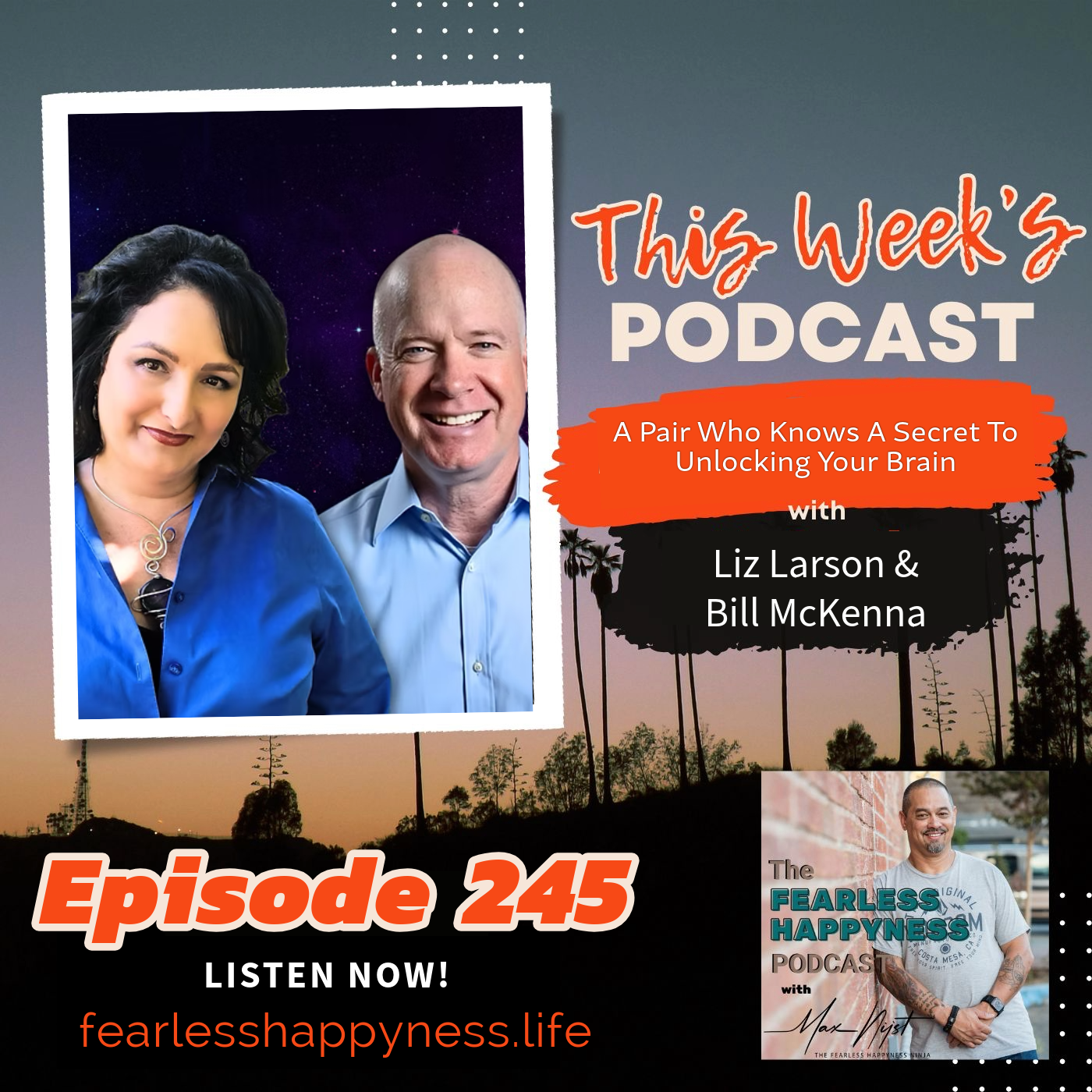
Explore innovative methods to reprogram the nervous system and heal the mind and body from trauma, head injuries, and emotional challenges. Max Nijst hosts Liz Larson and Bill from Cogno Movement to share their groundbreaking approach that combines neuroscience, physical exercises, and emotional rewiring to transform lives.
For more from Liz and Bill:
For More From Sober Coach/Substance Abuse Counselor Max Njist, visit
Max Nijst: Welcome to the Fearless Happiness Podcast, where we showcase phenomenal individuals who have overcome serious traumas, life obstacles, and challenges to find their own path to fearless happiness. Listen as Max Naist invites guests from all around the world to share their experiences and spread strength, hope, and faith. This is the Fearless Happiness Podcast. And this is Max Naist. Everybody, good morning, good afternoon, or good evening, wherever you are in this world. This is Max from the Fearless Happiness Podcast, coming to you again with this time two really amazing and special guests. â one joining me, my neighbor down in San Diego, and the other from Portland, Oregon. But what I like to do, Liz and Bill, is have you introduce yourself. So we're gonna start with you, Liz. Please introduce yourself, like who you are, what it is you do, and then you and I and Bill are gonna rock and roll. Well, thank you so much for having us, Max. We really appreciate it. And I am Liz Larson, and I'm one half of the Cogno Movement team. So Bill and I â own and operate the Cogno Movement team, and we created the system that helps people change their nervous system. So from trauma to reconnecting nerves to make the body move again, that's what we do. I love it. Because I think a lot of people. should pay attention to this podcast today because there's a lot of us that need to â let's say reset our nervous systems because of what's going on in the world. But Bill, introduce yourself, please, â who you are, what it is you do, and then we're gonna keep going. Well I I'm just the other the other half of Cogno, â Cogno movement. And â Liz and myself â we developed a a system that helps people With every aspect of life, you know, the way their brain runs, the way they process the events of life, their performance in not only athletically, but intellectually, spiritually, their relationships, their finances. You know, I I always like to say, what aspect of your life does your brain have something to do with? It's literally it's everything. Everything, right? So we find ourselves we find ourselves in kind of a a â a â a place where the scope is very broad. â and and not only is it very broad, but I would I would say that we have found kind of â the the ability to help people make change in Hopeless circumstances in in parts of their life that that nobody knows how to fix. and we have found some ways in to reprogram the system which will basically give a person an entire new life they never dreamed possible. Right. And I think you're correct, right? Because there's a lot of At least I've noticed, even in my little small town that we just talked about, right? Where I I've seen people where they look just like the lights are on, but nobody's home because whatever stressors are going on with them, right? Whether it's work, family, environment. â and I think this is important today because we have two people here, everybody, that are going to teach us or at least explain how we can change our brains in order to reset our. nervous systems, right? And overcome some of these challenges. So what I like to do first, since I got you here, Bill, right now, since we just what were some of those challenges that you have faced that got you into the work that you do? Like what are some of the things you've gone through that have helped shape who you are today? â well that's it's kind of a long story. You know, it goes it it goes right back to the beginning of life, you know, and I â the way I interpreted my â my â childhood, you know, I I was raised in what I like to call a â a traditional Irish Catholic â setting, which â you know, alcoholism and abuse of, you know, physical, emotional, you know, those sorts of things, which kind of set up a set up a â a pattern, if you will. And that pattern, you know, played itself out. â in a lot of different ways some of some of the ways were really great and and others like â you know nearly dying skydiving or breaking my neck bicycling or you know lots of like â crash and burn you know financially or in relationships you know different things as well as as â a lot of success â those those physical and emotional challenges, you know, ultimately ultimately led to for lack of a better term, an awakening and and then you know not only healing me but but then learning a lot about how this how this can happen different ways that it can happen and And â Liz and myself got together and and created this whole modality which is ever expanding. â Liz, you're next. So, what were some of the challenges that you have faced? I mean, going through, you know, you don't well, whatever you think is important for the audience to understand, right? And then I will get into the story of how you guys met, right, and created this because. I think it's important for people to understand the backstories, right? When they're hearing about these new ways to heal ourselves. Yeah. Well, I mean, I was not born in an Irish Catholic home, as you can tell by my face, or of an Italian, originally Catholic, and then â went to another really high demand religion, which was really challenging in my life. So that's one of those things. That â some people have, and other people are like, what the heck does that even mean? But for me, what it meant is not being, I wasn't allowed to be who I really am. And so I was kind of born this way. Like I was that kid that people would ask questions of that I had no business knowing the answer to. I remember being five years old and having a grown-up ask me a question about themselves or about life that I had just no business knowing. And I remember thinking, what the heck are they answering this? be asking me this for. Well then I knew the answer. Well, fast forward many years, I did everything I could not to be that. Anything not to be that. You know, I was a makeup artist, a cake decorator. I ended up being a owner of a $10 million a year business with my family. We were car dealers for 15 years. I hated the business. But in that business, I would help my â salespeople get through Neurological blocks. Like I knew there was a sales process. They would not be able to do it. Like not be able to pick up the phone and just call a client and say, hey, how was that purchase? Right. So I found myself helping them through that. Well, I don't know if â you went through it, but a lot of us did in business. There was a 2008 and a â crash, financial crash, another 2011 banking crash. And our business did not survive the 2011. And our business crashed, that business crashed in about three days. And it was the most horrific thing that had ever happened to me in my life. But it pushed me in the few years after to become who I was supposed to be. Right. It pushed me into â really looking at what it would take to help people change, really. And I took a lot of classes, did a lot of things, but what I realized is those changes were temporary. And they didn't hit at the core of what was really going on. It changed the logical mind. Pretty soon, me and everybody else would end up feeling terrible again, falling back into the pattern. So that sets it up for Bill and I to meet each other. I was working as a neurolinguistic programming practitioner, a master practitioner of that modality. And it worked great. Except for that I could not seem to make those changes last long term. Right. And enough to change people's life in a significant way. Then my each of my parents got a brain illness, Alzheimer's and Park pr â Parkinson's in the same year. Wow. And so I dove headlong into talk about a challenge, right? Right. We cared for them at their home for many years until their deaths, but I dove headlong into figuring out. How could the brain and body change each other? How can we make significant changes in the brain? And so I learned everything I possibly could. I know things about neurology I should never know, but that was the reason. So for me, it comes out of these really big life challenges and not taking no for an answer, continuing to look for a way to create more, to create change. Right. I see, I love that, right? And this is why I love my guests like yourselves, right? Because I mean, yes, we understand like going through challenges like that either makes or breaks somebody. Right. Like I've seen it in my life. Right. There's times that I wanted to throw almost well, I no, I can't say that, but you know, I had three family members die within like just over a year. Yeah. Right. Me too. So I had my My sister who died of Parkinson's, but you know, with her, it was she she had suffered so long. As a family, we were like, Good, she's not suffering anymore. Yes, we miss my sister, but then my brother, you know, took his own life eight months later. And to watch my mom go through that, right? And then six months to the day on a Thanksgiving day pass away, right? Like, I know, and you know it, there's people out there that either They fold, right? And either they become the victim and they just, you know what I mean? Like they don't want to get well. Or there's people like yourselves who said, okay, I'm not going to let this defeat me. I'm going to figure out a way how one I can get better. And now I love you're helping other people heal from the things you and Bill have put together. Because, you know, for me, thank God, you know, getting sober 22 years ago, right? I had, you know, I had people tell me like, Friends, hey, that AA is a break, they break their brainwashing you. And I go, I needed it. Right. I needed it. Right. But as I continue on this journey, right? I look into other things and I get to meet people like yourselves. And like you are fascinated. How can I better work? Like, because I've been in the addiction field for almost 15 years. And I just I'm always thinking, right, like some of the traditional stuff we learn when I first got into the business is like, okay, that stuff's getting old. It's not working. How can I help? Then you guys show up, right? So now I get to put like some of the things you're going to teach me today into my little tool bag and go, Hey, this is what I learned from Bill and Liz, right? Like, and you're right, like Bill said, we gotta, it doesn't matter, you know, addiction or whatever, right? We have to fix the whole person. And it's I'm talking the body, the brain, it just every part, like like you said, Bill, financially, spiritually, physically, emotionally, just I mean, you can't ignore it. I've learned that right as I've grown in my recovery, that I can't go, I'm gonna do that one, but I don't want to do that one, right? Because but so going back to you, Bill, â you know, as you started discovering â this modality with Liz, right? Like, what were some of your aha moments when you go, â hey, I can fix like I can change the way my brain works so that I can fix my body. get what I'm saying. Does that make sense? Yeah. Yeah. Yeah. There â well, I'll tell you a story because you know it's it's kind of pertinent to you know something you're interested in, which which is â a cravings, right? The the desires, an uncontrollable desire. Now, for some people it's chocolate. I'm still guilty. Yeah, I'm guilty of those two still. Yeah. You know Other people, it's alcohol, you know, some of them it's meth, you know, whatever. We all got our own thing, you know. So I met one that was â what was that? What's that Chick-fil-A? That's their little addiction to Chick-fil-A. â wow, I that it sounds crazy, but you know, we've we've seen a lot, and the the the the things â it seems like they don't even make sense, but â this is what people go through and â i was â early on i was in the â grocery store and i'm going through the aisle and and you know how on the on the next to the grocery store chain you know the the checkout you got all the magazines and i i'm looking at the magazines and there's cosmo and shape and you know different magazines and i So I'm seeing all these l you know magazines that are focused on women. And I and as I'm looking at the at all the the covers, it was like get your beach body now, you know, the grapefruit diet, do the, you know, this kale diet, you know, do you know, it was like all these things around diet and and you know, willpower. You know how to how to take off weight or you know those sorts of things. And I and I'm looking at that and like instantly I was like, they've got it all wrong. They they are all trying to push away the thing that they want. They want the pizza, they want the ice cream, and they're trying to either logically make sense of You know, if you eat that ice cream, you know, the glucose level and â you know the you know the you know the fatty content or you know, they so they're trying to work with people to convince them of something, but they have a strong feeling in the opposite direction. You know, I wanna I wanna have a drink. You know, that's I I'm feeling kind of tense right now. I'd like a drink. So so what the thought was. You know, we had we had figured out this cogno movement â system where we were able to help somebody process their emotions, you know, like their their trauma, their fear, their guilt, their grief, their resentment. But on the on the cravings for things, â I had this idea, and the idea was I wonder, and this is a wondering, I but I I kind of almost knew. Right. But it but I was I was wondering, could I have somebody imagine they're enjoying the thing that they love and want so bad and do these neurological exercises with their body, with their eyes, with you know their spinal cord, these different parts â of their body to. Exercise basically the entire system as they're imagining, enjoying, or actually enjoying whatever it was. And the very first session, it's still online today, and it was â Coca-Cola. You know, I at a â at a at a seminar and I said, Hey, is anybody â anybody here have any sort of craving that we could we could try this out this is an experiment right and the first one was just this sweet lady â she's you know maybe 30 is or so and she she was like yes Coca-Cola you know and and and â and i it's like I she has to have coke every day she enjoys it so much you know being here in San Diego Mexican food and Coca-Cola. It's like the perfect handshake, you know, like a like an ice cold Coke and and and a and a good taco. It's like, you know. Can't beat it. Can't beat it. Yeah, exactly. Exactly. So so so you know, and she's she's Mexican as well. So, you know, we understand each other. And â and so okay. And we we just had her to enjoy the Coca-Cola. And it was a level 10 type of craving for it. And we started doing the exercises and just having her enjoy, enjoy it. And it was like in a thick glass with ice. And you know, the perfect ice that she likes. And â anyway, boom, boom, boom, boom. It went from a 10 down to like a zero. Like she was like, no, I don't, I don't want it. And when she when she went to try it again after she said it tasted like metal. And anyway, â you know, I had I hadn't seen her in a few months and the and it crept back up to about a two on a scale of one to ten. â but we did that again and it went right back to zero. But it's a â the interesting thing that we found is that there is the the experience of life the experience of life happens through an emotion you know â happiness fear anger desire you know jealousy whatever anything and then you have your senses smell touch taste hearing smelling well let's say that that you have a situation where you're with your buddies. You know, I always I always say, you know, down in Cabo San Lucas, you know, go down, you know, Cabo San Lucas, what could be better than a â you know a corona with a lime in it on the beach right with your friends. So there you so there I am corona lime beach warm weather I haven't got a care in the world you know vacation and you're Good friends, you're laughing a lot. Well, what happens is I got a feeling of being accepted. I got a feeling of being loved. I got a feeling of of laughter, you know, relaxation. And then there's my taste buds. â lime, corona, cold, you know, the smell of it. Right. So what happens is it creates a bond. And when we do the exercise, bam, the bond breaks in between the emotion of acceptance, happiness, laughter, love, you know, all those things. And it busts them. This is with these cravings we experience, we have these intense â physical sensations. Right. And then we also have the emotion to go go with it. So we've worked with people with â popcorn, salty things, crackers, you know, you Coca-Cola, white wine, you you you name it, cigars, cigarettes. Everybody's got their own thing. Right. Absolutely. But it's what I heard you saying was instead of making it Like when you're craving, right? Like, â I can't do that. But in kind of enjoying what your brain is going through, accepting it, right? Not saying, like for me, if instance, if I got this craving to go have a Budweiser, right? I didn't mean I have to go have it, but what you're saying, if I'm if I'm right, correct me if I'm wrong, is don't make it a negative so much, but just kind of like let it happen. Right. Well, well, what you do, it's very, very simple, is you enjoy, you imagine all of the things. Now, it a Budweiser is not just a Budweiser. A Budweiser, you know, what's the right temperature? Who's with you? Exactly. What time of day? What is the is the is the Budweiser what temperature is the Budweiser? What temperature is it outside? And and what's going on, you know, for some of us it is we work with people and it's like you know, I want to have if I'm gonna have my Budweiser, I've gotta have chips and salsa. Or or no, there's gotta be a lime, not a lemon, a lime, you know, and say, and I want some salt, you know, or or it's so there's all these little â like traditional Condition that you have around it. And â and what you do is you live the experience, but you allow your brain with these exercises. We find the part of the brain that is stuck on this idea, and we let the rest of the brain take a look at it. There's all kinds of different ways. And the interesting thing about this is it's physical. It's not a mental exercise. It's a physical exercise. Everywhere you look is a different part of your brain. And we can actually see where the part through your eyeballs, because the eyeballs and brain are one. We can actually see what's going on. That's I love it, right? Like technology has come so far and these healing modalities. So Liz, besides meeting Bill, like what did you think when you were going through those challenges with your parents and stuff like that? Like when you said I I and then how did you and then kind of talk about how you and Bill met and how that started to evolve into what you guys do now? Well, I mean, when we were going through the challenges with my parents, it's I just did not think that. Could be right. Like my parents were so healthy. They never went to the doctor. They never took medicine. They never drank. They ate well. And they're all of a sudden in the same year, they have brain diseases. Like, what the actual hell? So I'm like, this cannot be right. This cannot be. There has to be an answer. And when we went to the medical, you know, to medicine, there's no answer for those. Right. No answer. Right. So, â I just knew there had to be another way. And it turns out there really, really is. It didn't happen in time for my parents, but I learned so much. And what they went through allowed us to bring this to the world. So â I was with a f a friend, we had put together a healing circle. And we were, you know, whatever we knew how to help people heal and people in our community, we all got together and would share it. couple times a month. Like, what do you know? What do you know? What do you know? Right. So we were going to â bring some people into Southern Oregon doesn't have a a lot going on. And it didn't at that time. It's I've been a while. There's more now. So we thought, well, let's bring some speakers into the area to our healing circle. And â you know, let's look for some people. Bill had had his first episode on Guy and he was teaching this very simple technique with water. And I thought, well, that's interesting. Let me reach out to him. And I'm not a person who reaches out to people. I just don't do that, right? And I've never done it since, but there was something about what he said about that this little technique he was teaching. It's not little, it's simple, but it's huge. That I thought, well, let's see if he wants to come. So I reach out to Bill and he answers. And I'm like, we start to put together a little seminar for him to come. And â I said, All right. I'd had the skills of being able to put together a website and market. So I said, okay, give me your website. Let's start marketing. Well, he didn't have anything. He didn't have anything. So like, well, okay, we gotta build something. So we we did our first seminar. And then in about six months from then is when the beginning of cogno movement started. But we were both really looking for something. Create change. We were working with people. Bill was also working with people, you know, every Saturday, I think, every Sunday, and not quite getting the changes we wanted. So we were looking for something deeper to create change in the system. I'm brought my background because by then I knew that the body could change the brain, and the brain could change the body. And the way they talk to each other could be altered in a significant way. Bill knew that too, but we didn't quite have the pieces. So fast forward to like craving, for example, there's this understanding that the nervous system drives everything and it's learning from when you're in the womb. So you do not have to be in a huge traumatic situation to have your nervous system out of whack. As it turns out, it could be a minor head injury. Two years ago I heard I I heard of a mom, we were talking about concussion, Said her child fell off a slide when she was three, you know, from the top to the ground. And from that moment on started throwing tantrums. That started to have difficulty in life, right? So the brain got knocked offline, the nervous system got knocked offline, right? And this was the thing with my parents, you know, we now we know through traumas and head injuries and life injuries, right? Every time you have dental work or have a surgery, the system goes offline a little more, a little more, a little more until you have these big â brain problems. Parkinson's, Alzheimer's, autism, and on and on and on. So for us, this is the thing with cogno movement. They're really, we haven't found anything that it's not useful for because it deals with the thing that the body uses. To take in all the information from the outside world and then react to it, put something out. So it literally has to do with every last thing that you do in your life. So the most important thing for us was how can we create change in that system to help the person get back everything they lost from each time that brain went offline and went a little askew and a little askew and a little askew. I love that, right? Because And I say that sincerely because I'm not I'll be honest, right? I like I'm tired of the the medical system and going, here's a bottle of these, take one a day or two a day, and you'll feel fine, right? Like I'm I've been through traumas physically, you know what I mean? Like splitting my head open when I was younger. I had back surgery not too, you know, a couple years ago, shoulder surgery before that, ankle surgery before that. And I know when you were saying that my brain went, I I feel it now as I get older, right? My brain says I can do certain things, but my body says no, you can't. Right. And then I get in this big fight with myself because I can't do the things I used to do and want to do. But I have learned, right, because in my own recovery is like I'm not going to the doctor who's gonna go, here's this for your pain, or I I'd rather come to you or Bill and go, How can I fix this? Right, using my brain. Because you hear it all, it's getting, I think it's it's spreading more where people are using their brains to heal their bodies instead of going to a doctor and going, I need a pill for this, or I need a pill, right? Even depression, right? Yes, I I'm not a doctor, so I'm not saying this, but I I don't think everybody needs because they're going through a bout of depression to be put on some medications, right? The brain is very powerful. Right. And we only use what 10% as they say, right? And a lot of our actions are through the 95% of our subconscious thoughts. Right. And like what Bill said, it right, it starts when we're younger and the programming we get. We don't even realize it. It it literally starts in the womb. So if your mom, you know, experiences a loud crash, let's say, you know, some pans fall. And she screams, and then her body is flooded with adrenaline. She's scared in that moment, and the baby experiences all those hormones too. That child's nervous system might record loud noises, really scary. Right, exactly. And then that becomes a foundational part of that brain structure. So, you know, years and years later, you have this extreme sensitivity to sound, and it's causing you problems in your life, and you have no idea. That it's literally just your nervous system going, Hey, dangerous fire. No, don't, you know, which can be changed and turned off. It's super programmable. And that's why we end up with the problems we have, because the programs that we have get kind of scrambled, and they're not necessarily bad things. They're just things that it learned, like, â that hurt me. â that hurt my feelings. â my feelings are my body. Right. I had a sensation. And so now my nervous system wants to expend energy focusing on that a little bit more, a little bit more, a little more. And then the more times you experience that something that feels like that, the stronger and stronger it gets. Now you got a problem. You know, now you've got an addiction. Now you've got OCD. You know, now you've got migraines. Now and it and it goes on and on and on. Well, it turns out that all we really have to do. Is show the system that that pattern wastes energy. It does, it wastes energy. And it's not necessary. And maybe it was never true in the first place. And the system, it's so awesome. It just lets it go in the moment, vanishes, gone. And then what happens after that is the body gets its energy back from that heavy, heavy program. You know, think about it this like way like you have a â your computer. But the internet is slow and it's loading, loading. Right. That's what our body does. It does exactly that thing. So all of a sudden that doesn't happen. You're full force again. And all the body's like, whoa, I've got all this energy. So now what does it do? It takes that energy to heal, puts it in the parts of the body that need to heal, gives you creative ideas, you know, your heart can expand and love. You've got all this energy to do what the body's meant to do. If you can get it out of that old pattern, I call it getting out of the the ditch onto the curb. Right. Right. And it's actually really quite simple, really easy to do once you know how to create inputs into the system. Right. And get them to change. See, and that's what I want. And I'm like I said, I'm so grateful you're here so people can hear that there's alternatives to some of the things out there. I'm sure you and Bill don't like either, right? Because it's right, like it's not a one thing fixes everybody. But I'm all about if if I can use my brain and my body to heal like breath work or you know, mindfulness or meditation, something that calms this crazy mind down, like. That's what I want to use, right? Because I don't want to stay. I already did that, right? And it didn't work. It made it worse. So yeah. So expand on that, Bill. Like if someone came to you and they said, I really need to fix myself. My brain is out of control. Right. Because of and then you, as you I'm sure you do your assessments and you figure out what's been going on with them in the past. How does that what does that kind of process look like? When they come to you, right? Because some people are not as open as others, right? Where they might not tell you everything because they're afraid of judgment or the shame that kicks in for us, some of us, right? Yeah. And because I remember, like, you know, part of the process of the of the 12 steps is that fourth one where I got to tell my sponsor and God, right? Everything I've done to just to get it out. And I realize that. It is true when they say you're as sick as your secrets, because that stuff stays in your body at a cellular level, right? Because I remember when I finally did it, you know, the best I could, according to the big book, you know, and this is not a plug anybody for A or I'm just letting you know my process. When I finally did it the right way and got everything, it was just like, like you said, Liz, that energy came back. And I was like, Man, where's this been all my life? Right. And and You know, like I'm a big proponent of what you guys do. I love it. Like, if I can refer someone to you that says, Hey, Max, you know, I got all this craziness going on. This is what's happening with my body, and this is what's going on with my brain. I could say, I got two great people for you. We got Liz and we got Bill. And they're gonna teach you how to fix that, right? Well, is it gonna are they gonna inject me with drugs and stuff? I said, No, just go call them and you know, listen to what they have to say, and they're gonna use your brain to fix yourself. Right, basically is what so yeah, right. Talk about that some bill, because like I know I could spend all the rest of this day with you guys, like just talking, picking your brain, and and because this stuff fascinates me because the power of our brain is so amazing. Like I like to say, is that like if we could just tap into it and like learn more about how our brains can help heal our bodies and vice versa. I think we'll have a much healthier â society, you know, in America, right? Because I mean, you look at the Eastern, some of their practices, right? Like, for instance, I'll and I'll let you go, Bill, in just a second. But I like I had a guy that said I went or this lady I interviewed, she said, I went to India 37 times. And I go, Well, why? She goes, They're some of the happiest people I've ever met. And I'm talking about the ones that are poor on the streets. They will give their backs off to you. They will smile at you. And she goes, It's just something about what they learn in their culture and in some of their beliefs, right? In Hinduism or Buddhism. He goes, She says, They're just some of the happiest people I ever met. And I'm like, then you come home to America and some of the places we go to, right? Like, you're like, â that's quite the quite the opposite. But yeah, enough of me, Bill. Like it. Keep going further because, like I said, I could sit here and and listen to you guys all day and talk to you. But I I really want the audience because you're bringing so much value right now to understand, find different ways to heal yourself. Right. Like I'm bringing this to the people. Like I'm not talking to doctors, you know, not necessarily that's a bad thing, but I I'd like people to look into what you guys do before they go to a doc. You know, obviously. Some people need to go see a doctor for certain things, but go ahead, Bill. Sorry, I get excited when I hear you guys talk because it's it's so fascinating to me. You know what? We're we feel we feel you. We all the time. We are so excited every day. We â you know, as I like to say, we don't like what we do. We love what we do. This is so exciting â to be able to help people with the these. situations that that it's is like no other way but you you mentioned you know what does it look like when somebody comes in and and the very very first thing is is a question and and that is have you had any sort of concussions or brain injuries and the answer is always the same No. And and anyway, I I like to use myself as an example here. Liz, Liz, one day, she asked me the question, and she says, Bill, have you ever had a concussion? And I was like, Nope. Nope. And you know, and but the funny thing was, is and then she starts down the list, except you nearly died in a skydiving accident and you were knocked unconscious for How many hours? Who knows? You know, and you spent 35 years in martial arts getting kicked and punched in the head. And and â yeah, you played high school football and you and you know, you knocked you knocking people out with your head, and â you also broke your neck â bicycling, you know, so so many, but the answer's always the same, â you know. â and the reason is is that. You know, you feel maybe a little headache, a little dizzy, you might barf, you know, things are a little wobbly, right? And you're like, shake it off. You know, our generation, you know, it's just shake it off. You know, there is no, you know, get up, soldier, you know. So so anyway, the the thing is, is you know, â you have to ask a few few ways, you know, have you had any car accidents? Did you used to play sports? You know, these sorts of things. And and â you know, did you go out drinking a lot and maybe â you know, fell down? You know, something. Anyway, the thing is, is that an untreated concussion is an untreated concussion, according to the Eamon Clinic. â the Eamon Clinic, â Dr. Daniel Eamon, â he's basically was a radiologist, turned psychiatrist. And he started scanning people's brains. He said the psychiatrists are the only doctor that doesn't look at the organ that they treat. And he was able to determine that, you know, people actually had these brain injuries. And it wasn't, it seems like a behaviour the addiction seems like a behavioral issue. But it's really not. What we found is that when somebody has a brain trauma, their behavior afterwards, they're more likely to go through a divorce. Their shoulder injury issues, their digestion issues, their, you know, â relationships, their finances. We we have people we work with that are. literal billionaires and they go through a head injury and lose everything. They'll start suing everybody and everybody starts suing them and it's out of control. But but â real life real life scenario is is that just as much as you you â you had when the injury was affecting your life you can bring yourself back. And the way you can do it is by physically exercising the brain. And you say, physically exercising, I can't get to my brain. What am I gonna do? No, you can't do it. You know, it's pretty hard skull. You know, it doesn't matter how much I push, I can't really get anything out of it, you know, and I can't I can't move my brain. Well, actually, there's a secret, and the secret is your eyeballs. Your brain and your spinal cord are one system. And â you can physically exercise the brain through utilizing those in concert. And we do it through every available means your peripheral vision, your focused vision, your eye positions, your your neck positions. And and with it spinning, all kinds of different exercises that are all done in concerts with each other. And it brings certain parts of the brain online. Your memory, your focus, your creativity, your relationships improve, your finances improve, your new ideas, all of them start to come back online and blossom. And it's really it's it's an amazing science to. Do this and watch somebody go through the process, their life becomes something that they can't even imagine today. And the reason being is that â we had a I'll give you an example. There was a kid, one of one of our clients, â we Liz and myself work with people intensely. You know, we'll we'll do one-off sessions or whatever, but we do have like what we call a VIP clients where We'll work with them for months. And when we do that, they're on a program where we meet with them once or multiple times a week and work with them a bit at a time. Now, I'm going to use this example. This kid, six years old. He at the time, he's now 20 years old. At six years old, he he was very fascinated with Waterworld. Do you remember that movie, Waterworld? Yeah, Kevin Costner. Yep. Back back in the day. And so so you know he's he's into it and he's like he runs out to the pool is him him and his friends like doing tricks, you know. So he's running out to the pool, go jumps up to do a backflip, wham, slams ahead right back at the edge of the pool. â boom, a bloody mess. You know, 911, you know, hospital, never the same. Never the same. He he had He had after that, after that, he found himself everything his parents would say. They say black, he says white. Do your homework, no way. You know, eat the eat your eat your chicken, you know, even if he likes chicken, no way. You know, not not today. So he's, you know, and not only that, but hating himself. hate hating himself and and being very uncomfortable in his body â couldn't sleep at night you know many many different problems anyway we get a hold of this kid and and now he's you know 20 years old he cannot drive for more than 20 minutes because he has road rage if he if If he if he gets into traffic, I mean it's it's on, you know, something something bad's gonna happen, like go to the go to the big house type of problem, you know. Is it not good? Well, anyway, bottom line is at the very first session, we found the problem in his brain, and we worked on it. The next week, he show he showed up to the next session and and he And â how was your week? You know, I had the most amazing week. You know, I could now drive and I don't feel anything. He says, I don't feel anything, but the â we just it's so funny because the way the universe works, two people that week, he said two separate people flipped him off, and and and and is he's looked at him and he and he was looking at him as a he's like, â my gosh, they must be having a bad day. It's like not that is not the way things would go. Anyway, this kid, it wasn't one thing, it was everything. He was pitching, he was pitching 75 to 77 miles an hour, right? On the radar. He got all the way up 85, 88, and then bam, 97. 97, which is right the one per fraction of 1%. But the performance, this is why at the beginning of this, we were talking. What is it? What aspect of life? Well, are we gonna handle somebody's anger or are we gonna get them? Up to major league status. It's everything, a life that was impossible before â in in every aspect. I love it, right? When we figure that when we have people that'll help figure that out for us, right? Like if you ask me how many concussions, I'll say, which one do you want me to start with? Right. Because I played football. I remember playing Pop Warner one time and I got the ball as running back. I went up the middle. Boom, all I remember is hearing a buzzing, right? And then I'm on the bench and I'm out. Hey, coach, I'm ready to go back in. He goes, Max, the game's over. We're going to shake. I'm all like I missed a bunch of time. Like, you know, and then I had another one in high school. I've got my bell rung a few times. And then I don't know if you remember when they were big in the skate parks years ago. Like when I split my head wide open in one of the pools. Like I'm talking, knock me out, right? And I could hear my blood going into the drain. I could see all the people and the paramedics trying to wipe my face telling me to sit still. And and then so like I tease with my wife. I go, I got I got excuses. I've had so many concussions, and you know, but my wife will give me the look and go, that's not an excuse for what you're doing. Go ahead. Actually, it is. Right. It's not an excuse, but it is a reason. Right. And I'm glad I'm talking to you two, because maybe we can connect later because I would like to figure out why I do some of the things I do and why my body is I mean, I'm not in bad shape, but like I have no right shoulder. Right. My I had solder surgery and the muscle atrophy has never come back. Right. Classic. I have classic. I had what they call â They call that the narrowing your of your spine, the the canal, right? Like the it was so bad that my left calf is atrophied. Like because I took after my dad. My dad had big calves. I have a big right calf. So if I want to show off a good leg, I just show my right one, but then I hide the left one. But you get what I'm saying. But I know that has something to do not with just the injuries, but the whole nervous system and not being. online completely right because as I'm listening to you and Bill, I'm going, No wonder my body's out of whack because it's not it's not firing the way it should be. And possibly my brain is not allowing it to do that. Right. Well yeah let's talk about why for just a sec. Cause I think anybody listening who thinks they've had a concussion or sees a a a person in their life that they love suffering with this. The question is why? So when the brain gets bonked It's like a bruise. When you bonk your arm, you get a bruise. Sort of avoid that area for a little while because it hurts, right? Can't see that on the brain. But what happens is that the brain will route around that area for a little while because it's damaged. Like it's not going to fire through. It's not going to connect through pre correctly. So it routes around it. And then while it's trying to heal, maybe it never goes back through the right channels. Or maybe the channel that it needs to go through was injured, you know, when you were two and it's not available. So the body does its best and it routes around. And when you're a kid, the way that your brain grows is right hemisphere one day, left hemisphere the next day. You know, back and forth. On a day that you have a minor head injury, whatever's supposed to happen on that side doesn't or is unlikely to. So it gets routed into a different. â area, then it you know the next day that it goes to the left side and then the next day back to the right. Well that right side's damaged again on that that side. It's still damaged. So whatever's supposed to happen on that day doesn't get done. So you kind of get these stacks of miswired programming, right? And then let's say that you whack your head and the part of your head that talks to that calf gets miswired, right? Now there's no feedback mechanism between the calf and that part of the brain. No part of the brain saying, hey, calf, send nutrients, send energy, you know, talking to that part of the body to continue it growing, continue being healthy, right? But as it turns out, there are other parts of the brain that can take that right over. You know, you ever heard a person who has epilepsy? Sometimes they'll have half of the brain removed. So that they can stop the epilepsy. And the other half of the brain just takes right over, doesn't skip a beat, right? So we know that that you said we only use 10% of the brain. So the other 90% is available. Right. So in our world, Bills and my world, we would create a feedback mechanism between that calf and another part of your brain that'll take it over. You can restore feeling almost instantly. You can start to see an atrophy start to fill in almost instantly when there's just the feedback mechanism put together, right? So it's no different. We think it's different when it's about an emotion. But let's say your wife says, How do you take out the trash on Fridays? Friday comes and goes, and you're like, I didn't take out. She's Well, you don't love because you didn't take out the trash, right? Right, right. I meant to take out the trash. I just, I don't see the trash. Literally, there could be a block in your peripheral vision where you walk past and you don't see it. So it doesn't pop into your mind. You know, men do this a lot. They're like, I don't see it. You know, the sock on the floor, the underwear next to the hamper. And us women are like, you know, you're just, you just don't love us. But the truth is you really don't see it. There's a part of your intake system that is blocked. And that is not just our, you know, not just calves and shoulders, not just trash, but then emotionally too. So you said something that means something that's different to me, because my brain and nervous system has a wall up against that. I'm gonna take that, I'm gonna internalize it. And then my feedback mechanism is something like Bill said, the kid with the road rage. It's something that doesn't match the situation. And we always think that's the logical mind. We need to talk about it. We need therapy. No, we need to rewire the driver that creates that feedback mechanism. We need to rewire that driver so that our output then is something different. So it really is a reason that changes when you sort out that miswiring in the brain. That's why Bill says relationships change dramatically. With this work, whether you're focused on it or not, because all of a sudden you have the ability to like hear your partner in a new way, see them in a new way. You're not reacting the way you did before. Right. And so that whole thing changes. And for Bill and I, it's a lot like magic. It feels like magic. It looks like magic, but it isn't. It's just a simple mechanical job of rewiring that system. I love it because I've talked to people where sometimes they said you just need to rewire your brain, Max. You know, I mean I I take it to heart in a good way because I think they're right with some of the it's funny because, like, for instance, I think you're I believe you're correct because like sometimes I'll walk, right? And someone goes, Did you hurt yourself? I go, No, that's just what happened after my back surgery, right? Like they think I injured my knee or something. And And it's funny because when I walk, I'll try to focus on walking correctly on that side, like a foot, you know, the normal heel to toe. â It's not correct. And it's so frustrating. And yes, I'm gonna definitely stay in contact with you two because I think there's some rewiring that my brain can use. And the reason being not for myself, of course, because I want to be able to write. Do some of the things I used to exercise and and you know what I mean? But I got 12 grandkids. I want to be around a long time for these grandkids. I want to keep up with them because they're playing sports, right? I got, but it makes sense to me what you're saying. It's not your brain can fix that stuff. And but sometimes I I know what you mean because like sometimes I'll do something. I don't know if it happens to you guys, but I'll and then I'll forget. What I was gonna do next, right? Like two seconds later, I'm like, what was I gonna do? â my god, I forgot, right? I'm starting to think, like, â I'm gonna get dementia like my mom did, or you know, my mother in law is 94 with Alzheimer's, but you can't tell with her, right? She's pretty healthy physically and stuff like that. It's just sometimes the only way you know is when she tells the same story to you ten times within five minutes. You know, when I was a kid, you know, and I'm I love it because I get to help my wife take care of her and watch her right live hopefully happily and healthily, healthily last part of her years. I think she's going to make it to 100 personally. I she's stubborn like that. I just think she wants to be around. My point being is I'm like so with you guys when it comes to rewiring the brain to make it function right. Like we all would want to, right? And Because I know mine doesn't, and I don't mean that in a bad way, but I because of my physical, I think my like you said, I don't think it's just firing the way it should be to tell those parts, hey, you need to heal, right? Like my sh yeah, yeah. You know what I mean? I had a it was supposed to be simple shoulder surgery, right? â fix my rotator cuff. It wasn't even that, it even became simpler, right? They said, You just had bone spurs, Max. Well, two weeks, three weeks goes by, my shoulder's gone, and I'm like. Well, that doesn't sound simple to me, right? But you know, 10 years later, I have no right shoulder. And I'm thinking, but when you go do those tests that they have you do, they're saying, Yeah, Max, you're this nerve is not firing off the way it should be. This nerve is pretty much dead, right? Those what do they call EMG tests, you know, but they stick the needles and they you know shock your your your system. And â this has been very interesting. And like I said, I could go Right, not just for me, but I want the audience to understand. Like we have people like Bill and Liz that have found a way to help you heal your mind and body without right surgeries or â medicines or you know what I mean? And â could we give you a little gift for that mother in law? â absolutely. All right. So as it turns out. That I mean, Bill's mom is 88. She just bought a new Tesla. She's flying here and there. She's doing whatever. And â you know, when I met her, I think she was an 80 and she did it, didn't look like that was going to be the way it was going to go, right? So it doesn't matter what age and doesn't matter â what the brain state is. Well, I mean, at some point it does, but if you can expand her vision even a quarter of an inch to the left or to the right or up. you can expand how much â brain surface is available for her. So it's very, very simple. We use these funny little balls. These are called a cogno ball. But here's all you have to do. Find something colorful and have her look at it. Start at her shoulder, like this. And then slowly, slowly moving it up. Now, can you see that my head's straightforward and my eyes are really stretched? Right. Just having her breathe and relax and moving that ball straight up. So if you're listening, I don't know if people you're listening on â just radio, I'm just moving a ball, just very slowly from my shoulder up and really stretching my eyes. Now my guess is gonna be that. You're not going to be able to stretch her beyond about right here in the beginning. Right. But even if you can get her a quarter of an inch out like this, and anywhere above her eyebrows, you're going to expand what her brain can do for that day. Okay. And then of course you're going to switch it to the other side. Right. And just have her breathe and really slowly. Now, if she likes to tell stories, have her tell you a story while you're doing this, very, very slow. stretching of the eyes. That's all we're doing. And you want to move from low to high because that's how the nervous system processes information. When you get above the eyebrows, you're actually in the ideas and inspiration area. New thoughts. Okay. You might hear that story change or she'll move into a new one. Okay. So that's the first thing. The second thing you can do is just move that object left and right. And the idea is to stretch a little farther and a little farther to the left, a little farther to the right each time. Make sure she breathes, breathes, and she can tell you her stories. You're gonna move from low to high up the body and spend a little extra time above her head. Now, I I guarantee you, because of what you've already said, it's gonna be a little hard for her to get her eyes up. But that part of the brain is something that we need to open wide up. We need ideas and inspiration open up here. So you just have her track and track. This probably could take five minutes, and it'd be fun to do if she's telling you her stories. Right. But check her balance before and after. And then notice the rest of the day how often she tells the same story. Or notice if she does something new. Or notice if there's just something brighter about her. Now, the farther you can get stretched, left to right, or above, the more brain capacity she'll have. If you did it for five minutes a day for seven days, You're gonna see a marked difference in how everything how she performs by day seven. What do think? I think that's I'm gonna tell my wife. She'll should probably go get a beach ball. I think we have some because we have a pool. We'll just grab one of those. But I think it's great because it's all she has is her mom right now. Her brother is right. That's another story. But anyway, we take care of her. And I think that would be something good that my wife or I can do with her. To like you said, help expand the brain again so that we see, you know what I mean? Because I I mean I love her to death and I think she's gonna make it to 100, but I mean, I why not make you know her quality of life even better if she can start doing different things or you know, like you said, expanding her world a little bit instead of just watching the TV and her crime movies or whatever. Yeah, I mean, that's a problem. The brain has got is in one mode and As we move our eyes, that's how we pull information from our brain. So if we're only moving our eyes here, this is all we're getting for information. But there's this whole world of information that lives all the way around. And we need those eyes to be reaching everywhere to get that information. And when it does, it doesn't just help the memory, but it helps the whole physical body because it's involved in those areas as well. And we lose them. As we get older, because our vision shrinks and shrinks and shrinks. Right. Now it makes sense that she gets very anxious when we take her out with us. Like sitting in the back seat. If I look in the mirror, she's got this death look on her. Like, right? I mean, she grew up here, she's lived here all her life, but like I can tell she doesn't remember or she gets she's just very anxious when we take her out. Bill, tell him about your mom in the driving if we have time. We have time. â Well, yeah, â the interesting thing, you know, that exercise that Liz just taught you, there is kind of the next level of that exercise where you start to push the ball further and further back behind, and and they're looking, and now they're really exercising the peripheral vision. So the the eyes are physically being stretched. And the peripheral vision is being stretched. And there's some techniques to â through motion and sound with the ball to get the person to actually be able to see further and further. This specific technique â we did with my mom. My mom â has all of her life, she's always been nervous driving, and and it never stopped. She she would always drive. 10 miles an hour slower than the speed limit. And and it wasn't like she was like, I'm gonna be conservative or something. It's just she's so nervous. Right. We did this exercise, and and about two days later, you know, I saw her and she said, I'm driving the speed limit. And it and it feels the same. And and and I was like, â my gosh, you know. What happens is the â the data, like â you know, at 150 miles an hour, you know, there's a lot of data coming at you, you know. At 45 miles an hour, it's a slower pace of data, you know, so she can take in more data, you know, faster processing speed. So, anyway, these are one one little example of what's possible. In very practical, you know, life benefit a better, a better quality of life. I love it. I love it. You know, especially when you can see the people and they notice the changes in themselves has got to be very rewarding for both of you, right? Like your mom. My mom was the same way before she passed away, right? Like I remember when younger, it didn't matter where we went, she would drive. But then towards the end, it's like, don't even if I drove. I don't want you to take the freeways. We can go this way, right? Like she was safer on surface streets, and I would make her happy and go, Okay, right. But of course, you know, the rebel son sometimes would go, No mom, we got to take the freeway because I don't want to spend all these rights and lefts, and we're gonna go straight there. And I can see it in her eyes. â but that's a great thing that I can do with my mother-in-law, right? So if she has an appointment, right? Maybe she's not so nervous anymore. And she could have a conversation with us while she's in the back going, Hey, it's a beautiful day, instead of like, you know, I could see her like grabbing the seat. Thank you for sharing that. And like I said, this has been like I could keep going with you guys, and I don't want to keep you from whatever you got next, but we'll we'll move on. But thank you, Bill, and thank you, Liz, for being here. Like I've got so many more. We might have to bring you back for part two because I'm sure people are going when we're done, they're gonna go, that's it. I want to know more. â and I I've I've loved what you brought to to the podcast today. It's been an amazing time. So this time I'm gonna start with Bill, men first. So, Bill, and I'm gonna ask you the question that I told you I do remember, which we'll start with fearless, right? What does fearless mean to you, Bill? And how does that show up in your life today? â gosh, you know, this is a really, really good, really good â question. And fearless. Is the absence of fear. You know, they they say courage is basically where you act despite your fear. And one of the amazing things about the work that Liz and myself have done, it is that it has removed the fear. It doesn't mean that I've lost discernment. But I've lost the fear, which means that I have a much broader scope of where I go, what I do, and and my responses to people and situations. I love it. I love it. What about you, Liz? What does fearless mean to you? And how does that show up in your life on a daily basis? â I mean, this is such a great question. It has everything to do with the word below it, the happiness. That when you're not driven by fear, when fear is not the thing that makes you choose or not choose, do or not do, you then have the choice to choose happiness. You then can be who you really are. Because fear is not who we are. Fear is just a reaction to stimulus. That our nervous system processes in a way that keeps us stuck and frozen. Right. Right? We do what other people think we should do. We say what other people think we should say. We're just driven by this â stuckness in a way of fear. But when that's gone, you have the ability to be who you really are, to even know who you really are, to thrive, and then to actually find the happiness. that you choose that you want and so one of the things that â Bill and our is talking about is that the absence of fear is love. You can't have love and fear at the same time. They don't they don't work together. You can't have the feeling at the same time. Right. Right. So when you are absent the neurological pattern of fear, you can love. And the big L, the universal love, the kind that allows you to have compassion for people that you couldn't. You were talking about how crazy the world is. It's mostly because we cannot see another person's perspective. When you're absent that fear and fear of that person, and just recognize, â they're just another human having an experience. â they have an interesting perspective. You can love them and you can find happiness in that. So being Absent of the neurological pattern of fear means everything, just everything. I love it, right? And I think more people need to hear what you just said, Liz, because you know what? There's too many people that are afraid of other people's perspectives or don't care for their perspectives. But I think that's what makes the world go round is like the differences, right? And I mean, you know it's what's happened in the world lately, you know. I mean, that's what I'm using. But like when I talk to like yourself and Bill, it only makes me stronger, I think, where I can go, you know what? I got these guys to back me up, right? Because look, I'm gonna be my best self regardless. And I'm gonna show people, here's Max, this is what I do. If you don't like it, that's fine. I'm not gonna hate you for it, but you're not gonna keep me from being the person that I like to say God meant me to be. Right. And it's taken me a long time to. And I'm still in that journey of discovery, right? The onion, right? Uncovering, discovering, and discarding, and then starting all over again. But I think the the beauty of this is I get to meet people like you and Bill and learn in our short, like you know, to me, this short period of time, how wonderful people are like you and Bill that help people basically find their best versions of themselves and heal the old. The old person, right? And come back with the new one. So since I got you right here on the screen, Liz, what does happen, knowing I put a Y in it, what does happiness mean to you? And how does that show up in your life on a daily basis? Well, it really is kind of an extension of what I just said. I think real happiness is being able to just be who you really are. I mean, it really is. We're unhappy when we can't express ourselves, we can't ask for what we need. We're unhappy when we can't be the human that we know we came to the planet to be. It creates this stress and contrast in our lives. But when you wake up every day and you're able to be who you are without grief, without shame, without fear, without anger, or at least the choice to turn that off if you want to, that is when you have true happiness. Nobody ever says how does happiness actually feel? It's a neurological pattern. It's a series of sensations that you put the name happiness on. Right. Really, it's a feeling anywhere above neutral. Neutral. Like if you're like, â okay, that's going on over there. All right. But you feel good. And then above that, if you can be accepting or willing or even express loy love or joy or bliss. They're all sensations that if we can learn how they feel and know how to get to that feeling state, we can be as happy as we want to be, as happy as we choose. I love it. I love it. That goes to now you, Bill. What does happiness mean to you knowing I put that why in there? â gosh. â you know â it's simply â the easiest way that I can describe it is really akin to what Liz was saying, which is the absence, the the absence of all these fear-based things. Happiness naturally emerges. So, and that's kind of the mission that Liz and myself are on: is to help people eradicate their shame, guilt, grief, humiliation, anger, resentments, you know, all of those things that keep them from their happiness. I love it. I love it. Well, like I said, this has been a great time. Amazing type personally for me. So I know the audience is gonna love it too. But if they want to get a hold of you guys, how does the how does my audience get a hold of you if they're looking into working with you or want to work with you? Cause they right want to go from the to the next level and fix their brains and their bodies. â they can go to cognomovement.com. And we have all kinds of stuff there. We have two free ebooks that they can download, all kinds of research. â we've got our YouTube channel, which is Cogno Movement official YouTube channel, with hundreds and hundreds of hours of we we have a podcast as well, but also just techniques. â there's a seven hour healing on there where you can do seven hours of our work for free. So â there's just a lot there. And those are the two places I would go. The other places are UK Health Radio. You can find us at the New Life Perspectives podcast, where we talk about this kind of stuff â all day long. â and I I think that's it. You can also go to Gaia TV, and there are 11 episodes of Bill's work and myself. And â if you have a Gaia subscription, you can watch those or If you go to the cognomovement.com, you can find those for free as well. So I love it. Wow. Like that's you heard them, everybody. Like you can't miss it. Go find their podcast, their YouTube channel, or go to Gaia TV. That's a big platform. Like to be on there, that's that's huge. I love it. I feel like I'm in great company with you guys today. But Like I said, this has been an awesome show. You guys are amazing. Thank you for being here, but you're not quite off the hook just yet. So I'll let you guys pick who it gets to answer this, right? So, Bill and Liz, what is the one piece of advice you could give my audience to help them grow as human beings and become better people? â well, we I'll say move your eyes. And then Bill, you go ahead. You say something quickly too. Move your spine. I love it. I love it. Well, this has been an amazing time, you two. Thank you so much for being here. And you heard them, everybody. If if Bill and Liv, Liz made you think if they taught you something, if they made you smile, and my famous, if they made you go, hmm, I like that. Please go to iTunes and leave a five-star review so more people could find the podcast. And go join me over on YouTube. I just started my channel. Please, everybody go over there and like it and subscribe. Would love to see you over there. And again, good morning, good afternoon, or good evening, wherever you are in this world. This is Max from the Fearless Happiness Podcast. Until next time. Are you tired of being weighed down by life's traumas and struggles? Join the Fearless Happiness Lifestyle and let us guide you toward a brighter future. Explore our past podcast episodes and get a copy of the Fearless Happiness book to ignite your inner strength. If you or someone you love is battling addiction or facing challenges related to unresolved trauma, know that we are here for you. Visit maxnates.org, M-A-X- N-I-J-S-T.org and take the first steps toward finding your fearless happiness. Thank you for listening. This has been a production of Fearless Happiness.


