
 Apple Podcasts
 Spotify
 YouTube
  RSS Feed
 Workplace Culture Expert Whose Personal Surrender Led To Her Life's Work with Jessica Kriegel | 247
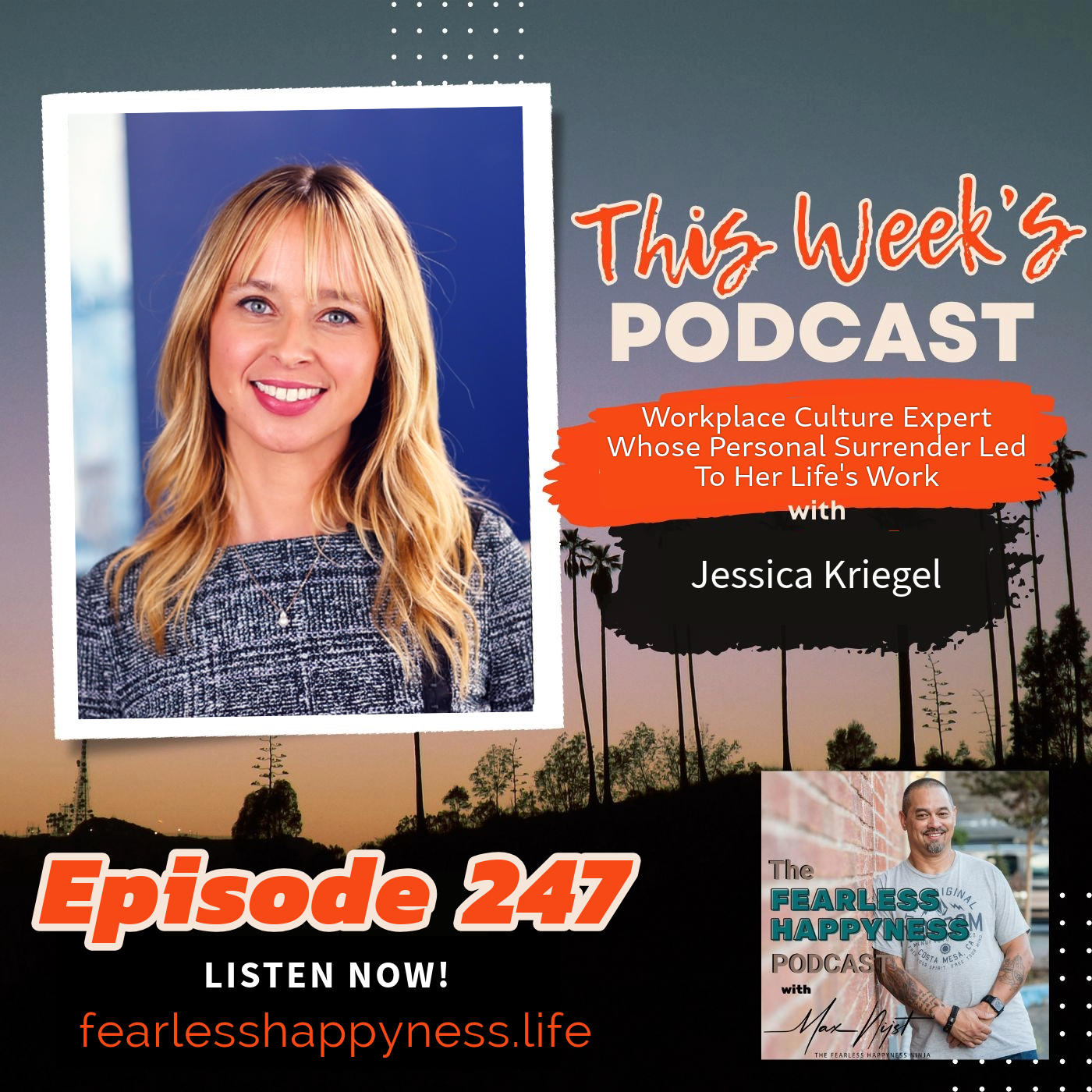
In this inspiring interview, Jessica Kriegel shares her journey of surrender, leadership, and personal growth. Discover how embracing surrender can unlock potential, improve workplace culture, and lead to greater success and happiness.
https://culturepartners.com/about/bio-jessica-kriegel/
For More From Sober Coach/Substance Abuse Counselor Max Njist, visit MaxNijst.org
Max Nijst: Welcome to the Fearless Happiness Podcast, where we showcase phenomenal individuals who have overcome serious traumas, life obstacles, and challenges to find their own path to fearless happiness. Listen as Max Naist invites guests from all around the world to share their experiences and spread strength, hope, and faith. This is the Fearless Happiness Podcast. And this is Max Naist. Good morning, good afternoon, or good evening wherever you are in this world. This is Max from the Fearless Happiness Podcast. Yes, I'm gonna say it. Coming to you again today with another amazing and special guest. And today I have Jessica Kriegel with me, but I'm gonna have her introduce herself. What I like to do, Jessica, is have you introduce yourself, like who you are, what it is you do, and then you and I, like I said, we're gonna rock and roll. Excellent, beautiful. Well, thank you so much for having me. It's an absolute pleasure to be here. I'm a big fan. â so I am the chief strategy officer at a culture consulting firm called Culture Partners. So I help CEOs drive results by activating their change. And I'm a keynote speaker. I'm also an author of an upcoming book called Surrender to Lead. And when I'm not doing that, I I volunteer as an end of life doula and I'm back in school now for what feels like the eighth time doing a masters in divinity. Wow. So you wear a lot of hats, it sounds like, and â you keep yourself busy, but in a good way helping others, right? At the we'll get to the end of life doula, right? Because it sounds like you help people get ready to cross over to the other side so that right, 'cause some people could be very I know for me, I'm not afraid, right? Like I've I've gone through my thing back in the day where I'm like I faced death. Not literally, but you know what I mean? Like what I was doing to myself. And now it's just like the faith has grown and it's like, okay, when that time comes, I'll be ready to go. So but let's start at the beginning. What I like to do, Jessica, is like go back and talk about some of those challenges you have faced that have shaped and made who you are today. Okay. Great. â if earlier in my career you mean? Career, childhood, teenage year, whatever you want to talk about. â well, I mean, let me just say so my to heh, you're how far back so you wanna go. Here, you know, I thought I had a really perfect childhood because my parents encouraged me to be as independent as possible. And that looked a little bit more extreme now to hindsight being 2020, looking at how I was raised, I don't know that I would have made some of the same choices that at the time I thought were really great. For example, when I was five, my parents put me on an airplane to France by myself and sent me off to go spend time with my cousins and my aunts and my uncles there for a month. And then I did that every summer. And you know, I remember being really afraid. I mean, talk about fearless. I was full of fear because I'm on a plane by myself. I arrive and there's my I guess an uncle I've never met that's picking me up and he's like, Hi, I'm your uncle and I remember thinking, I really hope that's true. And you know, there were there's always the I think that when you go through the fire, there is always something to learn from it and there's a a maybe a silver lining is a cliche way of talking about it and The silver lining was that I became super fiercely independent and very, you know, maybe overly confident, maybe cocky, a little bit narcissistic. Like it was all like, I got this, I can do everything, you know. And that mentality was how I did my work. It's how I led in business. It's how I was in my personal life. I wasn't volunteering because it wasn't there was nothing in it for me, the way that my mentality was at that time, right? And â that led to a pretty significant breaking point when everything fell apart for me because there's so much only so much striving that I could do before everything fell apart. And â that falling apart was the greatest gift for me personally at a spiritual level. I developed and grew in a way that I didn't think was possible. And then at a leadership level, the same thing actually happened. And I ended up being way more successful when I stopped trying to be successful. And that's really the inspiration for the book and for everything that we do now is is helping people â find their own moments of surrender so that they can unlock their potential. See, I love that, right? Because I was taught and it didn't jive with me at first, right? When I so I'll go back a little bit for so you get when I first got sober, I would hear surrender to win. And I'm like, You're talking to someone who came from a background like or from where I just came from, where surrender is not in your vocabulary. I'm ex-military, right? Where we don't talk about surrender. No, never surrender. Right. Never, right? And you you go until you fall on your face and even then you don't quit, right? But then it was taught to me, it's like, you know, in a spiritual way, you surrender to win, right? And in that surrender. Like you said, I think you said something that was that hits home for me is like there's a lesson in those surrenders or in those falling down and as they say, failing forward, right? As long as we're willing to learn something, it's really not a failure in my book. It's just part of the process, right? And you being in a leadership process â in a leadership role, right, there's gonna be moments where Okay, that didn't work. That sucked. What do I do next? Right. But what did I learn from that? So I can do something different, right? And I use like my role as as father, husband, and grandfather, right? I'm always like, â that didn't work. I need to try something different, right? So how what I'm getting at is like in those moments, how were those lessons, let's say, presented to you where you said, okay, my old way wasn't working, but I learned this. So let's try something different. And you know how that's how success is done, I think. Yeah. And it's interesting that you had an aversion to surrender. I think that's pretty common, especially since I wrote this book and started talking about it more. A lot of people see it as giving up or waving the white white flag. I did not have that aversion to surrender because my bottom when I got sober was so low, emotionally low, not, you know, materialistically low necessarily, but it was emotional low. That I was I was ready to do anything different than what I had done before. And so then when people were telling me to surrender, I was like, Great, I have no idea what that means. Like I'm willing, I'm open, but tell me how to let go because it feels like I've spent my whole life doing and now you want me to not do. And I can't just stop doing because every moment of my life was filled with doing. And that's something we call the action trap. So many people get stuck in the action trap of, you know, they want to achieve some result, especially in business, right? And so they focus on actions. What action do I need to take in order to get the result? And if I'm a leader, that translates to what action do you need to take in order for us to get the result? Kind of trying to get everyone to do what you want and be the way that you think it should be. And that doesn't work. I mean, it it actually does work. It works a little bit. We studied this with Stanford. Companies that are stuck in the action trap that have leadership in that mentality, they grew on average in our study over the course of three years by 10%. So it does kind of work, which is why it's seductive. You see progress, slow it is, and you're like, it's working. I just gotta do more, right? And then, but companies that were not in the action trap that had surrendered leaders, they grew 42% in the same three years. So your your potential is put maybe four times. Greater growth if you surrender, which is super counterintuitive. And so, â in my moment of surrender, what I realized is that it it was, I mean, going back to the military, it was all about controlling the controllables, right? Right. What is in my control? And this Navy SEALs are really good at this. They control the controllables, right? When the enemy chopper, with the chopper's going down an enemy territory. They're not like wishing it was different and blaming the pilot and then like looking at the ground and being like resisting the ground coming closer to they're just adapting. They're in that moment, ready to control the controllables, how they react. Right. So when you focus on what you can control, which is really just yourself, well, then you've you've surrendered. All of the things that are outside of your control, all the other people that you wish were different, all the circumstances you don't like, all the outcomes that you or thought you would hit but didn't, right? And that that is the surrender that helps leaders win. I love that, right? Because that's what I learned in my recovery, right? The more I surrender and just let go as a, you know, I let go, like God, and I'm gonna do what I have to do, right? Instead of Control like say I'm I'm just gonna say I'm not pushing any twelve steps here, but like sometimes I would early on I would be like, the meeting's gonna go the way I want it to go or it's not gonna go at all, right? Yeah in my head, right? But it always would turn out different when I would just go, let it happen, Max. You know, my sponsor would say, You'd never pass up a â an opportunity to keep your mouth shut. When I learned that, I learned to be a better leader when I did that, right? And the results and like you said, control the controllables. When I figured that I couldn't control the drugs and alcohol anymore and I surrendered that and I'm like, I'm done. Life, you know, obviously got better. Twenty-two years later, I'm sitting here and I'm having a great conversation with my new friend Jessica. And we're talking about leadership and surrender, right? Which 22 years ago, if we would have had this conversation, he would have like, I'm out, Max. You know, you're not getting what I'm trying to tell you. Right. Cause Right? What is that? You either want to be right or you want to be happy. And I choose to be happy today. So surrender is a big part. And especially being married, there's times I just have to throw in the white flag and go, Whatever you want, honey. And Yeah, we all do. Right. Exactly. Right. But I will or when I'm having a little discussion with my granddaughters, right? And they You're right, honey. You know, it turns out you know what my you want to know my line in those moments when even someone at work, I say, you could be right. You could be right doesn't admit that they're right, but it is just you know, you could be right. I mean, you know, who knows? See, I'm gonna use that. See, I learned something new today. Instead of saying you're right, I can say you could be right. You could be right. And then I'm gonna walk away and let them think about that one. Like what do you just say? But â you know, as as you know, this this thing called life and and business, it's a journey, definitely of a and you said former military, like people I know I read books. Like from David Goggins, right? That says, learn to get comfortable being uncomfortable. And I know there's people, and I'm sure you do too, that have that hard time just surrendering and going, I'm gonna let it go the way it's supposed to go. Or, you know, and see what happens, right? Because there's people I I'm sure you know and I know, they just love to have that tight grip on whatever they're doing, whether it's a conversation with you or work you're doing together. How do you handle that when that pops up, right? I mean, going through what you've been through and learn that surrender is a good thing now, right? It's helped me grow. It's helped you grow. And how do you handle that when you Well, I mean, it's a great question because I I actually think in corporate America it's a it's a pandemic. These are fear-based systems that we are operating within, right? What I mean by that is. You can have a company that's doing really well and their HR leader has their mission vision values on the wall. Everyone's talking about teamwork and unity and we're all in this together. But the reality is we are in a structure that is a pyramid shape and there's more resources at the top for fewer people, which means we are in competition with one another within a company to move up. And that means that in order for me to be okay, I need to be a little bit better than you. And that creates the fear-based mentality. And there's also a lot of pressure to produce results more than ever before within a frequently confusing environment. You have AI, you have tariffs, economic uncertainty. So much is changing, and we have to be able to change within these changing circumstances ourselves, right? Absolutely. Well, how do you do it? So the first thing is you have to In and this can be an intellectual exercise, understand that you do not have control. You have to release the illusion of control. And a lot of leaders think that they have control because they have a big title and a big paycheck and they've got people reporting into them on the org chart. They walk into the room thinking you all report to me and therefore you have to do what I want. And if it was that simple, we wouldn't need any more leadership books because everyone would just tell their people what to do and they would do it. And that would be the end of the conversation, right? Right. But obviously, I mean, how many times has your boss told you to do something and you haven't done it either because you didn't understand it, you thought you were doing it and he wasn't it wasn't the way he expressed it, you were checked out and didn't want to do it, you were already looking for another job. Anyway, I mean, you know, there's all these different circumstances. Right. So one is figure out that you're not in control. And then you gotta figure out, okay, well, if they don't really report into me in practice, they just do on paper. How do I get people to do anything? Right. As a leader, your job is to create movement. How do I create movement? And how do I do that through surrender? So you have to get out of the action trap. So you gotta ask yourself, what is it that motivates people to to take action themselves? How do I get Max to want to do whatever it is I'm trying to get you to do. And the qu the answer is, well, it depends on what your beliefs are. You have a bunch of underlying, deeply held beliefs about what's right and what's wrong, what's worth your time, what's not, what you like doing, what you don't like doing, right? Those are your beliefs. And you are going to act in alignment with your beliefs. So if I want you to act in alignment with the results I'm trying to get, have you take the actions I want you to take, I got to make sure that you believe in it. That your beliefs align with the actions that we need you to take. And so how do you do that? Well, I can't get you to think differently than you do. I can't just, you know, manipulate you into believing something else. Right. But then you gotta ask, okay, well, where do our beliefs come from? All of our beliefs come from the experiences that we've had. Right. So you've had a series of experiences that have shaped all of the beliefs you hold now. And if I want to shift your beliefs, then I need to create new experiences for you. That will shift those beliefs, right? Because all of all of our beliefs come from experiences. And that's something I can control. I can control the experiences I create for you. And by doing that intentionally, then maybe your beliefs will shift to be in alignment with the actions to get the results that we want. Right. So a classic example right now is we got AI coming and a bunch of companies are trying to become AI first and they're trying to implement AI internally and they're meeting a bunch of resistance and They're scratching their head about it. Well, what are the beliefs that people have about AI? It's gonna take my job. It's potentially going to kill us all, right? I mean, some people believe that. Right. They beat back to Terminator, right? Like, â there it's coming. Exactly. So here's my manager who makes twenty thousand dollars more than me, who I should have gotten the promotion, not him. And he's like, please start implementing AI in your daily work processes. I'm like, dude. Thank you for the direction, like absolutely not. And then you wait and see and you just avoid and you you know, whatever it is that you do to avoid taking the action that you need to take. Right. This manager has got to get me to believe that implementing AI is not going to cause my impending death or my loss of job. Right. Right. You can shift that belief. Well, then if I start to believe AI is good for me and good for us, and then I'm like, okay, actually I want to learn everything I can about AI. Because this is gonna help me. Right. And then now I'm not only doing what you said, I'm offering discretionary effort. I'm being proactive. I'm going above and beyond. So for leaders, it's really operating at the belief layer and understanding what the beliefs are that your employees have and how you can influence a shift in those beliefs is how you get them to take action to drive results. And that's surrender. Right. And that's I love that you you brought that up in. share that right because if you don't change the belief, right? If they're if you want them to do something like we just talked about, right? Say the AI thing, but all they have in their head and what they see is it's gonna take my job and then Terminator's coming one day would and they won't need me anyway. So why should I do it, right? Yeah. Right. And that's the tricky thing though is to go, no, this is here to help you. Because I know When AI first came out, I was that guy. Like I'm not gonna use it because one, I work in a field where I don't think it's gonna help. But then I find it it actually can help me be very more â a lot more productive when it comes to the paperwork and stuff I need to do. But at first it was like, how is this gonna happen when I were like for me and so I have a lot of human interaction, right? Like I how am I gonna do this? But then when I learned that it could be very helpful. That it helps in my documentation, you know, because I'm not an English professor, but it helps me make me sound like I'm an English professor. Right? You start to go, â hey, there's something to this. But you know, you know, and I know there's people out there. So how does that, you know, how do you help someone change that belief? Let's say someone who's been in their position for years, right? And has been there 20, 30 years and has done it. And they're experts, right? I mean, yeah. So let me I'll tell you a story to bring it to life. And this was with â medical center that we were working with. It was a hospital. They had an emergency department, and we were working with the head of the emergency department. And in healthcare, there's this tension between data entry and administrative duties, and then patient experience, right? So how do you get people who are super focused on patient experience to do the day paperwork, right? Or how do you get the people who are super into paperwork to care about the patient experience? It's that back and forth. Right. So when we got hired, â we always start with results. What is the result that you need to achieve that you're not currently achieving? And she was talking about this tension. And we said, give us an example, just one one kind of data entry point that's being missed. And she said the next of kin information is not getting gathered when people come into the emergency department. She said they're only collecting it 42% of the time, so less than half. And she had tried everything, right? She had tried training everyone on the form. She had tried mandating the form and having a policy, implementing some technology that would simplify the form. She tried translating the form. She tried incentivizing people to fill out the form with a pizza party. I mean, â all the things that leaders do, which is the action trap, like what do I gotta do to get the result? And that was exhausting her. It was exhausting the team and it barely moved the needle after six months of effort. She was only collecting the next if kin information 47% of the time. So it worked a little bit, right? That's the thing. It's like sometimes the action trap can be seductive because it kind of works and you think you just need to keep pushing to get there. Right. And so when we came in, we said, okay, let's back up. You're you're in the action trap. What are the beliefs that people have about the form? That's what we have to understand. And the belief that they had about the form was that this form is a waste of my time. You know, people are coming in with gunshot wounds. These are the first responders. They care deeply about the work that they're doing. They're not like lazy millennials who just don't care about paperwork, right? They just think they don't have I don't have time for that form. I'm trying to save a life right now. Right, right. So then We figured that out and we said, okay, well, what is the belief we want them to hold about the form, the shift, the change that we need to activate? And the the belief we wanted them to hold was that this is a critical form. This is a critical form to our process, right? In order to save lives. So we helped her identify two experiences that she could create and they're just telling a story. Like one of the most powerful experiences that we have at our disposal is storytelling because we're we're very moved by stories. That's why Hollywood makes so much money. It's why people podcasts, right? So â she told two true stories to everyone on the team for three weeks. The first was about a woman who came into the hospital. They did not gather her next of kin information. She fell unconscious. They did not save her life. She died. And they later found out that if they had known something about our medical history, they might have been able to save her. Second person comes into the hospital. It's a different time, same hospital. It's an older gentleman. He comes in. They do gather his next of kin information. He falls unconscious. They call the daughter. The daughter tells him about something that happened three weeks ago. They save his life. She told those two stories for three weeks, and in three weeks, they were gathering the next of kin data 92% of the time. It's like, as soon as you get people to believe. They will do the action that you want them to do, but they've got to believe in it. You know, it's like how do you get people to care? That's how you get people to care. You surrender to the fact that you cannot just s hammer them home with please fill out the form. It just doesn't work, you know? Right. You can create an experience that shifts their belief so that they will choose to do it. And that's that's how. And that's sounds like what we need to do. in the workplace today is shift that that thinking, right? Because you know and I know that's how I was taught. Work hard, work hard, action, action, action. Don't ever sit around, do nothing. You always gotta be doing something. Blah blah blah. You know what I mean? And it'll drive you nuts because you take a second break and â am I going to get in trouble for taking a two minute break or you know what I mean? Exactly. And so we it's it's obvious in your personal life, right? I need to take time to step back. I need to process and whatever. But then at the workplace we get there and we're all in competition with each other. And the manager has all these high expectations and things are changing and we gotta go, go, go. We gotta get to the number. And so people just default to the action trap without realizing that's not actually the way to reach your full potential. Right. And I love it. I can I can liken that to being a counselor, right, in the addiction field is Like I can't tell them, hey, you gotta just keep doing this, that you know what I mean? They're gonna look like you're already worn me out. I I haven't even left my room yet and I'm tired because you tell me I got all this stuff to do. But like they say, when you can disclose appropriately and and tell a story like this is what this is gonna look like if you do this, right? And they have some skin in the game because they go, â if I do this because he's done it, my life's gonna get better. Instead of telling him you have to do this, right? Well, and I have some mentors back in the day that said, You have to do this, Max, you're gonna die. Right. But I I loved my sponsor because he always suggested and then he would share stories like like he sold me on recovery, basically. Yeah. Well, the whole recovery program is based on the idea that I'm just gonna tell you about my story. And you're gonna have an experience in listening, and it may shift your belief that maybe what I did could work for you, you know. But if I showed up on day one and said to a new person, hey, listen, here's what you're gonna do. First of all, you're gonna start reading this book that sounds like garbledy guck because it was written in the 40s. And then you're gonna call me every single day and you're gonna go to, you know, right. Okay, back up, dude. I don't even know who you are. It just doesn't work. But that's how we operate in the workplace. Right. In Dad, we share our story and people who are interested, great. And then when you sponsor those people, â you know I'm not telling them what to do ever, you know. I'm just saying, like, here's what I would do. Have you have you prayed about it? You know? And it's it's a super surrender. Sponsorship is a super surrender practice zone too. Right. I'm right. Cause I always call my sponsor, you know, and this is not a recovery podcast for everybody, but I call him my Yoda because he would do that. He would tell me stories and use his Jedi mind tricks where I'd say, I'm not doing that. And then I would find myself doing it and go, Dad, did it again. Like I did it. Yeah. Right? Totally. But I love it because I think, you know, if I had a like you said, if I had a hardcore dude saying, Here, this is what you're gonna do, dude. And if you don't do it, I can't work with you and blah blah, you know, I've seen that. I probably wouldn't be sitting here with you because I would have like, Okay, it didn't work. I'm out. I'm going back to where it used to be, right? Yeah. And you know, for people who aren't familiar with the world of recovery and sobriety and all that, when you see someone who has an addiction issue or alcoholism and you want them to change, this is when you need surrender more than ever, right? Because you can't for the emotional appeals seldom suffice. You can't be like, please, don't you see how it's hurting us and we want you to get so it's like that's not it. All those interventions, if you've ever seen the show intervention. Right. We're like, we love you. Now if you don't go to recovery, here's what I'm going to do. I'm going to kick you out of my house. I'm going to turn off your cell phone. I it's all control the controllables, right? Right. I control what I do and then you can operate in your world controlling what you do based on what I've said about me. It's it's like the number one skill set in recovery, which is, you know, I'm in recovery. So it's not a coincidence that I wrote this book because I applied those tools in the workplace and they worked. I mean, we've had We've had departments of corrections, like state departments of corrections, that have homicide suicides in the workplace. Right. That have massive attrition. People are constantly turning over because who wants to work in a place where you're being killed by your peers? Right. Right. And within a year of applying the surrendered leadership philosophy, safety incidents went down, turnover went down, engagement went up. I mean, all of the outcomes and money reinvested also went back up. And that's in a prison environment, which surrender is like the opposite of the way their minds work. But when you gave them the tools, when we gave them the tools, everything changed internally. They're now currently going after the great place to work title, which is it would have been unheard of a few years ago. Right. Well, especially in California, right? Because that's just would have never happened. But thank God there's people like you. And see, I love this. how it shows up, even though you know, and it just relates to everything that we it can help us in life, it can help us in business, right? These principles that Jessica and I know they work. Yeah. Big one of surrender works. And it doesn't mean you're weak. It actually tells me you're strong because what it tells me, like when Jessica's telling me she's learned to surrender and right, this is how I changed like a workplace's belief and When she goes through it, I'm like, Man, I relate to that because When I stop thinking, right, that I am gonna rule the as I got told, rule the world from my high chair. It didn't work. Right. That's a great line. Right now, I've had a couple of my mentors say, Max, get out of your hair â high chair and stop ruling the world from your high chair because it's not gonna work. And I'm like, King baby. Yeah. Right, King exactly. So, but this is how it rel you know, I mean What we're talking about today, everybody, relates to and anything we do in life. It could it could help us in our our personal lives, our business lives, and if for those in recovery, our recovery life, or anything, when you know the real purpose of surrender and how that truly helps us stop trying to think I'm gonna get the outcome I want because I'm going to control what. Jessica does, right? And would this wouldn't be a great â conversation if I came into this conversation going, Jessica, you're gonna do this because I want you to do that. I want to talk about this. She she might have told me, huh, we'll do this another day, Max, because that ain't gonna happen. Or she might have surrendered, made me surrender and go, Look, we're gonna have a great conversation. And we are, but Yeah, totally. I mean, so I'll tell you another story that was a good one. â Ocean Spray, they had this really bad plant, their costs were super high, and there was very tense union hostilities. So the managers and the unions just like could not get along, and they hired a new plant turnaround guy and basically said, You got six months to turn this around, and if you can't, we're just gonna shut it down. So he comes in and he just observes what's going on with the unions and at the plant, why the costs are so high and why there's so much animosity. I mean, the unions really could not stand. you know, the the or the employees, right? The ocean spray management team. And so he comes in and on day one he realizes so the shift schedules, you know, usually there's 12 hour shift schedules. And these guys were coming in at two o'clock in the sorry, six o'clock in the morning. And they're coming in, it's in Wisconsin. So it's cold, it's dark, right? The managers haven't shown up yet. They're not coming till like nine o'clock. But the Frontline workers, the plant workers, all have a designated parking area, which is a quarter mile away from the factory. Whereas the managers had reserved manager parking right there. And as they're walking to work in the morning at 6 a.m. past all the empty parking spots, that resentment was just growing. It was just one of many experiences, right? So this guy comes in and on the first day he calls everyone outside. He gets a chainsaw. And he chainsaws down the reserve for manager parking signs. And he throws the chainsaw down and he says, park wherever you want. And then he walks back in. It was this super powerful experience, right? That was bigger than the parking policy. If he had implemented a new policy in which people could park anywhere, and then they sent an email announcing the new policy, there would have been some goodwill built there. But he was creating an experience to shift a belief. And the belief is I don't think I'm better than you. And we got to change things around here. Right. And it set the stage for the turnaround that eventually made it the the number one producing plant in the entire company. And the union hostilities completely died down and they have this wonderful workplace culture. But it's like that guy could have come in and said, listen, you guys got to show up on time. You need to stop trying to protest or whatever. Right. That just doesn't work. Right. Well, especially like you said, at six in the morning and it's snowing and you walk by. He's right. That's I love that story because that had to have been huge when when they saw him sh, you know, cut that down and go park wherever you want, they're like, â you just like cool. This guy's different. Exactly. Now we'll sit down with them and talk about how we can make this a better place. Cause you what he did is he made the playing ground even for everybody, at least when it comes to parking, right? And then when you don't have to walk. A quarter of a mile, like they say, like our grandparents, right? I used to walk to school a mile in the snow and a mile back and blah, blah, blah. You know, I love it. Just I mean that's how you can kind of start as a leader is do an inventory of yourself. Like what experiences have I created for the people on my team, and what beliefs have that led them to hold about me? And what do I want those beliefs to be? And what experiences do I need to create in order to shift those beliefs? You know, that's that's a really powerful starting place. You know, and I love it. And you and I will hopefully have a conversation after that because I kind of see that going on where I work, right? Or it's one of my clients, but as I I see the staff and it's split down the middle, right? You got clinical and operations and operations. The powers that be. And if they hear me, sorry you don't like it. You know, think that everything revolves around operations. And if it's their way or the highway. And me coming from both backgrounds, because I didn't start off in clinical, right? I've started off as a I I'm thinking to myself, there's got to be a better way to make this work because there's a lot of I see it. There's a lot of animosity. And I get both sides because I've been on both sides, but I'm trying to think to myself, how am I going to change this so that people go, â I like what they have to say? â and I love what they have to say. This is what's going to make our place a better place for everybody. Cause right, it's about it's almost like customer experience, right? It's how are we gonna provide the best care possible, but we can't do that because we're always bickering with ourselves. You know what mean? Yeah. Well, so let me give you a suggestion. So First is go to the other team, whichever side you're on, and say, Can we spend an hour, two hours just talking through all the ways in which I could support you better? And you come from a place of love. You come from a place of love the way Thomas Aquinas defined it, which is to will the good of another, not any other type of love, right? Agape love. And you say, I just want to serve you better. I need to know how I can do that. And you spend just two straight hours workshopping, asking questions, ask for feedback, and then take that into consideration and execute upon it, right? Do better according to what they said they need. Now, what experience are you creating for that other team in that moment and what belief are you going to drive? Like, first of all, wow, thank you for asking me this question. That's very wonderful of you. And then It may occur to them to say, can I can we, you know, I'd love your feedback too. How can we help? Right. And then we're both coming from a place of service. Instead of being like, listen, operations team, this is what we're not getting, which is how we usually approach when there's departmental silos. It's pointing fingers at here's why you are failing me. Instead of, I want to know more about how I'm failing you so that I can do it better. And then full stop, right? Cleaning your side of the street. How do you just Ask how you can serve better and see what happens. It'll probably unlock something remarkable. Yep. I agree. And I will try that. Even though I'm not I wouldn't say I'm in a management position anymore. I'm kinda in the background now and and just helping with that client care, making sure we get them the days they want. But both sides come to me and ask me how we can make things better. So that's I'm gonna do what you just said. I'm gonna say, Well, how can I serve you better? How can I, you know, do better for you? And then Yeah, that's a whole other conversation. But I I love where you're coming from, right? Because we we come like they say from the back. We both come from that same s school of thought where we, I like to say, grew up, right? Yeah. To learn these principles and and right. Ultimately, like you said, it's gotta be you gotta come from a place of love and compassion first and foremost. And how can I serve? And then I think if you know how to do that and you really are practicing that, then you can do the surrender right and and change the stories wherever you are. Like I like right now it's my family. Like I wanna create, you know, this environment where my grandkids don't just look at grandpa and go, Ooh, I don't know. You know, he's in a bad mood today. Can I â go and talk to him? Yeah. I want them to go. I don't care if he's in a bad mood, because he said I could talk to him anytime, right? And come yank on my shirt and go, Grandpa, I gotta talk to you. but what you've taught us so far, right, like is amazing because these are life lessons and it's not just for business. I I you know what I mean, like the surrender part we could use in our everyday life. And I think, you know, and you see it, the craziness in the world that's going on today, especially in our state. I mean, you can't help it, but I wish some of the leaders would do the same, right? Would go, I'm gonna surrender my result. I'm gonna surrender what I think I need to do. And I'm gonna let the people and all of us come together collectively and make this a better state, right? But that's another podcast. But let's dive into your book. I know we've been talking about, you know, surrender and leaning and stuff like that, but what was that? moment when you said, I'm gonna take everything I've learned and turn it into a book and I'm gonna help people. Cause it doesn't sound like it's just a business book. Like it could help anybody in their everyday life. Yeah. I mean, so I had this personal awakening, you know, where I did surrender at a at a personal level. And then I just started applying it in my job. I mean, it was just a very internal decision that I had to show up â in this way everywhere that I operated. And so â at the time I was the head of HR for a technology company and I had just gotten the job and very excited. It was, you know, growing organization. I was the CHRO and on my first week we had a board meeting and the board let me know that we needed to cut twenty percent of the workforce. â wow. I know. So here I am having this spiritual awakening and I've now got to lay off 20% of the people at a company I just joined. And I was bummed to say the least, right? No one likes laying people off. Right. â but I was also really focused on doing the next right thing. And so what it felt like to me is that I could not control. the decision to lay off the 20% of the people. As the CHRO, it wasn't my call. It was the board of the CEO's call and they made that call. So to to fight reality would have been to argue with them, right? And it really would have probably just gotten me fired. Like we need you to play ball. We don't need you to argue with our strategic decisions and direction. Right. Right. So this was in 2019 or tw 2020. They had just â signed Class A office-based lease in the Bay Area and then COVID happened and then there was no one in the office. So we had these big expenses. I mean, we were a little bit upside down as a company, right? So, but how do layoffs usually happen? Layoffs usually happen in secret. You lie. To the workforce, you act like everything's fine. You meet in private to discuss how many people you're gonna lay off, which people you're gonna lay off. You get the financial analyst to come in and show you spreadsheets of okay, you've picked seven people. This is how okay, now you picked 30 people, okay. Now this is how, and you kind of play with the numbers until you figure it out. Then you organize a communication plan where you keep it all a secret, you loop in the IT guy. So on the day of You drop the axe, you let everyone know in a joint Zoom call, you disconnect them from Slack, and then you deal with the fallout. And all of the trust has been broken, obviously with the people you let go, but also with the people who are left behind that didn't see that coming. And then they're worried about, am I next? And that just couldn't that felt like the opposite of surrender to me. That felt like controlling a situation and manipulating people through secret keeping. And even though it's the way It's always done at every company. It it just didn't feel right. So I decided I was gonna walk through the front door and I was gonna tell everyone at the company that we were having layoffs and we didn't know when and we didn't know how. We didn't know who. And we were gonna figure it out. We would keep them informed. And I just announced it. Like, here's the truth. Let's see what happens, you know? Right. And â here's what happened. First of all, there was a lot of conversations. There was people who were worried and they called me and they wanted to talk more, right? Right. And then people just started to work, get back to work. And then some people started to look for jobs, right? And then some people got jobs and they left. And by the time we had to execute on the layoffs, the company had right-sized itself because people left on their own terms. Right. People who stayed behind stayed because they believed in the company or they knew that they were top talent and they didn't want to give up and or they were confident that they'd be able to get something. And we didn't have to pay any severance. It was better for the shareholders because ultimately we saved money doing it that way. And there was no broken trust. If I called any of the people at that company today and I said, Hey, would you join me? â you know, I'm recruiting at my current company, will you come over? They would come. Because it's so rare in business today to have leaders who are willing to be transparent, even if it might mean bad news for me. Because the risk I was taking is that I would lose the people I didn't want to lose. Right. Right. Right. But ultimately the goal of the exercises was to lose people. If you lose this person instead of that person, you know, I was willing to be inconvenienced to live and lead with integrity in that moment. And when I did that and I saw how much better we were off. for it financially and emotionally, that's when I was convinced and said, Okay, we gotta I gotta share this because this is not how people are operating right now in business. No. I and you're so how many times have you heard that where people walk in and they get that paper handed to â you've been laid off. You know, especially after two years of hearing we're all family, which is total nonsense. I mean, it's just crazy. Right. I mean, I would rather have someone like you come in and say, Hey, look, I'm not gonna beat around the bush, but we're gonna have layoffs, but I'll keep you informed of when that'll happen. Cause then like you said, it gives me the power to go, okay, I'm gonna go right. I can take a look at myself. Hey, am I that good of a worker where I think I'm gonna stick it out and I'm gonna fight for this? Or â maybe I haven't been doing so great. I'm gonna go look somewhere else and, you know, or start my own thing or or whatever. Right. But â At least you knew the truth and you could make that decision through your own free will. That's I love it, right? Because that's what I love. And I bring it back to recovery because this is how I relate, right? My sponsor said, I don't care what you do, but you gotta be honest with me, one hundred percent, or I can't help you. Right. 'Cause if I'm lying to him, how is he gonna help me when he doesn't know the truth? Right. When I came to him like whether it was brokenhearted or defeated and I'm like, This is what happened and he'd go Okay, we're gonna put this plan together. This is what's gonna get you through that. And when I follow the direction, I'm like, wow, that works. That worked. You know, that works. And and and and that's how I try to that's the legacy I wanna leave my family, right? Yeah. Kids and grandkids is that integrity thing you integrity thing, integrity thing you just talked about, right? Because I want my kids, grandkids, great grandkids, and everybody around me to go, you know, Max. or grandpa or dad, when he said he was gonna do something, he did what he said he was gonna do when he said he was gonna do it. Right. Because there's a lot of times I've I've been in work situations where they told you one thing and it was totally the opposite and you got blindsided and you're like, wow, that stung. Yeah. But that experience creates the a general belief that leaders can't be trusted. And that's what we're dealing with, you know. So you have to focus on creating experiences to reinforce that you can be trusted. And that's what I was doing. Right. And I'm I'm hope you're paying attention, everybody, because this is ex extremely valuable what â Jessica is talking about, right? Because if you lead â you know, with integrity and honesty and and you know, you don't try to control the things you can't control. And you surrender, like life is actually pretty good. I mean, we're all gonna have moments, right? We can't help that because life happens, right? Like they've you've probably heard in the rooms, right? Like, you know, my job is to stay sober and you know, I'm as I'm doing my job. God, how's it going? So I just went blank. See what I mean? Like that's why I don't send you a lot of questions, Jessica, because my mind goes blank and but â what I was getting at is that â you know, I stay sober while I'm doing my job and and In my sponsor's eyes after my last relapse, that was he meant that I was gonna be of service whenever that opportunity popped up. Not just in the meetings, not just at home, but I could be walking down the street and someone needs a hand lifting something, you know, just be of service because he goes, You gotta learn to be selfless. Yeah. Right. And but then I've read books and I I've learned a lot about being a servant leader, right? Where I'm not always in the front. Where I'm bleeding from behind, right? Cheering on my team, going, Hey, this is, you know, and then if they ask me what I would do, then I could tell them, or they say, Hey, we watched you do this, Max. This is how we're gonna do it. I'd say, Cool, let's do it. Right. And it's just conscious it's a conscious decision, right? I mean I I'm not just naturally selfless. I don't volunteer because I, you know, it just comes to me. I it because It works. And I, you know, I decided that was something I wanted to do. I started doing it and it was uplifting and it made my life feel more purposeful and meaningful and rich. And so now I keep doing it. It doesn't mean that on my way to the homeless hospice where I'm an end of life doula, like I'm not sometimes feeling like, â right? Like I'm gonna go hang out with people who are dying. It's not fun. You know, I mean fun's not the word, right? But it's it makes my life so much more important and that I like feeling like what I'm doing is important, not necessarily just making myself happy all the time. I tried making myself happy all the time for decades. It did not work. Well, that's why I knew this was gonna be a great conversation and I was gonna learn so much from you because right, like this is what I want you to understand, audience, right? Is It's okay to be selfless, right? To work on being more selfless. Because in the end, how rich am I really? Right? If I've done that and I know when my days are coming to an end. If I can look back and say I did my best, like I followed Jessica's lead, right? And we we went out there and we helped people and whether it's in the workplace or at home or Jessica being on my podcast, like I can die with a smile on my face because I don't ever have to look back and go, wow, I was the Grinch over here. I was a Grinch over here, right? Or and you know, and this is why I love what I do. And this is why, you know, I'm glad I listened to my mentors when I started the podcast and had that little like Voice of God in the back of my head saying, no, it's not going to be just an addiction recovery podcast. You're going to bring whoever I put in front of you. And I'm like, â okay, I can do that. Right. Because I've had like with you, this is one of the best conversations I've had. And these are the great conversations I have every day. And I'm not saying if you're listening that I don't have it with you, but these are people that I love having on the podcast because they share, I like to say, their experience, strength, and hope. wherever their backgrounds from with the world and they're here to help us all live better lives. So I appreciate you doing that, Jessica. It's been a you know, it's been an awesome time, but we're not done yet because I get to ask you questions. And normally I point to my back and say, look, see the fearless, right? But my backgrounds didn't I didn't download â today. But we're gonna start with fearless, right? Okay. What does fearless mean to you, Jessica, today and how does that show up in your life? Going through what you've been through. Well, I think that w y the opposite of fear is love and you know, willing the good another of another. So fearless is full of love. And when I come from a place that's full of love, then I, you know, experience a lot less fear. Absolutely. Right. And then courage follows shortly after. I love it. Yeah. So then I'll add the next question, happiness. And normally you see it, but I don't it I put a Y in it. I'm sure you know that. Yeah. Knowing I put a Y in happiness, what does happiness mean to you today? And has how does that show up in your life on a daily basis? to me, happiness is elusive a lot of the time for me. And I I think I spent so much of my life trying to seek happiness. And now if it I it's a gift. When I get to be happy, it's a a gift that I feel a lot of gratitude for. And otherwise I'm not really bothered anymore. You know, for me, happiness is kind of an a a symptom of doing meaningful work. And so I focus on doing meaningful work. And if I get to be happy along the way, fantastic, you know. But you know, I'm an alcoholic. We don't feel happy all the time. Right. I mean, but look, look what you're doing now. Like you're bringing You're bringing joy and happiness to places that most people don't see it happening at anymore, right? Because you're bringing that leadership style of surrender, which means people could be their people can be themselves and not have to worry about what I look like in front of somebody else. As long as I know I'm doing my job the best I can and I don't have to put on this facade, right? 'Cause like you said, us alcoholics are right. We're not always happy, but I'm happy today because I have Jessica on my show and she shares some really good nuggets with all of us. So you heard her, everybody. So if somebody wants to get your book when it gets out, right, or they want to get a hold of you and talk to you more about leadership or just ask you questions, how do they get a hold of you, Jessica? Yeah. So the book is available for pre-order now. So you can go to surrender to lead.com. And â if you want to get a hold of me, you can look me up on you know, LinkedIn or any of those social medias, Jessica Kriegel. I have a weekly newsletter called This Week in Culture that comes out on Wednesdays that kind of reflects on what's happening in culture through this lens. â and then our company is called Culture Partners. So if you need some work and you want us to come help, check out Culturepartners dot com. I may send my company over to you. Not my company, but the company I I help out. I'm I may send them your what what can you say the name of it? â it's â Yeah, say it's SoCal Beach Recovery. Okay. No, â we have a lot of cli of clients. And so sometimes people are clients of ours. They don't even realize it, but not yours. I love it. â well, like I said, this has been an amazing time, Jessica. I mean, I could sit here with you, like I could turn the rest of this podcast into a recovery podcast for me and you, right? And we can as they say, shoot the shit and talk recovery. â but I won't do that to my audience. I I mean I know I probably have some of them out there that are going, Hey, this is good. Let's keep going. And then some are like, wait a minute. Let's keep talking let's keep talking the business and how we can make things better in the you know, in the w workforce. And anyway, but â you're not quite off the hook just yet. I get to ask you my favorite question, and I don't have to point anywhere because it's the one I ask all my guests at the end. It goes like this. So, Jessica, what is the one piece of advice? you could give my audience to help them grow as human beings and become better people. Hmm. Find something to have faith in. And that thing could be a spiritual higher power, as you know, for you and I it probably is. Or if you're a leader, that thing could be in the collective intelligence of your team as being higher than your own individual knowledge. You know, have faith in the team. Or if you're still not feeling good about that, just think about what you believe the source of all good is. And just answer that question. What is the source of all good? And then have faith in that. When you have faith in something, it gets rid of that fear. It allows you more comfort with surrender and it gives you something to lean onto when you're feeling uncertain. I love it. You heard that, everybody. Well, this has been a great time, Jessica. Like I said, I could keep going. I I love The fact that we made it happen, even though we were both on different ends trying one technology and the other wasn't working. So weird though. That's why I said like you sometimes you love technology and sometimes you hate it. Exactly. Well, thank you so much for having me. This has been such a great conversation. I'm so glad that I have a new friend named Max now. And â Absolutely. And if you're ever down here it's south of where you are. Come by, we'll go get a cup of coffee and indeed. I would love it. But everybody, you know, you heard Jessica. If she made you think, if she taught you something, if she made you smile, and my famous, if she made you go, hmm, I like that. Please go to iTunes and leave a five-star review. And come join me on YouTube and please like and subscribe my new l YouTube channel where you can actually watch me and Jessica have this conversation. And again, good morning, good afternoon, or good evening, wherever you are in this world. This is Max from the Fearless Happiness Podcast. Until next time. Are you tired of being weighed down by life's traumas and struggles? Join the Fearless Happiness Lifestyle and let us guide you toward a brighter future. Explore our past podcast episodes and get a copy of the Fearless Happiness book to ignite your inner strength. If you or someone you love is battling addiction or facing challenges related to unresolved trauma, know that we are here for you. Visit maxnates.org. M-A-X-N-I-J-S-T.org and take the first steps toward finding your fearless happiness. Thank you for listening. This has been a production of Fearless Happiness.


