
 Apple Podcasts
 Spotify
 YouTube
  RSS Feed
 Psychotherapist Who Sees Self Awareness As The Key with Chad Taylor | 244
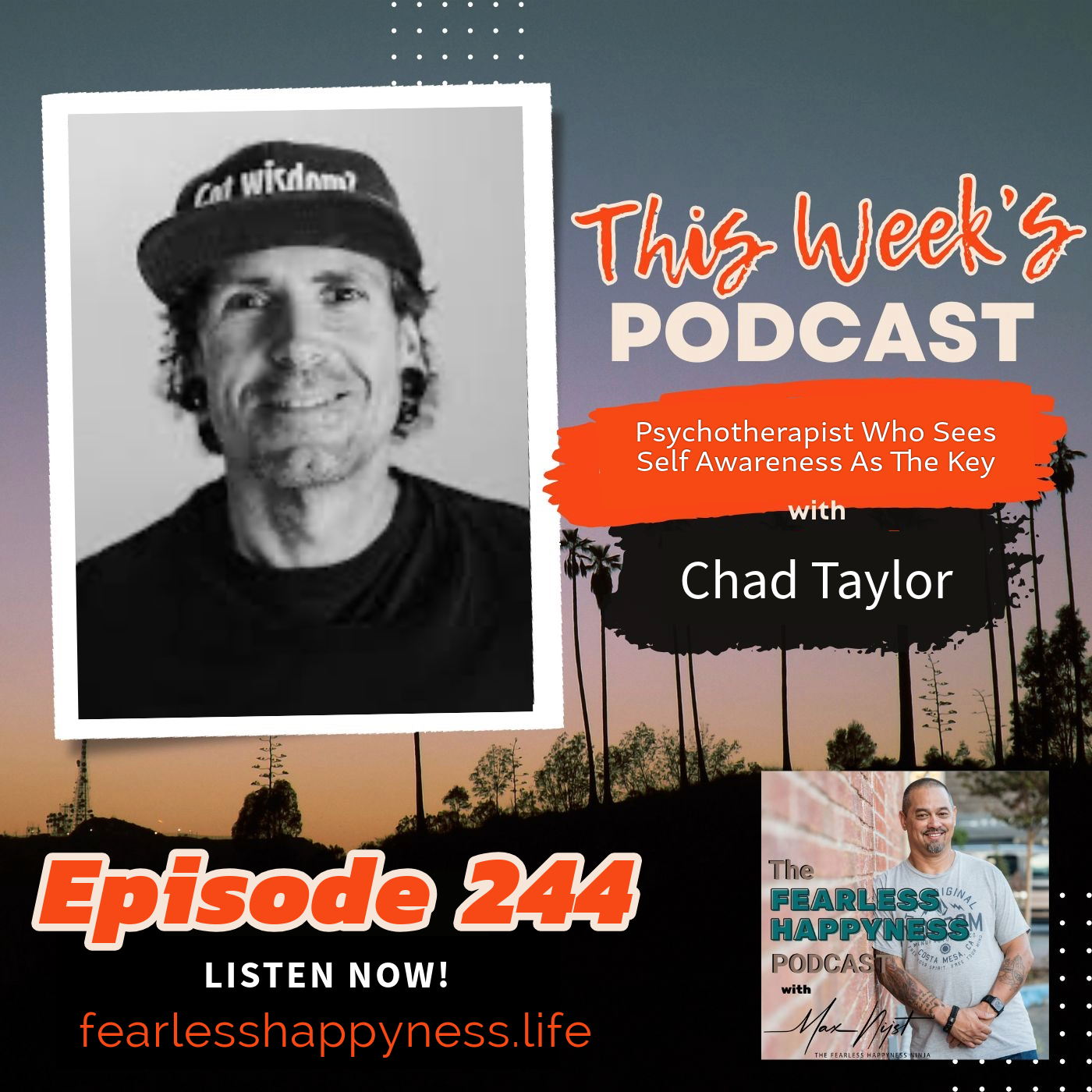
Join Max Nijst and Chad Taylor as they explore the journey of recovery, the role of faith and science, and practical insights for personal growth and relationships. This conversation offers deep reflections on addiction, spirituality, and living authentically.
For more from Chad Taylor:
Book- It's You Oh Fuck It's Me
Website: www.chadtaylorpscyhotherapy.com.au
For More From Sober Coach/Substance Abuse Counselor Max Njist, visit MaxNijst.org
Max Nijst: Welcome to the Fearless Happiness Podcast, where we showcase phenomenal individuals who have overcome serious traumas, life obstacles, and challenges to find their own path to fearless happiness. Listen as Max Naist invites guests from all around the world to share their experiences and spread strength, hope, and faith. This is the Fearless Happiness Podcast. And this is Max Naist. Everybody. Good morning, good afternoon, or good evening, or in the future, wherever you are in this world. This is Max from the Fearless Happiness Podcast. Coming to you live, not live, but coming to you with another amazing and special guest, which I know this is going to be an amazing conversation all the way from Australia. Today we have Chad Taylor with us. But Chad, what I'd like to do is have you introduce yourself to my audience, like who you are, what it is you do, and then you and I are gonna, like I like to say, rock and roll. Hey Max, thanks for having me on. What do I do? I I'm I'm a at the moment I'm a clinical psychotherapist. I've just published a book and I'm a father, I'm a partner, I'm in recovery. I guess I'm a fellow I'm a fellow human being trying to navigate the crazy world we live in in two thousand and twenty six. Well, â from what I've been seeing, and I have to say this because of my cousin, right? Like the craziness is going on in Australia as much as it is in the United States, right? Like is that like is the news only showing us little bits of what's going on, or is it really like here going nuts? I'm pretty I live in a sort of coastal rural area, so I am probably a little bit I probably know less than you because I don't watch the news. Because I just I really think for my for all of our nervous systems, sometimes the problems we hold come from the TV. Absolutely. Well, I'm like you, right? I I don't like watching the news. It's just sometimes when I'm scrolling and I'm seeing family members scroll what they're seeing, I'm just like, thank God I don't watch the news, right? Because I might â tell chat, hey, I'm having such anxiety, I don't want to talk today, like blah, blah, blah. But what you and I know there's more to the world than just. scrolling on Facebook or watching the news and right. And I love talking with my fellow recovering people. And, you know, in your case, a a therapist who now is probably helping people overcome that hurdle in their life. Right. And if you're anything like me, you're probably trying to â s you know â get rid of the stigma that comes with becoming a recovering person, right? Or in addiction, because I know And it's kind of changed. It's getting better. But when I first got sober, right, over twenty two years ago, right? The the it was, you know, people thought I was like I was the guy that came from, you know, Skid Row that was, you know, sticking a needle in my arm, â out of a cardboard box, which â close a couple of times I came close to doing, right? Or the alcoholic who's behind the store, you know, drinking their alcohol out of a brown paper bag. And you and I know that. Addiction effects, it doesn't discriminate. It affects anybody, you know, anybody. And a lot of the time I always think that, you know, it's some of our doctors' fault that have created some of the addictions in our world, right? But let's talk about you and talk about those challenges. â you know, go back as far as you want that have created who you are and who have shaped who you are. Yeah, and something you just said then, you know, like I think the fault. There's no fault anywhere, but we've sort we've lost our way. We've lost our way as as a species really in you know, we've replaced money and and, you know, drugs and alcohol, probably a good place to start. Drugs and alcohol always served a purpose throughout time, right? Throughout history, you know, in a in a ritualistic growth â modality, not for pleasure and not for escapism, for a purpose, I think Things like peyote or ayahuasca or even alcohol. You know, I think they served, you know, I'm not a Christian, I'm not anything, but you know, why did why why does the story go that a man turned water into wine? You know, because I think in small doses and in ritualistic environments, small doses of s I don't take anything now because I know that, you know, anything for me any anything in a small amount for me is a bit of a worry, right? 'Cause if it's this good in a small amount Right. Ten times this amount. Absolutely. There's always been there's that drugs and alcohol have served a purpose. But I think we live in a world now where it's more used as an escapism. You know, it's drink caffeine all day for a lot of people. Right. And then, you know, work hours as caffeine and then after hours as wine or alcohol or drugs. Right. You know, and I grew up in a home where, you know, I had a I had a devout Catholic mother. And I had an alcoholic atheist father. So I think I grew up so fucking confused. Yeah, I'm gonna say that had to be very confusing, right? You got a very devout mother who right, and then you got a dad that's like, no, that's you like bullshit. Religio religions for weak people, right? You know, and that always fascinates me, like how like opposites like that attract. Right, because you know there's gotta be I I don't know because I have never witnessed it, but I hear about it, right? The the arguments behind closed doors over that stuff, right? And and right. I'm sure your mother's like, No, the kids need to know there's a power greater than ourselves, right? That guides us and take you know, all that. And then you got a dad that probably says, No, once you die, you die and that's it. Right? There's Yeah, we you know, g be dragged to church on a Sunday and then you know, come home and get another sermon of, you know, weak people go to church and God's bullshitting and it just makes them feel better, you know. So I guess it left me pretty confused and that wasn't I always had the personality of an alcoholic as well. I'd always had the personality of an addict, even as a kid, right? You know, I'd sneak food and I'd sneak food and sneak lollies to my room and then, you know, so funny enough when I got to when I got to recovery, it was like, you know, I started doing therapy pretty early on. It was chasing back these behaviors that, you know, they they say in they say in, you know, sometimes in the rooms of places like twelve step fellowships, you know, that we were and I don't really like these sayings, but you know, we were liars and thieves and cheats, right? And I don't really like that because it's easy just to say that and leave it there. Unconsciously, we're all fucking liars and thieves and cheats as human beings, right? Like you can't tell me you didn't see that guy was going for that car park. You can't tell me you didn't see that. You know, that person was with a full trolley food of a full trolley of groceries was going for that register before you quickly walk faster than what she could go and jumped in there and pretended it didn't happen. So I guess when I chase her back, I used substances or I used things to change the way I felt pretty much from very early on. And I don't know if that was I think it's a bit of both. I don't it I don't think it's a purely biological thing. And I also don't think it's a purely environmental thing. I think it's a combination of both of those things. And then so by the time I was nine or ten, I was sneaking alcohol and, you know, holding my nose and drinking it in my bedroom purely for the effect. It was never about, â I'm gonna love going to work today and I can't wait for that, you know, glass of, you know, that schoon, I don't know what you call them over there, but that glass of beer. With the condensation running down the side that I've heard some people talk about. That wasn't my story. It was almost what's the cheapest I can get? What's got the highest percentage of alcohol? And how fucking quick can it get me there? Right. That's we have some similarities right there, right? 'Cause when I started, same thing. It wasn't about â I'm doing this because I'm gonna wind down from school today or, you know, or work or no, it's how fast can I get to Right. Excuse my language, fucked up. And right. And it and it's funny because, you know, and you know this probably in your studies too, right? They talk about it being genetic and you know, and environmental, right? Because and there's quite opposite, right? Where my children have never seen me drunk or loaded, but yet they all have had their issues, right? They've all And they used to even go to meetings to 12-step meetings with me when they would stay with me on the weekend, right? When it was my and then I know someone whose, you know, children whose fathers all have the gene and all and a couple of them are pretty still pretty active in their addiction, except for one. But all the kids are quite opposite, right? They're really hard workers, they take care of their kids, right? They don't really indulge a lot. Once in a while they have a barbecue with friends, right? Have a couple beers. But like you and I know, right? That like one is not enough, right? And our what is it? The millions not enough, and one is right. That whole like I can't drink like a gentleman, as they you know, some of the sayings you hear in the twelve, I cannot do that. It just doesn't work for me. â right. But when we're growing up, right, I think, and it's funny because my dad, I found out when I turned a year sober was an alcoholic. But I never saw him, right? Because they divorced when I was young. So I never saw him take a drink. I never, you know, I just heard stories of him and his drinking escapades and I've heard you know and his, you know, poor eating habits, right? Which killed him at fifty five, you know, of heart disease, right? And but I know of other uncles that weren't quite as bad as my dad, but they all have heart disease or cancers and right. And I guess what I'm getting at, right? I think it's a combination of everything you're bringing up, right? 'Cause â what's the saying, right? If you go to the barbershop â long enough, you're gonna get a haircut, right? Especially if it's in your genetics, right? Because or if you hang around with the dogs, you're gonna get fleas, right? So when you at a young age, right, figured this kind of like you said, you were sneaking alcohol into the room and you're plugging your nose to drink. Cause I remember the first thing I didn't like how it tasted. So I did the same thing, but I knew where I wanted to go, like you. But I would think I was about, I want to say 11 or 12 when I first, right? But at 13 is when I I say when I speak sometimes in a meeting is like I went to a party at 13 and I didn't get home until I was 32. So what was that like for you? You know, on your journey into addiction, and then talk about that and then talk about your journey into recovery and then where you are today. And then we're gonna talk about your book. Sounds good to me. I love this, you know, we feel so blessed to do these podcasts and it's not so much for sometimes I forget there's whoever watching. It's just like this conversation I get to have with another amazing human being a lot of the time on a parallel journey. So yeah, it it you know, I I I did drink because â drugs weren't really that big in my story, like they were a little bit, but where I grew they weren't where I grew up there wasn't that many then. I got sober in two thousand and one, I got sober pretty young as well. â so my kids have never seen me drink, right? And just quickly while I'm on that, something I never thought that would have happened was about two years ago when my daughter was thirteen and my sister and her husband, they sort of they they drink a bit, but it's more of that party sort of element. So they you know, they've got the fridges with all the alcohol and there's music and there's you know, and and my sister star my daughter started like begging me, but can you please just get drunk once? I wanna see how funny you are. And I'm like, hey, darling, it's not funny for dad to drink, you know, like trying to and I'm like, but plea and she's almost begging me, like coming up to New Year's of this party that we're going to, could you please just drink just for tonight? Could you just get drunk? I want to see how funny you are. You know, because so it's nice, it's nice to me for me to see that she has a completely different relationship with alcohol and alcoholics than I do, right? Because she's blessed has never seen me drink. So my story was that. It progressed pretty quickly, right? It did by the time I was thirteen or fourteen I got my first job, which was at like a local supermarket. I knew if I got two shifts a week, I could get a case of beer and I could get two packets of cigarettes. Right? So and whatever beer I got, whatever case of beer I got back then at say fourteen was determined upon what was in the specials list. So it was shit like over here Tilly's Red and Resh is Real and all this stuff that nobody wants to drink, right? You know, like Even fosters, I know you guys seem to love Fos Australian fosters over there. We're here, no one fucking drink I don't know one person in my life that's ever drank fosters, but it seemed to be pretty well marketed overseas as as this Australian beer. You'd say it on a movie or something or a or an adult. And you know that is so funny that you say that. I haven't drank in a while, but I had a friend who married an Australian girl, right? And he's still over there. And he would say the same thing even back when we were drinking, he goes, No one drinks this beer over at at home. Like 'cause that's home to him. He's been in Australia probably thirty five years now, right? Right after high school. But she could say the same thing. We go, we don't drink fire. Maybe it sounds like every Australian does. Yeah, I I don't think I've ever seen a Foster's in the wild ever. I've only ever seen it on TV. Right. I love it. So then for me it was I it progressed, right? And it progressed because at twenty two, most people would think it's just being a teenager, but for me there was something different. There was like you know, there was just something different about it. And I d I didn't know. My story was I didn't know. I didn't even think about recovery until I was there. And at the time my mum had had cancer on and off for a fair few years and got to a point where the we thought she was going to die. And I I was back living at home after another what we call in the you know, what we call in recovery circles a geographical, where I thought if I just move away and go to a new city or a new town Then I'll be able to restart. And it's it's all this shit around me, but not me. I never really looked in the mirror. I always looked out the window of where I could go, where I forgetting I'd take myself with me. So I was back at home. â kind of long make a long story short that me and my father end up having another punch up, and then that night I was sort of took off to a mate's house and then come back the next day, and my mum gave me an ultimatum, which was go and get some help, or You're gonna have to sort of pack your bags and be out of my life because I can't I can't deal with this, you know? And and there was a part of me then even that was almost like, Well, fuck you, you know, it's all your fault, the typical alcoholic thing. It's right you, you, you, you and there's no me. And I was a kid when I look back now, twenty two, right? We're kids. Like I thought I was I thought I was this grown up adult and now I look back at twenty two when I see a somebody come into the rooms or somebody come to recovery or come to my counselling practice now at twenty two and I think, wow, like I'll this age. So then I you know, I I f I sort of argued back a bit and then two days later I found myself in a detox facility and then in a in a adult re rehabilitation centre which was full of criminals and 'cause we couldn't afford to pay for a public rehabilitation. So I was in a like a sorry, we couldn't afford to pay for a private rehabilitation. So I was in a public system, right? Which was just I would say that ninety-five percent of the guys there were bailed there from jail. Right. So it was either serve out your jail sentence or you can have, you know, time over here, which will look good when you go to the court. So it was a confronting thing and they were big dorm rooms. So there was like twenty of us in a room. So you know, almost like a bed, not even like a jail cell where you got your own room. It was like my bed and then like another bed of grown men that, you know, were pretty sketchy people. But pretty the stories were pretty sketchy. The men I got to know in there were fucking amazing human being individuals, right? Because they'd removed they'd removed all the shit out of their lives for that period of time, but not many of them made it. You know, they were they would leave the rehab and, you know, twenty eight day program. So there was a big, you know, like say I come in and somebody else was on day twenty six. Well only got to know them for two days or day twenty You it was a it wasn't like a everybody comes in at the same time and then everybody finishes and then there's a new lot of people. It was a rolling so as I'm c as I'm in there, you know, there's people graduating that day and they're not even making it back to the nightly dinner, which was part of the program was, you know, you leave in the morning and then that night you come back and have dinner with everybody after you've been out in the community and majority of â wouldn't even make it back that night. You know, and that was and I remember hearing you know, stories like from from the workers and from meetings I'd go to that, you know, only only one or two percent of you guys will make it. And I sort of, you know, I made a decision right there that I was going to be that one or two percent. I didn't want to live I guess I had enough space to see I'm not living the life I wanted to live. Like I remembered what it was like as a kid and despising alcohol and what it did to our family and what it did to my father when he drank it, right? Despising it. And then here I was completely unconscious to the fact that I was just a mini version of that and having no fucking idea that that was me. Right. I can relate to that because â that was me. You know, I said I swore I would never be like my dad. I ended up being just like him. Right. But in my eyes I was worse because he went overseas where his job took him when they got divorced. Right. So kind of had an excuse. I could be in the same city as my kids. And be so ash you know that guilt and shame that kicks in. And for years that's how it, you know, I'd either wait till they went to school and or I'd wait till at night when they were all sleeping to go do my thing, right? Because drugs are a part of my story, right? So not just the drinking, but when I'm doing all that shady stuff to get my drugs and right. Knowing I live in the same city and my kids, I gotta do it at certain hours so they don't see me. Because if I know if they see me, and you know, I could tell you about that later, but Yeah, I created a vicious cycle, like you said. And â man, like I I'm just I I relate to you because I went to a place that was basically the same thing. It was and it was funny because you know, I was looking at three years in prison at the time when I first got sober, right? The judge says, you know, you haven't done anything I said, right? You're not leaving my jail unless it's to two places. Either one, I find a place for you to go. Or two, you're going to prison and I put you on that bus to send you to prison. Those are the only ways. I'm like, God, you're mean, you know. I mean like, I'm a nice guy. Come on. But it was fun. When I got to this place, there was two sections, right? It was at the end of a cul-de-sac. One side were like the private pay, out of state people or you know, private insurance. And then the other side was all probation and parolees. And it was funny, the first night they put me on the other side, I said, I don't feel comfortable here. You need to put me with those guys over there. But you know, long story short, the the good thing is there's seven of us from twenty two years plus later that are still sober, that stuck together as a group of guys that said, You know what, we're gonna prove everybody wrong. We're gonna stick together, we're gonna do this. And there's seven of us that are twenty two plus years sober. That well, well done. You know, that's that's a hearing that and knowing the journey that we all take, that's a testament to to work in a program and also, you know, evolving, right? The the basis of a twelve step program is learning, teaching us how to evolve. You know, it's not it's not what we know about ourselves that brings us unstuck. It's what we don't know about ourselves. Exactly. Touch on that a little bit, Chad, so people understand. I've tried to explain it. People look at me like 'cause I'm not maybe explaining it right, but Touch on that, right? Because it is about the stuff we don't know about ourselves that we get to learn about, right? Or the stuff that was hidden because of our drinking and you know, it's coming to light now. Talk about that a little bit. Yeah. And even in the rooms, you know, like we get to step four, which for everybody out there, you know, the first three steps are really about just the first one is about realizing we're all powerless over over alcohol or drugs, or really powerless over our thinking is what it breaks down to later. But that's what we're powerless over. And then therefore, because of that, our lives become unmanageable. And that can interchange, right? There's some people I think that their lives are unmanageable and then the drinking comes in. And I think in a way, it's almost like that where did it start? Well, the chicken or the egg. I think it started with both, the unmanageability of life, like I've already discussed. Absolutely. Then the alcohol creates more unmanageability, and then we just keep going, right? And then the second step being, you know, believing that there's a there's something out there which is a bit confusing in itself because it's like it's out there but it's also in us. You know, how can this how can this power of a power greater than me be out there and in us? And I think there's not enough, in my opinion, there's not enough in input and understanding of the first two steps in recovery in the rooms, right? Because if you look at the program, step three doesn't come until well, well through halfway of the programme. If we remove to wives and if we remove to employers and if we remove working with others, right? Because that's really not you know, that's not focused on our recovery. There's only about a hundred and eleven pages of actual program for us to get sober ourselves. Yep. How at the end of how it works is where it says we are now at step three, right? And that comes in like page sixty two or page sixty three or page depends on what version you've got. So sixty over sixty pages of the whole â one and a hundred and eleven pages of programme including the doctor's opinion, which is, you know, in it doesn't it has Roman numerals for I'm giving everyone a lecture out there, but step one and step two, it's really important to understand that that power greater than yourself can be another layer of consciousness for yourself that's connected in with the universe. So my concept of God or a high power is literally consciousness, right? And that c so that means that when I say that, you know, there's a power greater than myself It's out there, but it's also in here. Right. So then if I in other words, if I learn that, you know, the sayings in AA that, you know, it's not it's not so much what I did that I have to work on, it's why I did it. Right. Right. And I love that, Chad, because I think if people just got that ex explanation, less people would be afraid of that, you know, the God thing when Because you could you as you and I know at probably early meetings on, I listened to those old times. Like, if you don't do this, you're gonna die. And I'm like, You don't even know me. You tell me not to do something, I'm gonna do it, right? Or you tell me not to do or you tell me to do it, I'm gonna do the opposite. Right. But that's how I learned, right? Like I love my sponsor for not like pushing the God concept. Like I came when to believe in God for me when I was done with the 12 steps and I saw How my life had drastically changed, right? Because when I was in that place I was just telling you about, I had relapsed four times, right? Because I took, I took the reins back, as they say, right? And almost didn't make it back. And then I realized that that last day was only one use, but it made me feel like I had been out there again for years. You know, that feeling you I'm just I'm looking in the mirror, just going, and I just remember hitting my knees and asking God, okay, God. If you're â out there as much as I, you know, despise having to do this, right? But I think I was sincere at the same time. I was like, okay, if you keep me sober, I promise to do the work to stay sober. And I'll do whatever it takes, right? And I told my sponsor that, and here I am, like you over twenty two years sober, and I believe it was just you know what I mean? I believe That power greater than myself, or whatever you want to call it, the universe, Buddha, whatever, right? And and Chad and I are not pushing anything on anybody out there, but they're just we're telling our stories, right? But â you know, like you and I get to live, we live these past lives, right? And this is what I love from an old timer that I heard. He goes, We get to live two lives, the best one last if you do the work. And I right, I love that. You know, and and just on what you said then, like it's pretty narcissistic to think that we're in charge of our own destiny, right? Like if we only get look around. Now we've even created this term human nature, like we're fucking separate from nature. Like it's humans by na by by nature we're narcissistic beings, right? And right. So for me, my concept is more science than it is my concept of higher of a higher power is more science than it is a man on a cloud, right? I don't I don't you know, so for me, like I don't know, anybody that believes science has to believe that there was a big bang that created the universe, right? Right. And then on top of that, science tells me I'm not a scientist, but science tells me that there's no more energy in that universe right now than there was a fraction of a split second after the Big Bang, right? So that for me is my higher power. It's like so me and you And this cup and this microphone and this screen, at some point, we were all connected as energy. Right. That's enough for me to say, okay, well, you know what if we chase this back far enough? Past all the stories and the teachings and parables of Adam and Eve that people now like to try and pull apart because they they make out like it's you know, and then was it based on a true story? Fuck I don't know. I don't remember it if you if I was around then, right? But if I trace it all the way back through the funnel to science and go, okay, well. Surely there must have been an intelligence, an energetic intelligence, that was smart enough to create the universe that we're in now. And that's fucking enough for me, right? That I'm not it. I'm not that intelligence. I'm not a man on it's not a man on a cloud. I'm not fearful if I masturbate that I'm gonna go fucking blind. Like all these rules and doctrines that have been set. Like that's that's what's wrong with religion, right? Like it's not the the real thing. So anyway, I'm nothing. I'm not I'm not, you know, I'm not, you're not going to hear me get on here and say I'm a devout Christian or a Buddhist or an atheist or anything. I'm just I'm trying to navigate how can I be the best version of me and how can I grow the most. Really, so I do less harm in the world, is the basis of my life and maybe do good. And that's the only reason I'm still in AA now. I'm not in AA for the stories. I'm not in AA for going there and telling you a story about me. I'm almost like, Both Jesus and the Dalai Lama said in different versions, you know. The only way you can dismantle the only way you can dismantle something is from the inside. So for any purists out there, I'm trying to maybe evolve twelve steps a little bit. And I don't mean evolve it to Chad's way, evolve it so it hits the masses so it doesn't die out. Things need to evolve and change, right? If I just go there twenty four years sober and tell my story, it looks like this sometimes. this and institutions and jails and stories and people want to be the funniest in the room and the most hilarious and they've been to jail the more times and all this and then it's like for ten or fifteen minutes getting the laughs and fucking they may as well be a comedian and then it then it goes and then I got sober and now I'm the I'm the president of the Commonwealth Bank, which is like the biggest bank in Australia, right? So it's like the fuck happened here. Like I wanna know about I wanna know about this part, not the fucking We all know what sorry for the th that language, but we're all we all know what it's like to drink and black out and do all those things if we're in this room. I don't need to hear your fucking story when you're forty years sober telling me about what it was like. Once I've identified, you know, if there's a newcomer in the room, a hundred percent I'll tell my story. Right. If it's people that know me, it's pointless telling my fucking story. Absolutely. I get that. Right. And I love what you're saying because it's the same thing. Like when I was struggling, when I first got sober and first came to that facility I was telling you about, we had to go to this men's stag on Tuesday night. It was a requirement. We had to go. And â you know, my sponsor, you know, in his wisdom, we go, you know, I know you're struggling. He goes, you know, we'd walk in and it's one of the biggest men's stags in the world, right? Because they it got so big they had to split it between three different facilities like it's huge and it's standing room only every Tuesday night at any of them right so I went to the one in Newport beach at by the beach right and I remember walking in and he goes okay you don't have to believe in God but he goes why don't you believe in the power of this group and he stopped me and he goes look around at all these guys and what happened for me is when I looked around I saw guys in nice suits talking to guys that were tatted from the neck down you know what I mean and hugging each other and You know, having that connection, right? And which I've learned later too, that the opposite of what I've learned of addiction is connection, right? And that's why, you know, I think our program has worked so well for over almost a hundred years, is because it's it's based on one alcoholic helping another and surrounding yourself with people that have the same issues going on and having a common goal of getting and staying sober. But that was very powerful for I it was all kinds, you know. I I'm talking these guys that owned, like you said, owned companies that I was introduced to and were the nicest men I ever met. And then these guys, this guy just did like 20 years in prison, got sober, and he's been out now and he's been sober for 10 years and he's hugging me and you know, saying, Hey, welcome. Right. And I'm like, you know, this is you can't explain stuff like that sometimes to somebody who doesn't understand it like we do, right? That's just but You can't you can't explain anything to somebody that understands that. My explanation of this in therapy is right, you've got to have lived it. That's why I I'm probably a unique therapist where it's not I'm in this chair and you're in that chair and I've got my clipboard. There's no fucking notepad. Throw the note for any therapist out there, throw the fucking notepad in the bin. Don't wear your shiny clothes and your shiny shoes. People want authenticity, right? My books are so full and I had this disagreement with my supervisor for a long time that was like You can't wear your hat to work. You can't go to work in bare feet. You can't wear thongs. I don't know what you call â over there, but I think they got another name over there which is a more of a G string than a behavior called flip flops or like you know sandals that you know, there there's a version of the rubber ones called thongs. And, you know, like I don't own a college shirt, so I can't I'm not gonna go and buy one just to go to work as a therapist. So I guess where I'm going with here is it's it it's exactly what you said, right? It's it's these preconceived ideas. Right. And we gotta get rid of them, right? That's why I love the places I've worked at. Like I had to work I worked at a place that's very well known here in in California, right? And I had to wear a a collared shirt, slacks, right? And I'm thinking, well, being real, like if a guy comes in and looks at me, he's gonna go, He's never been through what I've been through, right? But we also I worked at a place that let us wear flip flops, shorts, hats, t shirts, right? And the The clients loved hanging with us 'cause they felt comfortable. They didn't see us as authority figures, if you know what I mean, right? They were willing to open up because we all looked the same. â We all are we all are the same, right? On any given day. Absolutely. The most famous therapist in my out my area are the most sort of and when I say famous, you know, I'm a pretty small area, so you wouldn't have caught him anywhere public or anywhere big, but he he helped so many people and had his books were so full and he suicided one weekend. in his fucking garage because therapists believe that they don't need fucking therapy, right? It's not it's a bit like a sponsor out there, I'm sure you've seen it, an AA mentor or a sponsor that's got sixteen sponsees and he's burning his own life to the fucking ground, but he thinks he's doing well 'cause he's got sixteen sponsees. It's like my my catchphrase in all my work and my book is stop looking out the fucking window and start looking in the mirror. Well, I was taught in school that a good therapist has a therapist. A good counselor has a counselor, right? And in the program, like my I like I have a lineage, right? I don't know if my great grand sponsor's still alive because I know he struggled, but he, you know, struggled with health issues. But I had a sponsor who had a sponsor who had a sponsor. And they all worked together and I all worked with them. And it was, you know, it was they showed me what I believe that AA looked like. From the very beginning, right? Like helping people and then sticking around to show people how we stay by sticking together, right? Like sticking together. man, we can, I I know we could you and I could probably have this conversation for like hours and hours. And people, I bet you they love it, right? Because we're just being two real dudes, right? Who got sober and believe that like We don't how do I put this? I wanted to say, like, I I love your philosophy, right? Like this using the science and and what you can't, you know, like when I was, you know, being sponsored in the beginning, right? And my sponsor would even say, I know you're gonna have a hard time that â trying to trust something that you can't see, touch, feel, taste, or anything. But I'm telling you. If you do the work, you'll understand it, right? Cause when you take someone through the steps, you're gonna come back 'cause he would tell me, I you're helping me more than I'm ever helping you. And I'm like, dude, I don't know what you drank today, but I think you're there's something wrong, right? Like, 'cause you're saving my life. And he's still my sponsor over twenty two years later, right? Like I trust that man with my life, right? And â But I I tease, right? And I everybody in the audience, if they're still sticking with me, right, here has heard this story. I always gonna tell you, Chad, right? I always tease my sponsor. I said, I'm gonna come to your office one day or your home, right? I'm gonna walk in the door and I'm gonna see you floating in the middle of the room, right? With this green aura telling me, Max, use the force, right? So I call him my Yoda, right? Because he's he's never yelled at me. He he's never ever told me you have to do this or you have do that or I can you know what I mean? It's always been suggestion and he's always been there for me when I've been at my lowest and through those relapses, right? And said, Hey, when you're ready, I'm I'm I'm back, right? I I mean I'm here for you when you come back. And and he only got scared like the first two times when he thought I wasn't gonna make it back. Right. And I heard it from his wife when I took my ear. But right, those are the kind of people like I and like yourself I choose to hang out with, right? That are gonna shoot me straight because here's what happened, and I'll tell you the truth, right? Like honestly, I was still in recovery pointing like the finger, like you said. I was like, it's your fault. Like, you know, my ex-wife, she's doing this, and what a you know, blah, blah, blah. And one day my sponsor and mentor said, Dude, don't come to us like that. If you have a problem, we want to hear what your part is first. And it taught me self-accountability. And accountability to them. So I wasn't constantly going, Well, you know what my boss did, or you know what my kids are, you know what I mean? And I learned to go. I guess what it did is it helped me, like when I'm in a stressful situation or I'm having this heated discussion with somebody, like I can take a look at myself during that and go, okay, what am I doing that I need to change at the you know, like our tenth step, right? Like changing it right at that moment so I don't hurt someone or I don't hurt anyway to be and You know, to be that example I want to be for my kids and my grandkids. And realizing that, you know, that that line out of the book, right, which I've used in my own in my own words, that whenever we're triggered, whenever we're disturbed, whenever that we've got a problem internally, whenever we're emotionally dysregulated, majority of the time the problem lies with us, right? Like it's different if a dog's coming to attack you, right? And you're emotionally dysregulated. Completely different. That's a normal human instinctual response, right? Right. Or A car crash or trauma, right? Those sorts of things, those big events. But if, you know, someone's talking about Donald, I don't by the way, I try and live my life in the middle, right? I try and live my life in the middle of most things because I don't know enough about anything to fucking have a judgment, right? And this is what AA's taught me and Twelve Steps have taught me and my mentor and my therapist. It's like, you know, my therapist now, if I say something, I say something with conviction. He'll just look at me with a blank face and say, â you were there, were you? And it's almost like a slap in the face that I knew. That's like, 'cause I get carried away like the rest of us, and I'm like, and if we went to any if we went to any coffee shop or cafe right now, purely with the intent of listening in to a conversation, we live in an addicted culture, and Richard Raw, who I'm sure you've heard of his stuff, but if you haven't, R O H R for anyone out there, amazing fucking man. Not in not in AA, but loves AA, was a Franciscan monk and fell into AA with them having AA meetings in his under his church. And like he says AA's you know, AA he believes that the twelve steps will be the next frontier of giving back to the world, right? But anyway, and he says the biggest addiction all of us have are addiction to our own thinking. It doesn't matter what the topic, and therefore all human beings are are caught in addiction now, but we're addicted to our way of thinking. And I love that because like if I go down the coffee shop now purely with the if we go there today purely with the intention to eavesdrop, it'll be, â and then he fucking did this and then she did this and â can you believe Trump just said this and fucking Iran's doing this and Venezuela this and â yeah and then I was driving on the way to see you and I'm late because you know the fucking Roadworks guy, he turned the sign around on me to stop. Can you fucking believe that? Right. Well, and that's the world we live in. And I caught myself the other day in the office 'cause I gotta practice what I preach. I was doing something at home, I le I left a little bit late, and then I got caught in a bit of traffic and then I turned up and I was like two minutes late for my to open my office up and the client was there and I said unconsciously, â sorry I was late, there was traffic and then I said and I thought about it and it didn't sit right with me within three seconds, hadn't even opened the door and I Actually Truthfully, I was fucking around at home. My ADHD believes me to think that I can fit three more things in before I leave because I've got an extra five minutes and I I didn't manage my time. And the client was like, This is why I love coming here, because you're real, right? You you're not like Well, I've worked with therapists who have forgotten the zooms and then when I've called them on it, they've said, No, no, we didn't have one booked in. And I'll be like, but You know, no no account if if this is what I'll leave you, this is what I'll say right now. If you're in if you're in a relationship, a friendship, a workplace within reason unless you need to stay there financially, where people can't take accountability, they have no i it's always an excuse or a or a justification. Get the fuck you s get the fuck out of there. It's not a safe space to be in. I I love what you're saying, 'cause I got caught doing that last night, right? My wife said, Keep an eye on the veggies. Don't let him burn, right? And I let him burn, right? And then when she said, â when she got upset, right, I got very defensive. Like, well, what's the I'll eat him? I don't care. Right. And she got angry with me. And, you know, we could we come back when we're calmer. And she goes, You just you dismissed everything I was just trying to tell you, like my effort and everything, right? By doing that. And she explained it, and I was. Why she's right. I should have just apologized and took accountability and said, Yeah, I burned the veggies. Sorry, I wasn't paying attention, right? Instead, I had to make it about me. I made it about me. Like And and let's let's see what what's underneath that, right? We're not going to turn this into a therapy session because it's your podcast, but what's even underneath that for her? What what is that not listening, right? Like what is it there, do you think, that that triggered her? What do you think really it is? Is it the veggies or is it something a lot deeper than the veggies? â it's a lot deeper than the veggies. And I like you said, we could turn this. I can tell you what I think I know because I see it, right? And she's told me. And â all of us, I believe, you're right, we're human beings and we're gonna act out, we're gonna respond wrong or right. And and like you know, I try to practice every day, right? Pause when agitated, right? Or be so I don't say something because early on in recovery, whatever came Even faster than to my brain, it came out of my mouth and I got myself in trouble so many and I've done that with my wife, but you know what I mean? I'm learning to think before I speak and and communicate in a better manner, right? Because I mean all her and I both have like baggage from past relationships that we tried very hard not to bring into our current relationship, right? And we acknowledge that, right? We tried not to do that. I do it sometimes, she does it sometimes. But I think that's why we get along so great, right? Sometimes we don't take ourselves so serious. We laugh about it. We just kind of move on and go, right, because she knows I love her. She loves me. But when it really, like last night, really a f hits that nerve, right? And you talk about what's underneath that, it's probably from her not being heard or taken for granted, right? By some people that we currently know. And what that's another thing we thought but Right. And and she's made a stance in her she's drawn the line in her life where like I'm not letting people treat me that way anymore. Period. I'm gonna tell you the truth. Right. And if you don't like it, that's on you. But I'm gonna stand my ground. Yeah, and I think and I think respect, you know, we we talk a lot about, you know, needing â you know, loyal qualities, but to me, if we could actually learn to respect our partners and respect ourselves, because what I see in that. And this is a way I would explain it in the therapy session, because it's funny when people think it's people think that it's the affairs and it's the all those sort the all those sorts of things that are the big things that break a relationship. It's a repetitiveness of unfortunately for me included, these little things where it's like 'cause those veggies being burnt almost for for her level if she chopped them up and put â on and everything, it almost feels like a disrespect that you couldn't give the time right. And I do this shit all the time. So none of this is pointing the finger because we all know this, right? One at you is three at me, right? Right. So I've I've been known, you know, my partner will say, Are you even listening to me now? And I'll be Yeah, yeah. And she'll What did I just say? And I'm off thinking about fucking how am I going to market my book or something else. And I'm I'm trying, you know, so just so when I say that to you and this is how I do therapy, it's not about pointing the finger. Right. It's really it is really about like what's underneath all that. And I think a lot of it is disrespect, you know. Disrespect all the time. And if we could actually learn and a lot of the time we're getting offended about shit that doesn't matter. Not the veggies, but I mean like we're getting offended over somebody having a different view of Donald Trump than us or a abuse of him because I get a lot of this where people get so wound up over here in Australia about what the T V tells them to get wound up about. Right. And I'm like, â do you know him, do ya? Like none of us fucking really know what's going on. Let's be truthful. We think we do. But like I know I'm like a grain of sand on every beach in the whole of the earth. That's about how much I fucking know about any topic. And if I can remember that, then when my partner gets cranky at me for burning the veggies, I don't need to justify it as to the reason why. Right, exactly. I let them burn. It's just like, yeah, I didn't hear you and that would have felt like disrespect. Right. Yeah, and that's she knows that. Like that's why we have Like I am going, I have hearing aids, right? That the VA has given me, right? So now I I have I have to not tell her like I heard okay, like I heard her, right? 'Cause she'll do exactly what you said. Okay, what did I say? And if I go, I didn't hear you or why did you say okay, right? So I'm learning and she is learning too though, not to like talk when I'm not looking at her, 'cause then I won't really hear you that well. Anyone. Right. So she'll make sure. So we have this thing. She'll come in front of me and say, Listen to what I'm saying. I need you to understand this. And I that's when I say, Okay, perfect. Cause then if I mess it up, she'll know, like, you heard me and you still messed it up. Right. But that's you know, we've worked on that in our almost nine years of marriage. Right. And I've had to learn how to change things. She's learned how to have change some things and right, come together as a couple and and And â And some things never change, right? That's the truth. Some things never change. Like if if we could actually accept more and want to change less, the other person. But that's key, like in our relationship is accepting each other for who we are and what we've done. All that like not expect I'm not gonna try to change her. I love her just the way she is, and she does the same with me and we have these talks. But you know, it's your you're right. It's like in our book, right? Acceptance is the key to all my problems today. If I can learn to accept people and places, things, and situations as having to be or being as as they are right at that moment, then I don't get wound up because it's supposed to be that way. And I'm like, okay, I'm being in the present moment. So that makes me feel good too. Cause I'm right. I may not like some of the things I see, as you know, we see going on around us, but I'm not gonna, you know, and I can well I'll talk to you about this â whole Trump thing and MAGA and Republican after, but I I didn't even say anything about something and I got backlash even from family. I'm like, whoa. Okay. But yet you're attacking me because I said all I did is that I watched the other halftime. I didn't want watch this guy, right? Yeah. We've all got a choice in life. And if we could allow other people to have choices Like we live in a pretty fucking shitty world if everybody wanted to do exactly what Chad Taylor wanted to do. Right, right. Or Max. You know what I mean? Like, hey, you guys if you're gonna do what I wanna do, or you're go kick rocks, as they say, or go do whatever you wanna do. But then we'd look around and go, Wow, this is a pretty lonely world because nobody wants to hang out with us, right? Yeah, and the worst thing is I'm a pretty shit cook, right? So unfortunately talking about your burnt carrots and burnt veggies, we'd all be eating shit veggies and like probably Air fried chicken schnitzel and that'd be pretty boring world to live in. That's right, or bacon and eggs. That's about the only thing I know how to make very well because I do it for my mother in law every day. But this has been awesome, right? Now, so let's let's kind of take a break from that and talk about your book and what's in your book, what drove you to write the book, and then yeah, let's talk about what's in your book so people have an idea of what's what you wrote about. Yeah, well the book's called It's You. â fuck, it's me, or as you Americans say it, it's you. â fuck, it's me. I love the passionate. I love the passion, right? And it's so true that and I wrote it because it come out of it come out of it was you know, I I say openly in it and I give a bit of my story where it's the book I wish I had been given. It's the book that even in even in the rooms of recovery, it it's the book that I think is needed that, you know, relationships fail. Because we're unconscious of our own shit. Like it's a pretty simple quote that I've used opening it up. But it's so true because the majority of things I see in therapy now being a therapist, and obviously when somebody sees me for a while, if they're in a relationship, generally I'll end up seeing the other the other party at some point. Because if one person grows and the other person doesn't, there's more chance of the relationship failing and ending than both of them staying stuck. And you probably see this in the rooms of recovery, right? Where somebody might have tolerated their partner or their spouse being an alcoholic for all these years. And then they get the person gets sober and clean. And then the relationship ends up because, well, they were both stuck, you know, because I'm without being too full on here, like a person that chooses an alcoholic or an addict, there's an issue going on for them as well, right? Like there's a codependency issue, there's a There's almost like in in something my therapist said to me early on, right? Was when I started seeing my my mentor, he said, Next time you want to look for a partner, find one that if she never changed a single thing about herself, you don't need to fix her. If you want a fucking project, go and buy an old car. I love that. Because this is what I see day in, day out. Like couples come in and it's almost like if he just did this. everything would be okay and then it's obviously well if she did this did just did this. Right. And it's literally like one person speaking one language, one person speaking Japanese, and the other's person speaking Chinese, and they can't hear each other, right? They actually can't hear each other. So we're always pointing the finger, a bit like what I said before, you know, what what is it that why why with you leaving the clothes on the outside of the washing basket on the floor? Why are you leaving them there? Why is that such an issue for me? Because really it's it's probably ten or fifteen seconds to pick â up. Right. Back to that respect thing. Or, you know, what what is it that causes the problems in the relationships? And it is a miscommunication. Like everything comes back to well, you use you said before, you know, the opposite of addiction is connection, right? The opposite of of you know, of every like we're we're chasing as human beings, as all animals. You know, we chase connection. My two dogs, my dog was almost three when I got the other dog. And then now they almost get separation anxiety when they're apart from each other, right? Because it's comforta they're more comfortable with each other. Yeah. It becomes happy. Yeah, we're driven to be in packs, right? We're driven to be in tribes. Right. And I think we live in a world now where it's almost there's many and I'm pretty passionate about this, there's so many people out there now making a fuck. Trying to make a business model of being a victim. But it really shocks me that and the the co like I might do a post or a paragraph out of my book on social media that I think's pretty good and it gets the the minimal amount minimal amount of likes because I fucking hate the hustle of social media, but I know I've got a good product and I want to get it out there, right? Right. So I'm I've got a h I'm starting to hustle as much as I hate it. â so anyone out there that's listening to this. Make it fucking easier for me. Just have some engagement because I don't want to be the whole coach, you know, the coach model. Right. â you know, DM me now and I won't do that. But I'm I'm off topic, but I'm not. But where I'm going where I'm going back here is is what I'm trying to say is that, you know, it's about someone I see it a lot on my feed and maybe it's just my algorithm, right? But it's almost like this American dude who's, you know, got a manicured beard and he's got tattoos and he's clearly on steroids and You know, he's got his hat backwards and none of this is a judgment, but he's he's he's sort of talking about I give you bar booze to deal with a narcissistic wife. And then his whole feed is like guys on there, â you know my wife, do you? â you lived with her for ten years. â you know, and it's it's poor and I get that we need understanding and empathy. Right. But it's really it's really about okay, well, how can we turn that? How can we see, well, what's my part in it? Why have I chose five women? That have been narcissistic. What is it in me that does this? So and this is the basis of the book. And I go into a lot of, you know, from when we're born and I give diagrams of what happens with our psyche and now and and and how we sort of become literally enclosed pretty early on, which is what religious teachings have said, and that you know, we call it the egocentricity in our colleagues anonymous or the rooms, where how do we break down that egocentricity to get a connection again with ourselves? and with others, you know, like even the the the word religion comes from Latin terms which l read legare, which actually means reconnection. And then when you really look at it, it's reconnection of head and heart. But when we're born, our head and our heart are connected. And then at some point they become disconnected pretty early on, right? Right. And I the the store again, no one out there bash me for this 'cause I'm not a Christian, but The story, hear the words there, the story, not the real event, because I don't know if it happened, I wasn't there. But the story of Adam and Eve and things like that almost give us a metaphorical story that we we were we were living in perfection and somehow we fell out of perfection, right? And then we're trying now to recreate some sort of perfection again. But we can't go back where we started because we're not three years old anymore. â unfortunately we know the way the world is, you know, that we almost we're born in what they call or what Robert Johnson calls, who's an amazing Jungian and you know, was a amazing Jungian teacher and book writer and author, that we're born into almost a state of unconscious perfection where we see the world perfect as a little kid because we're unconscious to really what's happening, right? Right. And then we fall out of that and we fall into what we call what he calls conscious imperfection, where now You know, we're in imperfection and that's where most of us stay. â fucking this person did this and can you believe my ex-brother in law has done this and fucking who would buy that type of car? Everyone knows dodgers are shit and you know, like, â he's a Republican, don't fucking go near him or you know, â democrats are this, and you know exactly what I'm talking about, right? We live in a polarized world where we stay in unconscious perfection and what we don't realise is We're trying to fix the world so we feel okay inside. Where if we just fix ourselves inside, the rest of the world feels okay, right? Right. See, and I love that you said that, right? 'Cause like many of my guests who I bring on here have talked about that, right? It's like you can't fix anything outside of you and feel good about it because it's not it's you gotta start with you, right? Like the whole airplane analogy, right? I have to do the oxygen first. If I'm gonna help my wife that's sitting next to me, or my son or daughter or my grandchild, right? Because and you and I know probably pre-re you know, pre-recovery, right? I was so busy trying to fix everybody else that I fell into a pattern of like destroying myself, literally. Or as my mentor said, Max, you were killing yourself on the installment plan. That's what you were doing, right? Yeah, yeah. And that's why the serenity prayer or the serenity statement, if somebody can't If somebody doesn't really hates the word God or higher power, just remove that part out of it. That serenity statement with a lot of I get a lot of clients, you know, who don't wanna don't wanna â go down the higher power path at all. And that's okay. I don't need to force them as to why they need to have a higher power. It's okay, let's just turn it from the serenity prayer into the serenity statement, right? Right. Nice. You know, w really what it's saying is When I've got a problem, I've got two choices, I accept it or I change it. But what I need to do, the keys, the last line, that I need to have the wisdom or the consciousness to know what I can change and what I can't ex what I what I have to accept, right? It's pretty simple. You know, and for anybody out there, I'm sure you've said it before, you know, grant me the serenity to accept the things I can't change, courage to change the things I can, and the wisdom or the consciousness to know the difference, right? Pretty simple. Yep. You can come to therapy for for ten years and whinge about your partner. Would have been a lot cheaper just to go through the divorce and leave them and work on yourself and maybe attract somebody. And I'm not saying you want to trade them in, but fuck, there's nine billion human beings on the planet almost. There's not just one person for me and you. Right. There's multiple not that I want anybody else. I've got an amazing partner in an amazing I say to people, I have the best relationship I know outside of a Disney movie. Right. Right. I love it. So I don't want to trade her in, but I do know also that if for some reason we grew apart, for some reason which I hope we don't. We just got engaged two weeks ago, so that's not not the angle I'm going at. At the moment, our canoes, we're both in a canoe, right? Each and our canoes are going in the same direction. There could come a time where one of our compasses get one degree off. Right. And pretty quickly, right? We're going in two different one degree now in three thousand kilometers. Is it Pretty far apart, right? Right. And that's the serenity prayer right there. It's either okay, acceptance got apart, can we course correct and maybe put our compasses back together? Or has it got to a point where our values, our morals, what we believe in, who we want to be, where we're going in life, where we want to live? Like there's so much complexity to make a relationship work. Right. No, I but I love that. That's what I use when I'm going off kilter is the serenity prayer, right? And not â just to so I I that I love that last part, right? And the wisdom to know the difference or the consciousness to go, Okay, â Max, you need to rethink this. Stop what you're doing, quit, you know, letting your A A D D or whatever get the best of you, and just stop and pause for a minute and think about what you know, what am I doing? Right And you can use it anyway. Anywhere. Right. And it was something that I learned when I came back the last time â that has stuck with me too. It's like You know, I heard a mentor tell me, you know, you need to be harmful to none and helpful to some, right? And luckily I have a a great sponsor. He says, you know, that you know that I am responsible. That's bad on the â back of our literature, right? I I get bumps every time I repeat that because he goes, That's you, right? But not just in the rooms of AA. You need to take that out and put and anyone, right? Cries out for help. Leave the AA because that's what I want you to do. I want you to be a guy that helps whoever needs it. Right. Get outside of yourself. You need to learn to be less selfish. And if someone needs your help, go do it. Right. It could be holding the door open for someone that's going into a store or bringing the cart back all the way from your card to where the carts need to go. He goes, Trust me, do that enough and you're gonna understand what I'm telling you about, right? And That's why guys like you we practice that, right? We that's why we have long term recovery, right? And I love what you said earlier in the podcast, right? I don't go to AA because I go because of the connection and I know that I'm there for a specific reason, right? You're right. If there's a new person, yes, I'll share my story because they might go and I've had this happen, I'm sure you've had it happen too, where they go, You just saved my life. And I'm like, What do you mean? He goes, You told my story. You told my story, and I was gonna walk out of this room and go drink and you know, or do whatever. And I go, keep coming back, right? Like that's yeah. What I love, like what that Tuesday night meeting, right? When those guys hugged me and said, Keep coming back. I'm like, Wow, okay. They don't even know me, but they want me to come back, right? But the people that know me don't want me to come back right now. They're like, just stay where you're at, Max, do what you gotta do. Right. And I I got that â you know, that kind of harsh ultimatum too from my mom, right? When I was in jail the last time. And I tell this, I've told this a couple of times on the podcast where She looked at me across the glass, picked up the phone. I picked up the phone, and before I could speak, she said, I love you, son, but you're no longer welcome at my home. If you come near my home, I will call the police. And my neighbors know if they see you and I'm not home, they're gonna call the police. What are you gonna do? Right. And for once in my life, all those empty promises left me. And all I could say was, I don't know. And she started crying. And I'm like, like, what are you crying for, mom? And she says, That was the best answer you ever gave me. She goes, Maybe there's hope, right? And she walked out. And that you know, and here I am now. And, you know, I got to give her before she passed away fourteen years of my sobriety. And she thanked me two weeks before she passed away. You know, we were watching T V together at her at her â assisted living. And she's, you know, I'm like, What's going on, Mom? She goes, I just want to thank you for your for you know, th well, she said thirteen. I didn't correct her, right? I go, â well. Right? God answered. That's one of those things, right? How important is it? Exactly. And I knew at that moment, stop, just let her go. And I said, Well, mom, you know what? Thank you for never stopping praying for me. Right. And I thanked her and we watched the rest of the show. And, you know, I think I was, I remember I was like seven o'clock, right? And it's I'm forty something years old, 49, I think, at the time. And she's like, Don't you think it's time for bed? I go, Mom, I'm 49 years old. I think I could stay up with you and watch some more TV. But Monnie, isn't it? But you know what? Some something I didn't say was before that, you know, my mum had the cancer had spread into three different parts of her body. So you know, the prognosis was going to be death, and then I went to recovery. And then miraculously her cancer went away. I I did the program and then her cancer went away and she's still alive now. She's got grand she was only in her forties then. She's got grandkids. She's, you know, seventy five now. She she you know, like and I get the same thing. It's like Maybe this is this higher power thing, right? Unfortunately, maybe people say I don't believe in a God because you know, why would people suffer? Maybe, unfortunately, the only thing that was gonna get me to get sober, to get to where I am here right now, was the fear of her dying and me being removed from a life, right? And I'm not saying that for everybody. It's okay for people to say, Yeah, but my mum did die if they're listening. We don't really know we don't know, right? There's a good parable It's it comes from a Chinese parable, The Man on the Horse. I'm sure you've probably heard it, you know, and I'll give you the quick the quick version where, you know, this Chinese farmer has a horse and he uses it to plough the field. Right. And all of a sudden one day the horse runs away. They wake up and the horse has got out of the paddock overnight and it runs away. And the neighbour comes running over and he says, Isn't that bad? Isn't that terrible? It's such bad news. You know, your horse has run away. And the Chinese farmer just looks at him and says, â it could be good, could be bad. And then the next day they wake up and the horses brought back four wild Brumbies. We call them rum brumbies here, but brought back four more horses from the wild and call come back to his house. So now he has five horses, right? And the neighbor comes running over and he's like, â that's the best news. Isn't that amazing? I can't believe how good that is, you know. Makes a big deal out of it in a dualistic moment view. And the Chinese farmer says, you know, could be good, could be bad. And then the next day, The Chinese farmer's teenage son, who's about sixteen, seventeen, he's trying to break in one of the horses and it bucks him off and he breaks his leg. And once again, the neighbour comes running over and says, Isn't that terrible news? You know, if those horses didn't come back, that wouldn't have happened and the farmer once again says, Could be good, could be bad and then the final sort of punchline to this story is two days later, the army come around and they're subscripting all the young able bodied men to go to war, a war that they can never win. Right. And they look over at the farmer's the Chinese farmer's son because he's got a broken leg, he can't go. And once again the neighbor comes running over and isn't that amazing news, you know, that's so great. And the Chinese farmer is almost, you know, the the wise Yoda or the wise Yoshi or you know, that is we don't know at what point our stories are good or bad, right? Is what I'm trying to say here. We don't know at that time when I went to rehab, I was forced to rehab and I didn't want to fucking go. My mum was gonna die of cancer, right? That was the That was the broken leg, right? That was the viewpoint of this is so bad. And then here we are, you know, twenty four years later on this podcast where I would have been dead and so would have she, I truly believe. Right. Yeah, I've I'm with you on that, right? And I love that Chinese parable 'cause right you look at and and if you think about it, almost all that stuff was good, except the broken leg, right? No one likes to get a broken leg, but that was it turned to be a blessing in disguise 'cause it kept him from going to war if you Right. It's all in our perspective, right? And I I just I've had such a great time with you here so far, but now we're gonna get into the questions. I teasing you said I don't remember, but we're gonna start with fearless, right? So going what you've been through, Chad, right, and have gone through in your life and the things you've you know, in your recovery, before recovery, and just every your life in general. What does fearless mean to you and how does that show up in your life on a daily basis? I think for me, fearless is, you know, not it's not so much the word fear. It's more about the energy that comes from fear, right? It it's an energy of I could be fearful about jumping off a cliff with a parachute. I could be fearful about my partner getting angry at me burning the vegetables, right? I could be fearful about one of my kids getting sick. You know? Fear to me is it's it's what is what is fear activating me and becoming mindful about what how how do I get through that emotional state? Like, you know, It's really I think fear for a lot of people creates anxiety, right? And what is anxiety, right? It's and the problem then is too anxiety, there's a level of excitement in anxiety. That's why we go on roller coasters, right? It's fearful, but it's also super fucking exciting. Right. So nothing is what it looks I think nothing is what it looks like. Nothing really is what it seems. There's always a there's always an underneath. So for me, when you asked me that question, I knew you probably asked me that question, it's like it's It's how do I get through this next minute, this next hour, this next day, this next year, whatever it is, how do I get through this and not let the fear consume me? It's almost like that cliche saying, which I know you would have heard probably millions of times in your life having this podcast of, you know, it's not the lack of you know, everybody's fearful, it's about really having the courage to push through that fear. You know, fear is feeling feeling like you want to avoid something. And having the courage to push through it, right? And I know that I haven't invented that right there. But it's true though, if you think about it, that's how we we won't ever become fearless per se, like in our lives, right? But w if we face our fears and push through and do it anyway, right, whether we fail or not, we're gonna learn a lesson, right? But that's where we gain courage. Then we become more courage courageous, let's say, and we learn to fear less. Yeah, and it's a safety instinct. Yeah. Really fear if we look at it at a base level, it's a safety instinct that keeps us alive. You know we have crocodiles, you guys have alligators, right? If we had no fear, we'd just go in there and just muck around and swim with them and think, no, we're okay. Right. And so the problem is to become fully fearless means your life's pretty short, right? Right. True. I love it. Well, that leads me into my next question. And if you can see I put a why in happiness and I did that on purpose. Did see that. Right. So What does happiness mean to you, Chad? And how does that show up in your life on a daily basis? Yeah, and again, happiness. I think I've really got to look. I try and go to the dictionary and I try and go to Google. What what is happiness? What where does the word come from? What does it mean? Or what do I you know, happiness is, you know, a new car for some people, right? It's a new job, it's a new house, it's a new partner, it's fake tits, it's steroids. Yeah, I'm j I'm exaggerating here, but You know, most of us think happiness comes in a place when we reach there. You know, where the word happiness actually comes out of a series of words. But what it l from Latin terms, what it basically means is to be present as the moment is happening. Is literally happen happening is almost, you know, the state of mind when something is happening. So for me it's always again bringing it back to, Okay, well, you know, I could be really excited about going on a holiday or coming on this podcast, right? I could be really But that feeling I had of excitement might have come on for twenty-four hours before this or whatever. But I never get back, you know, I never get back that first part of this conversation that we had. But I'm loving where we're now. You know, if you know, if if I'm thinking, â wow, I wish I had said this when he said that, or and I'm not. I'm just so present with you right now that I can't even remember half the time what I said, right? And someone might reach out and say, â I loved it when you said this. And I don't think I ever said it, and I may have said it. And I may not. And if because this is recorded, right, we can prove it. But sometimes I'll say things and someone will come up to me and say, â I loved when you said this. Or yeah, when you said that, and I think, fuck, I don't even know if I said that. And whether I did or I didn't, a bit like your mum with the thirteen years. Right. It doesn't really matter. They've heard what they needed to hear. Exactly. So to me, to be present as the moment is happening is happiness. It's not in the next car. It's not the next orgasm. It's not the million dollars when you win it in the lotto. It's not, it's not there. It's always here. Yeah. I love it. I love it. I couldn't agree more. You heard that, everybody. I hope you let that implant in your brains because it's all about right in the moment and and appreciating, right? Like gratitude, everything that I have, not worrying about what I don't have. And if I can do that in the present moment, that's why Chad and I have had this great conversation so far, which I'm very blessed that you took me up on this and we got to have this conversation. We didn't let anything stop us, everybody. Just let me let you know that we made it happen. I love it. So I'm gonna ask you this, of course. So if my audience wants to get a hold of you, Chad, get your book, ask you any type of question in regards to recovery or your therapy or whatever. How do they get a hold of you? So there's a few ways as far as my book. The easiest and simplest way is on Amazon. So it's on Amazon. It's you, â fuck, it's me. There's Kindle, there's Paperback, there's a hardcover. Hardcover's actually really good quality, surprising for Amazon. Sorry, Jeff Bezos, but it actually put a pretty good book. and I got a website, Chad Taylor Psychotherapy.com.au. Obviously being in Australia, you won't find it without the AU. Right. Social media my fucking pet peeve, but I'm trying to build it up a bit. I think I've got two hundred and thirty-seven followers on TikTok as of this morning because I only started the account a week ago and I've got just over a thousand on Insta because it was a little bit before that. But Chad Taylor dot it's you is where you'll find me. So TikTok and Insta. What about Facebook, just in case anybody's Facebook I've got a it's it's you â fuck it's me group and my basis of that is one day maybe to do a book study if we get enough people where people that have got my book, we almost dissect it and it'll be a free it'll be a free thing. I don't need to my my the basis of my book is really I want to give back to the world. It's almost like the in AA we talk about the seventh tradition, right? That we're fully self supporting. This book was almost given to me I I didn't it wasn't hard to write it. I wrote it in four weeks. Someone said to me today, â I know the I know the years that it would have taken you to write that book. And you know and it did. It took forty seven years, right? I'm forty seven years old. It's It's a life of experience. But as far as, you know, for start to finish, it was a you know, I was in Bali, I was on a holiday over Christmas and it was literally three to four weeks from start to hit and publish on it. And I know and I sort of want to give back. So any money I make out of this book for anyone that buys it, it's gonna be used to print more books and I want it to go to jails and and, you know, refuges and things where people might not normally be able to afford books, you know. So I really I sort of want it to be a bit of a movement. The same way the study will be, hey, if you really want to study it and you can't afford it, send me an email, I'll send you a digital copy. Like it's not it's not about making money, right? And I've printed little I've got key rings made and hats made and bookmarks and you know, so I'm gonna try and without being too wanky, right, I wanna try and run a promotion sort of each month where somebody that's taking a photo of their key ring or reading their book in a public place or something and tags me in it on their social media. isn't a shame to do it, right? Then I'll, you know, I'll send them a key ring and a book and a hat and a shirt and I sort of want to make it fun more than money. This is about fun. I love it. That means I have to get my book because I want a hat like that because I want to wear that hat over here when I walk. I'll tell my wife, remember, look. She said, that's right, you better remember it. But I'll be getting your book. â and I won't there ain't no shame in my game. But that's we that's where I knew we were a c a lot of like that's my second book that I just released too. Is it's not about making money off it. It's trying to give back to the world for so many people, you know, inside and outside of recovery that have helped me get to where I am at today, right? And it's kind of like what the book says, right? My book, I feel, is something that anybody could use if they're having a rough time, whether it's with drugs and alcohol or just life in general, right? 'Cause I put some little action items on the back of each chapter and here you go, right? And I'm the same way, right? If you need it, just let me know. I'll send you one. I don't care. Right. But Chad, this is Go ahead. And one last thing, I I've written in the back there that if you've bought it and you really think you've got fuck all out of it, just message me and I'll refund you. Just leave it in a cafe or somewhere public. 'Cause I do trust that it'll get to who it needs to get to, right? So if if anybody out there buys it and they really think and be honest with yourself, they really think this is this isn't worth the two coffees that I could have bought the money with because it's not that dear. Really email me and I'll fucking refund you, honestly. It it's not like a money back guarantee, but it's like just don't throw it in the bin. If you want a refund, which won't happen, but if you do, because I can guarantee you'll get something out of it. But if you really did, just relieve it somewhere public and I'll refund you the money, right? Like it's not that big of a deal like you just said. Right. I love it, Jad. Like I said, this has been an amazing time. Thank you so much. For being here and spending this time with me. I've had such a good time, you know, hearing your story and where you've been and how you help others. I love it. But you're not quite off the hook just yet, as I like to say. Now my favorite question that I ask of all my guests, and it goes like this. So, Chad, what is the one piece of advice you could give my audience to help them grow as human beings and become better people? Gonna be a quick one. When you're looking at that window all the time, that metaphorical window. Maybe wipe it enough because you might be surprised. It might be a mirror. I love it. You heard that, everybody. Well, like I said, Chad, this has been an awesome time. And I knew we were gonna click. I mean, we're this was awesome. So thank you from the bottom of my heart for being here and spending this time with me. So you heard him, everybody. If Chad made you think, if Chad taught you something, if Chad made you smile, and you know, my famous, if Chad made you go, hmm, I like that. Please go to iTunes and leave a five-star review. And come join me on my new YouTube channel where you actually get to see and hear Chad and I have this awesome conversation. So again, good morning, good evening, good afternoon, wherever you are in this world. This is Max from the Fearless Happiness Podcast. Until next time.


