
 Apple Podcasts
 Spotify
 YouTube
  RSS Feed
 A Veteran Who Will Never Stop Learning Or Serving His Fellow Man with Robert E. Jordan | 246
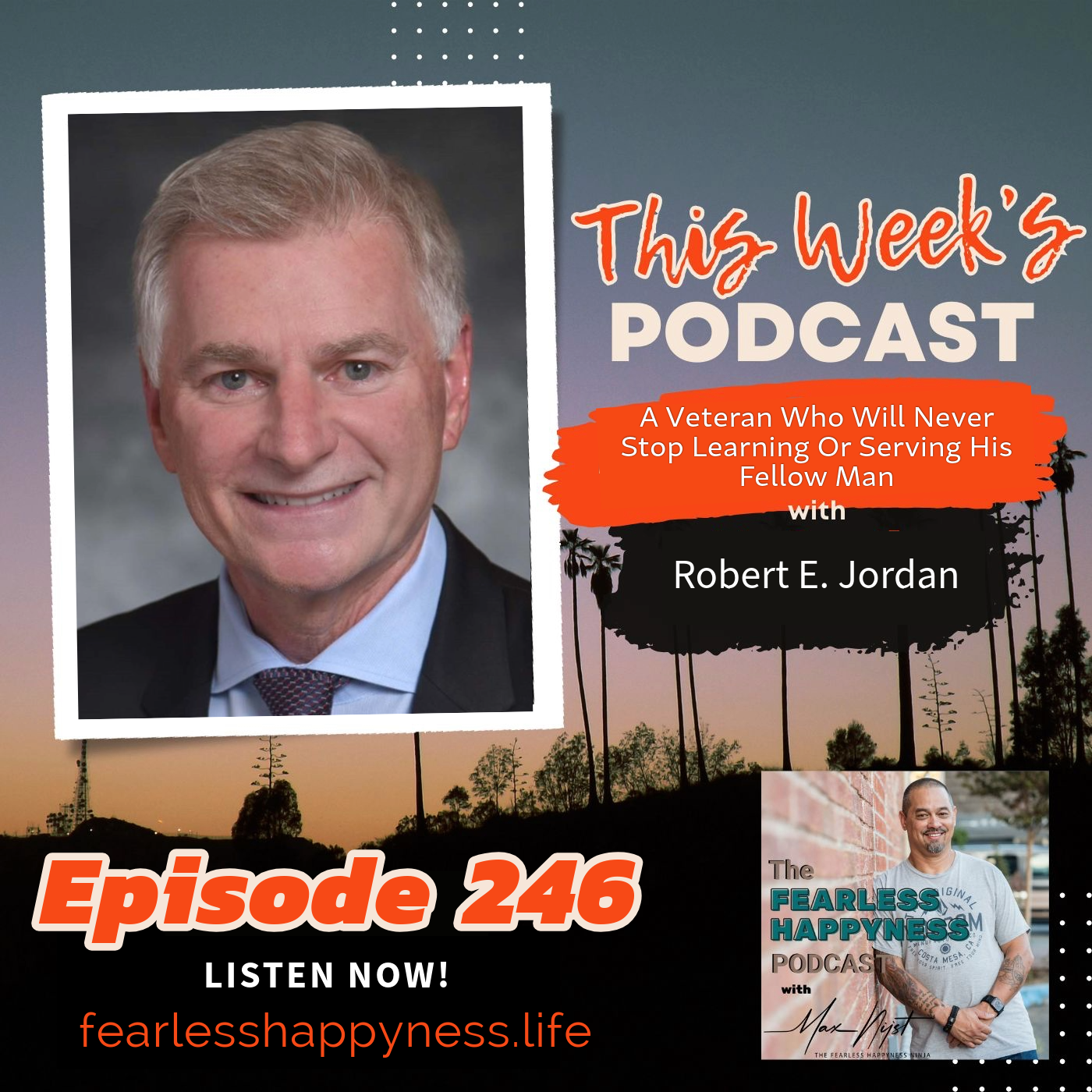
In this inspiring interview, Navy veteran and pastor Robert shares his remarkable journey from military service to faith-based activism. Discover how his experiences in war, trauma, and service shaped his mission to help others through writing, ministry, and philanthropy.
For more from Robert:
Podcast: The Veteran's Outlook Podcast
For More From Sober Coach/Substance Abuse Counselor Max Njist, visit MaxNijst.org
Max Nijst: Welcome to the Fearless Happiness Podcast, where we showcase phenomenal individuals who have overcome serious traumas, life obstacles, and challenges to find their own path to fearless happiness. Listen as Max Naist invites guests from all around the world to share their experiences and spread strength, hope, and faith. This is the Fearless Happiness Podcast. And this is Max Naist. Good morning, good afternoon, or good evening wherever you are in this world. This is Max from the Fearless Happiness Podcast coming to you again with another special and amazing guest. And I really say that he's a fellow squid, like I am, fellow Navy veteran. â but he's 11 books. He's just a fellow podcaster, but I'm gonna let him talk about what he does and what who he is and So, what I like to do, Robert, is have you introduce yourself to my audience, like who you are, what it is you do, and then you and I are gonna rock and roll. Okay. Well, thank you so much, Max. Appreciate it â for having me on your podcast. â a little bit about me. I grew up in upstate New York, â little village of 300 people, quintessential New England. wonderful place to grow up. â the center of the village was the church. â I grew up went to high school, graduated high school, started farming, â went to community college. â and â at that time I I my goal was to serve publicly. I wanted to be a â work in law enforcement, earned a degree in criminal justice, but then I I decided to go in, you know, â go into farming. I raised beef cattle. and â I really enjoyed that. I did very well. Then I realized that â life had something in store for me. I wasn't quite sure. So I returned to â to school and I I I graduated from the State University of New York at Albany. And then â I knew something I really wanted to serve publicly and â I needed worldly maturity because I grew up in that little small village in upstate New York. So â I I actually enlisted in the Navy when I was 34 years old. My goal was to serve four years and then â return to back home and go to law school at the University of â Albany at the â the law school there and then serve publicly. So I finished my first four year enlistment. I really enjoyed serving the Navy in front, in fact, the first tour of duty â was in Japan, so I got to see the world as as I hoped. â I I re-enlisted for another six years. That would have been 10 years total. â I already made chief. and â but the morning of nine-eleven changed everything. And I knew right then and there I would stay in the Navy until the Navy no longer wanted my service. And I would say I would serve another 18 years. â the morning of 9-11, â I mean, I would never have imagined where the Navy would take me and send me with the finest â patriots, the most hardened warriors, skilled technical technicians. â I served â with not only Naval Special Warfare Army Operations Group, I served five tours of duty in Afghanistan, â multiple deployments around the globe. But â that â those five tours of duty in Afghanistan really shaped me and would take me on to my where I am today. But so â fast forward â to a tremendous career. â And â I served, like I said, with the finest people â and a tremendous career. â but as I was getting ready to retire, I served at the Pentagon. I was not only was I I was a Master Chief Petty Officer, and then I I commissioned as a warrant officer, which is very, very unusual, â because I wanted to stay tactical and I wanted to serve at a time of war downrange. And I I did that. And â but as I was getting ready to retire. â I was sent over of all places to â for a behavioral health mental health screening. And I was speaking with an army psychiatrist â at an army base there in Washington, DC. And of all things, â he mentioned God. Now, the reason I say that is because that conversation â took me in a completely different path because â if you had asked me what I would do with my life before I walked into that office, I would have said, well, I'm gonna retire and I'm gonna go right back to either Iraq, Afghanistan, Syria, wherever the war was would would take me, and I would serve as a contractor and the rest, and that would have been that. But because of that conversation I had with that army psychiatrist, I decided when I left that office and I was going back to the Pentagon, I would enter into seminary. And so â yeah, that's what I did. I I and so that that meeting took place late summer of 2019. In October, I saw I found myself in seminary. and â so since then in the in the past six years, I completed seminary, I'm a pastor, â I'm a podcaster, I've written 11 books, and I serve people all over the world â to include â Taking care of the poor, widows, orphans, those at risk in Afghanistan. So I gained a great affinity with the Afghan people as I served there in a combat zone. Because â what I realized, â and again, everything is tied in to my â to my relationship with the Lord, but even as an armed combatant, I realized that â there was no greater â environment to to serve humanity then than there. And â so I I gained a great affinity with the Afghan people and I continue to do that to this day. I'm in I'm in contact with â those in Afghanistan every day. and so after I retired, I worked as a contractor for a couple of years here locally. â and then I worked at Operation Blessing, which is part of Christian Broadcasting Network, as an operations â officer in their international disaster relief sector. â but I I fully retired in March of â 2023. And since then I've dedicated â my life to ministry, you know â and â just that's what I've been doing and writing and â helping those who are poor and at risk. So wow, thank you for for sharing that with us. And it's funny when you say that, right? It's because it brings me back to a time in my early recovery when My mentors and stuff said, When you want to hear God laugh, tell them your plans, right? So, like in your case, you had your plans and then you had that conversation, and God said, This is where it's gonna change, Robert. Right. So and obviously, I mean, you okay, so this is where you and I are different, right? You got to have that adventure, right? I joined the Navy, I went to boot camp in San Diego, went to A school in San Francisco, and You know, hoping right. I don't know if you remember, but they would give us these dream sheets and say, We can't promise, but we want to see where you'd like to go. And I'm saying, sure. So I put knowing what I was going through before I left, you know, Califor or you know, my house or went to boot camp, I'm like, I gotta get out of here or I'm gonna fall back into some sane behaviors that's gonna get me in trouble. So I put like Spain, Portugal, all these foreign ports, right? I get my orders the day we graduate, and I'm going back home to my Orange County and getting stationed 20 minutes from my house in Long Beach. And my I don't know, you probably remember the commercials where it was like the Navy, it's not just a job and it's an adventure, right? And you would see the fleet on those commercials. My mom goes, What happened to your adventure? I said, I guess it's gonna stay in California, right? You know, and there's some things that I think about when I hear you speak, I'm like, man. It would have been great if I would have continued and you know, retired Navy too, because then I probably would have had those adventures, right? Because I got out like less than a year before we went to the Gulf, the first Gulf War, Desert Storm. And â and I got to serve with well, at least when we did our Colonel Usher drills, right? I got to see some of those special warfare guys. We had SEAL team five on board. I was on a LHA at the time. You know, we got to see Marine Recon, L the SEAL team five, and you know, I'd sit on the deck and watch them do their stuff and just go, like, well, this is the adventure they were talking about, you know, for me. But I didn't take advantage. I ended up getting hurt. But like again, I love to say thank you for your service, right? Because I think you know, and then I think it shaped you all that time you did in the service. God was getting you ready for your ministry. And right. And but I'm here to tell everybody, right? I like I talk about the 12 steps sometimes. I talk about what God, the Lord, who I have faith in. But this is I just want to give people the opportunity to see what's happened in your life, right? And how that you've written 11 books, but talk about some of those, like say the challenges, because you were there. Right during wartime and you've seen battle. How did that affect you when it came to your faith or just shaping you as a person? Right. Like, cause I know I've seen things in my addiction where I was like, Well, if there's a God, why is he letting me go through this kind of thing? Right. But you get what I'm saying? And you've seen the poor, you've seen what battle, you know, what war has done to a country. How did that shape you early on where you were like? Man, I don't know like if I want to do this or not. I mean, you said you wanted to keep going, but it had to have that effect on you mentally when you were seeing, especially children, right, going through ravages of war. How did that shape you and how did that affect you? Well, that that question is often asked me, you know, how could you do what you did if you're a man of faith? And so, you know, you you you really have to rationalize these things, or either you do it or you don't, right? And so I I I was filled with the the desire to serve selflessly and purposefully, right? I I wanted to serve my country. My both my parents were World War II veterans. and I really wanted to do this. And â of course with nine eleven occurred, obviously I was in it for the long haul. So â I n I j I just I I knew that that we were at war and I didn't know where that would take me, but once I I I realized that my path was going to take me to Afghanistan. then I realized that wow, this is this is real. â and once you land there â and you start working with these guys, then you realize that you know this is not what you think it is, right? Because nothing prepares you unless you're a unless you're a special warfare operator, nothing can prepare you for that, right? Right. â unless you're â you know, and so but what I had to rationalize is this, and â you know the the opposing force is the enemy because they want to be, and that's that's it. Right. You know, once they're no longer a combatant, they're no longer the enemy, s you know, on the battlefield. They give up, they surrender. and one of the things I I would tell people is, you know, when it When a combatant is no longer combatant and is wounded, they get they receive the same care that we offer our own personnel, right? So â there's a big difference between the way we care for people and and the way the enemy cares for people. We know that for a fact. That's what separates us. And so, â but you know, my service having been with these really staunch stoic. Men â and women for that matter. â You know, even though I received the highest levels of training, â you know, I can I can freely tell you without â you know, without really bluster or but I freely admit this that, you know, I don't think I was emotionally prepared for â for what I would â witness and what I would observe and what I would â you know experience. And That's just the way it is. And â so from that, â you know, I I did experience trauma. I did experience you know, some really some deep seated â moral injury, â some PT and I certainly chronic PTSD as a result, just because I'm not as strong as the people I served with. And I mean that I can freely admit to that. Right. â But I'm still grateful for the opportunity to to have been to to serve there. And and for that, I â I'm very grateful. â and so â but it would it it did come at a cost. â I did â experience trauma and like I mentioned I had gone for mental health screenings because I was â I did experience â you know chronic PTSD. â anger, depression, survivor's guilt, all these things that that come with that type of â experience, right? Right. Yeah. You know, and that I mean you can't help it, right? But no, you're going through that. And I I mean I'm gonna follow that up with I know some people that have served at the highest levels, right? With special warfare and They I mean, even them they talk about the PTSD and like it's something you can't escape from the things you see and that you have to do in those situations, right? And you know, but It I don't I mean, I have my own form of PTSD and that's survivor's guilt in another arena, right? Not from my addiction. So I kind of get it from seeing some of the things I've seen when I was actively in my addiction on the street and stuff like that, what I've seen with people and stuff. So I kinda get it, but war's different, right? Yeah. And â you know, because I think about 9 11 when that happened. I mean, I was already out of the service and I mean that's no other story. But I think about â What that did for our military, right? Like everybody was like, okay, we're staying in because we we're gonna protect our country now that this has happened, right? Wasn't that the first time in hundreds of years where an an enemy has hit American soil, right? So it kind of set the Patriots off, like, â that's never gonna happen again, right? So yeah. But going back to that, so as you were serving. â and we know what happened in Afghanistan with the pull out and stuff like that, right? Right. I mean, I don't because here I don't trust the news, right? They don't talk about it much. But from what I hear from people that I know in the military, it was as bad as some of them said it was once we left. That when the Taliban came in, they were just it was free for all for them to do whatever they want to, and that's why I think that's a probably a big reason you want to go back and help the children and people that are suffering from that time because of what. That specific those specific regime that's what they do to their people. But I want to ask you, right? Because I'm sure you saw it, because I don't care how tough you are. When you see something happen to a child, right? Whether it's wartime or here in the states due to domestic violence or whatever, that has an effect on even the toughest person. How have you managed to? I mean, I know you say you still suffer from the trauma and chronic PTSD, but did you get help for it? Or how do you handle it? I know God is probably a big factor in your life to help you with that, but how else? So if the audience is listening and they're like, I gotta figure this out, like, how did that how did you find the help that you needed to continue doing the work that you do now? Yeah, great, great question. Well, first off, â You hit on a very good point. The disastrous withdrawal in twenty twenty one, August of twenty twenty one. it really in my mind was a surrender because we turned it everything over to the the the enemy, right? Right. But what we really did was we we really turned our backs on our Afghan allies who fought with us for 20 years and we left them in the lurch, right? And that the Taliban would hunt them down and kill them. Now, and they were really our â our aligned and highly skilled and highly trained Afghan special forces. The Taliban does not really care about a regular conscript, right? You know, a private or sergeant that was just an Afghan army. Right. â the the real threat is the highly skilled Afghan special forces, the commandos and the rest, right? So â and Really, what happened was just inexcusable. I mean, it so that was a catastrophic mistake. â so that really led to a for many of us that were Afghan war veterans, this moral injury, this betrayal, â if if you will. So that's deep-seated. â so how d so to answer your question, you know, â I have to rely upon Both secular and non-secular treatment programs, right? Right. So the VA offers, you know, they take very good care of me. I will have to say that. â and I I I follow through with a 12-step program, Celebrate Recovery, which I think is phenomenal, right? Right. â I'm in fact, I'm I'm involved in that ministry myself. I mentor and and support men who are afflicted and addicted through the ministry of celebrate recovery. â and so also through. â the va through their counseling services. I get my my prescription medications through there. and â I think a lot of the also â my my reliance on my faith which only gets stronger every day because I am a pastor and I get to work so much so in depth with â with my relationship and the which â which I said gets stronger every day. Now because I I tell people You know, although I've completed seminary, I don't consider myself a theologian. I consider myself a disciple. That's all. I'm just an ordinary guy who is trying to strengthen my relationship with the Lord. And through that, I try to just reach out to help other people. That's it. So if you were to ask me what verse chapter is this, that, and the other thing, I I really can't tell you. But I do know what the Lord has done for me and I want to forward that along. And I know that that there is the good news of the gospel. And I that's what I w I try to try to relay to others because there is healing power in that. I know that for a fact. And so, â but I will tell you that â you know, that the the government, which is really almost non existent there, â and and the effects on the ordinary Afghan people are just devastating. â and so. I try to do my best to help as as those that I can to make their lives somewhat better than what they you know, other than if I if I couldn't, their lives would be miserable. Right. Right. And so I just try to help what where and when I can and try to ease what suffering to whomever I can in some very, very small way. I started my own nonprofit, â which is called Bright Future Philanthropy Corporation. â so I have that and â it's a Virginia based 50 â 5013C. â if you you know you can see behind me some of my books. â they're all available on an Amazon, but also if someone wants a an author signed copy, they can or they can â order them right through me through email and I don't sell them. They're for donation only. And â 100% of those donations go to feed people. So I don't want to take away from anybody, you know, so I cover all the administrative costs myself. So if someone wants to make a donation, I'll send them the book. They they they â you know they provide for postage. And I tell people just give them away, right? Because the worst thing that somebody can do, I believe, is buy a book and then put it on a bookshelf. It doesn't it doesn't do anybody any good, right? So just give them away. Just give them away. Maybe it'll it'll influence somebody to, you know, to to offer a donation â the second, third, fourth time around. I I doesn't matter book sales to me. I would rather have them given away and perhaps someone give a donation. So because all the money I, you know, I help â young women with a seamstress academy so they can learn how to sew, so that they can earn a little money selling dresses, you know, things like that. You know, widows, orphans, feeding them, things like you know, the little things, but makes a big difference when you're hungry, right? Absolutely or you're sick, right? So yeah, yeah. Well, you know, I'm gonna say it, but God bless you for doing that. Thank you. Because I mean, when I'm hearing you talk, like I can even feel myself getting choked up thinking about like that betrayal that they must have felt when we just left, right? We just left and not understanding, see and We'll talk after because I have some friends that you know they're on the other side. They're going, â we didn't do that. He did it the correct way. And we know who we're talking about. I'm like, No, we didn't. No, we didn't. You asked people that I know in the military that were there at that time and go, No, we didn't. But like, God bless you that you still show up for them. So that there is a face from us, right? That says we still care and we're gonna do our part to help you guys because we didn't want to leave you. That wasn't our choice, right? Because, like you said, like. The Taliban went after them like full for like to destroy and get rid of anything in their way, whether it's women, children, the the the men, right? Because that's what they do. And it's it's sad, but you know, at least I you know it comforts me knowing that you're still helping, trying to help them in some form or fashion. Right. So, you know, I always say, like when I hear that, God's got a place for you when you get up there, when it's your I think He's gonna. But cause war, as as you and I know, I mean, I I can't say that I would I'm a wartime vet, but I've got friends who've come back and and talking to you, I can still hear the pain in their voice, right? Because we did sign up because we wanted to serve in a capacity to give back to our communities, the country we live in, right? To kind of say, like, thank you for giving us the life you've given us. So now we're gonna give back, right? That's why I love this saying from JFK is not don't ask what your country can do for you, but what you can do for your country. I mean, whether whatever politics you believe in, I think that's a a quote that just stands out for the ages, right? Yes. And you know, now you're serving God and and you're right, because I mean, I can sit here with we could probably be here for hours and I could ask you this and how'd you start this? And how do I get involved? But let it let's talk about. some of the books you have written and what are in those books. So right when we get to that point, we can say, okay, this is how you can get a hold of Robert. Let him know which book you want and he'll get it to you. But talk about your books. Eleven's a lot of books. So I want to hear about them, Robert. Yeah. Well thank you. Well the the first book I wrote is is titled A Faith Flag and Family A Purposeful Guide for Selfless Service. And that that was born out of â when I was a senior enlisted Leader, I started writing letters â to sailors. And I think the first letter was addressed to five sailors. And I just delivered, I just here, here, I want you to read this, right? And so they were a memo format. â you know, why and I think the and I do I know the the first letter was why I serve. Try to inspire these five sailors, you know. â in this memo format, why I served to inspire them to serve. Right. And so the next month it I I wrote another one. And then it went maybe to 10 sailors. Then it went to 20, then it went to 50. And then over the course of a few years, you know, it was I I don't even know how many people were getting them. It just it just ballooned to, you know, hundreds and hundreds of people. And then People would forward them to their brothers, uncles, cousins, and people would send me emails. â I, you know, my relative sent me this and thank you so much. And so that was the first book. â I I come I â put together a series of, you know, I put an â anthology, if you will, of all these memos into this first book, Faith, Flag, and Family, a purposeful guide for selfless service. â and then I started â I thought, well, â it's gotta be a second book, right? So â I wrote â I've written historical accounts of my my parents' war service during World War II. â I've written philosophical book, â My View of What Others Perceive. â that's that's kind of a overview of how I look at life, â the struggles of you know, â my youth, â growing up, growing older. â then I wrote some â sh â anal â anthologies of short stories. There it's entitled â The Warmth of the Gospel. and so there there's a couple of those you can see them right behind me. I see them right â and then I've written â a series of biblically based teen novellas. â with an inspired â in collaboration with my granddaughter â and so they're really neat now that my granddaughter came up with this idea to they're they're very small in size â these books they you know so there's my hand so they they're they're designed to fit in a girl's purse â wow so they're like a pocket book right and so â so we we've written â three in that series and â and that she's the main character and I'm the protagonist. I I save her from from evil, right? And and so they're really neat. They're they're nice little stories. And so we've written three of those. We've written four children's books. â and so we have those. â and then so that's the eleven. But I also have put together Nine volumes. So this is in advance of the 11. So nine volumes of coloring pages for those living with PTSD. So there that's really unique because â there's each volume has 31 intricate designs and 31 journaling pages. So the idea is focused attentiveness. So you you color in with c with â coloring pencils the design. You can spend hours on these designs coloring them in. But then you have a journaling page for the corresponding day. And so yeah, yeah. So I I I put together nine volumes of those. So all in total, there's over 20 books that I've put together over the last six years. So all of which are available â on Amazon or through me, â whichever. â but so that's a little bit about the books. â And so â I'm currently writing a book â right now. â I'm co-authoring it with it's a really unique book. and â I'm really excited about it because â the book â is it's written in collaboration with â a woman â who lives â outside of the United States. â and it's going to be â Her views and my views on faith. And she is not a Christian. And so it's just kind of resolutions of faith. â and just kind of, you know, come together and look at life through her eyes and my eyes. And it's not â it's not in a way to convert anyone, it's just to kind of look at life and and â from two perspectives. And so â I'm really excited about that one. It'll be under my name of obviously, but â her name it will be â only â as a pseudonym because of we have to protect her identity. So gotcha. I I love that though, right? Because you're gonna show the world that you can look and have faith from two different perspectives. Still get along and help other people. Yes. Right? Which you know, as you see in the world today, it just seems if you have a different view or you're I won't get into it, but you get what I'm getting at, right? Like we've seen recent events where if you have a certain view, you're you're wrong, you know. Anyway, â and I love that, right? Because I think this world has gotten gotten away from that oneness that God wants us to be, right? Like one with each other, connected. â which you know, like your 12 step program, which I've been to a few â Celebrate recovery meetings here locally and I loved it. but I got sober through 12 steps of AA, right? AA, sure. And you know, that's my foundation, but it's the foundation that has been laid out for me that has always pushed me to get to know God even more. You know what I mean? Like, â and if I didn't have that connection with people from different backgrounds, I mean I'll be sitting here with you. But you know, to go in a room and go. Wow, that person comes from a totally different background, but we're hitting there together and and we're we're helping each other is to me like that's the best thing ever that I have learned from my recovery is that it doesn't matter where you come from. We have one purpose, and that purpose is to help one each other. And our case gets sober and stays sober, right? And then things evolve from there. â so as you're gone in this journey and written your books, I mean. It sounds like you're a very busy man, right? But it also sounds like you like you love it's it's a work of passion. Like this is what you love to do. You're just and it doesn't matter who you are. You if you need help, you're gonna be the guy that puts his hand out and says, right? Because and I'll, you know, there's a saying or on our literature in AA that always gets me emotional, but it was one of those things I read that clicked for me. When it said, when anyone anywhere cries out for help, let the hand of AA be there. And for that I'm responsible. Why my sponsor said, take out the AA part right for now, because after my last relapse, and he said that anywhere, when anyone anywhere cries out for help, you're gonna be that guy that's gonna help someone. I don't care, it doesn't have to be in a meeting, it does whoever. And thank God I listened to him, right? 22 years later, I'm still sober because of that advice. And Amen. Because being around guys like you that I have met along the way, right? That I choose to surround myself with and learn from you because like sometimes I feel like I'm I'm still, I mean, it's always good to feel like you're learning, right? And keep learning. But when I meet guys like you, I just I'm like I and I'm I'm like in awe because I'm like, okay, there's so much more for me to learn. How can I help do this? You know, because I see Robert doing it. How can I expand my help for other people? And I guess this is a good outlet for me to bring like have you on here is to share your story so people could see like, wow, Robert has come right, he served our country for 27 years and now he's serving others. It's amazing. â thank you. â Well, you know, also one of the things I've I â you know, I'm a doctoral student as well, and so. you know people will say well you know by the time you finish â you know with that degree you know you'll be because I'm 66 right so you'll be 70 years old so but you know what to what end will you know and so there's always those naysayers you know they try what so I but the reason I'm I'm really focused on doing that I have a I have a 14 year old granddaughter and so I'm trying to motivate her and so What better way to celebrate her â graduation from high school is both of us will be in cap and gown? â That's that's that is so awesome, right? But I'm with you, grandpa. I'm the same. I got yeah, grandchildren, and I have said I want to go back and get my master's, right? And right. So same thing. People go, Well, you're gonna be 60. And I'm like, Yeah, so like yeah, right. God never says you stop learning. What's where in the Bible does it God says? Stop learning at this age, right? Yeah. It always seems to me like we're supposed to be lifelong learners, right? Especially in our faith and how to grow that faith and help others in the process, right? It's a lifelong process, correct? That's right. Yeah. And that's all I want to do. I just want to grow closer to to the Lord and and â you know, and just be able to be a better person, a man for all seasons, right? For those that I serve and love and Those who are poor, those at a risk. And also just to be of that motivational factor for my granddaughter, you know, as she grows up and begins life â you know, after high school and she can always look back and because â I'm very, very close with her and â you know, â and â I just want to be that motivational factor for her and you know, that force for good and all those things that we're supposed to be for our grandkids, right? You know, so that's right. Yeah, I agree. Cause that's like I have 12 grandkids now. No kidding. Yeah. My goodness. That's what I say. So I look in the mirror and go, really? Yeah. But like I see that in my grandson. And then not because I'm leading the way, but he I mean, he stays, he does sports, right? But he stays after school for the extracurricular classes. He just loves learning, whatever it is. And then he goes off to practice, right? You never see him until eight o'clock at night. I'm like, man, I wish I was like him back when I was his. But but if I can, like you say, help lead in that way, right? For him and my other grandkids, we're like, hey, grandpa's always learning, right? And pretty soon we're gonna get to call you Dr. Dr. Jordan, right? I love it. Right. But â but I think you're right. That's that you can't get better than that example. Like your granddaughter's gonna look up and go, Wow, look at grandpa, right? We get to put on our cap and gowns, you know, and and he's graduating and I'm graduating and you know it's amazing. And like I said, like thank you for being here and sharing this story of your life with us and and where you've been and how you've taken those challenges and and turned them into triumphs, right? Because you're I liken it to my recovery, and you understand this, right? Like not thinking how am I gonna help someone and my sponsor said, just keep doing what you're doing, you'll realize it. When you do, you'll look you'll thank me later. Cause when he would help me right through the steps, he'd like Max, you're helping me more than I'm helping you. And I would look at him and I would go like, You're crazy. No way. You're saving my life. How am I helping you more? And then when I did it, I went back to his office and I said, You're I get what you meant. I said, you know what I mean? There, and there's nothing like it. And like, right, that's one thing I would like to start down the line. And maybe you and I can have a conversation another time is. Cause I live five minutes from the back of Camp Pendleton. Right. â wow. And I want to start like my friend did I I'm drawing a blank. I told you my CRS is getting worse, but before he passed away, he started a nonprofit for veterans to help them, whether they have addiction or they need you know, homelessness or whatever. And you know, God took him at a young age, but he was, let me put it this way. God, he was on fire for the Lord, and it was his driving motivation, right? Because he got injured both in the service and out of the service. And I think it was a brain thing that happened. He he fell, bumped his head, and that was it. And I miss him every day. But he was constantly trying to help his fellow veterans with whatever resources he could. And â and that's another story I could tell you about because it got actually got crazy because he opened a little store and next door. Some really weird things are happening, and yeah, we'll talk about that later. But I want to be like you guys, right? Where because I know, and I hate to say this, right? When I got out of the military, it's almost like getting out of prison where they said, Here's your gate money, good luck, right? And I'm thinking I joined the Navy, it's gonna be easy to get a job. They didn't prepare me for civilian life, and right, and I want to do that for guys getting out and ladies. Right. Not only maybe they're struggling with addiction, help them with that too. Maybe housing. But anyway, that's another podcast. But you know, I think when we join the service, it sets us up for that lifelong service, right? Like you can't help but want to help other people, no matter what that looks like. And â gratefully you're here sharing that part of yourself. So I'm going to ask you some of the questions that I I can't remember that we jokingly talked about before the podcast, right? As you can see, fearless, we're going to start with fearless. So, Robert, what does fearless mean to you? And how does that show up in your life on a daily basis? Well, yeah, that's a good question. â Fearless. â I don't think of myself as I just you know, being you know, I think we we we see ourselves as this fearless like a lion or something. I I just I'm just a humble servant who's willing to go forth â and you know maybe extraordinary measures to to help others. Now where that takes me, the I I've been places that have been where I've been very, very scared, where I where the circumstances have been very challenging, where â they've been very austere. but I have been I have I I I I'm I'm first to tell you I have not been fearless, but I've relied on the Lord to get me through. So I would rather say I'm a hu a humble servant. â because if I said I was not fearless. I would probably I wouldn't be telling the truth. So I love it. See very humble, everybody. I love it. â I love it. â that leads me into the next question, right? As you see, I put a why in happiness. Knowing I put that why in happiness, what does happiness mean to you today, Robert? And how does that show up in your life on a daily basis? Going through what you've been through or having gone through what you've been through. Yeah. Well, I I mentioned it earlier. It's it's my granddaughter, right? Now I have, you know, we have a wonderful family, small, but I was gone so much in my military career, I lost a lot of time with my family, â my wife and and and and â and our family. And so now that I'm retired and â I have the time I have the chance to to really â spend time with my granddaughter who lives very near to me. So I get to I get to see her throughout the week, weekends, you know, I we have such a special relationship. So â I text her before she goes to school, I talk to her after she gets home from school, and I and I â I talk to her before she goes to bed every day. I love so yeah, so that that makes me very, very happy â to be with her because â you know, as because her life is just starting and I I just want it makes me happy knowing that I'm trying to be that â a good man for her and to prov to position her for success â in all things. â and so yeah, that's where my happiness comes from. I love it, right? Because you get to make that up, like you said, because of your military career. That's why I always thank the families too. I always say thank you for your service. â yes, of course. Some of them look at me like, what are you talking about? Right. And I'm like, because You're sacrificing a lot to allow, you know, whether it's your wife or husband or brother, sister to go serve our country, right? Cause, you know, like my my daughter-in-law is in the Air Force and it's planning on retiring. I think she's starting year 12 this year, or I maybe even later, but she's been in the military quite. But you know, I understand it because you know, they're at a place for four years, and I from the kids' point, I try to think. Gotta suck, right? Because you're there for four years, you start building your friends, and then it's â time to move. Right. And as you know, that you're either not home or you're moving to another place, or your duty stations over here, or and it's a tough life for everybody. But I think, you know, from my perspective as a former Navy guy, too, I didn't get to experience everything you did, but like I'm So honored that you're here to hear your story and how you're now giving back and being present for your granddaughter, right? Because that's gotta make your family happy when they're like, â grandpa's being so good to his granddaughter, right? I mean, but it's strange relationships. I get it from what I've seen from my friends in the military that are either you know deployed or having to move constantly. But again, thank you for your service and thank you for being here. but so let's get in so. Again, re where can they get your books, Robert? Where can they get a hold of you if they have questions for you or want to support you in your â nonprofit and helping others? Or if they just have questions how to get started helping or they have questions in their faith, how can they get a hold of you? â yeah, thank you. â they can go to my website. â it's â fatherbob.co, not com, but co fatherbob.co. â there they can â it'll link them to â a complete library of my books, â my nonprofit Bright Future Philanthropy Corporation. â it links it to my â Substack where I write weekly. â and so â yeah, they can and they can get a hold of me, you know, via email. And so yeah, that's the best place to â contact me. Awesome. You heard that, everybody. Pick them up on it. â Well, like I said, â this has been one amazing time. I'm so honored that you joined me today, but you're not quite off the hook just yet. Now I get to ask you my favorite question that I always remember. And it goes like this, Robert. So, what is the one piece of advice you could give my audience to help them grow as human beings and become better people? Yeah. Well, I would say this. You know, it it's it's We're we live in a legalistic society, right? And we want to and I think â we compound and complicate things so much. and we make things very, very difficult for us to try to figure out our way. But really, the Lord made it easy for us, you know, because there's to follow his way, you know, just followed his simple rules. Love thyself, you know, loved as you would love him and love your neighbor as yourself. That's it. It's pretty easy, you know. Just be humble people, love you know, help people, â extend yourself further than three feet, right? And just just that's it. You know, just Just love others, love thy neighbor. I mean, how often is it that you don't even know who your neighbor is anymore? You know, right? Exactly. And in some of our cities, as you know, they could literally be like you could reach out and touch them, but you don't know who they are. I get it. You know, or like here's a good point. Like, you know, when the lotto reaches a billion dollars, we all run to the 7-Eleven to buy the lotto ticket, but yet. In the hopes that we would win, which it the odds are so against that. Yet we'll step on, step over, step around the guy who's got his hand out for a buck. Yet we won't do that. And that's the biggest reward when you can do that, right? At least I know I I did that with a kid, and I don't say this to brag, but it just he he asked for help, right? And I'm like, he didn't I he didn't smell like of alcohol, you know what I mean? And he he looked like he was really struggling, he was homeless. He said his family wouldn't let him. So I gave him some money, but I also got him something to eat. And I gave him my you know, my two cents. I said, here's what you can do, this is what will help you. Whether he takes it or not, I said, you know, turn around and help somebody else, right? And what happens is I said, God will help you and you'll get to where you need to go. Yeah. That's right. And he kind of looked at me and he's he thanked me and you know, and he goes, and I saw him like shaking his head, like, â man, like no one's ever told me that, right? Like they just hand me money or whatever. And but you know, I think like you, if if we let's put it this way, my favorite quote. Goes like this, and you've probably heard it before from Jesse Jackson. The only time you should ever look down on someone is when you're helping them up. Right. Right. And I love that, right? Because that's what we should be doing with each other, right? Like, as you see, everybody, Robert's here gracing me with his present and and you know, giving us some great wisdom. So I hope you all were paying attention. Again, Robert, thank you so much for spending this time with me. It was an awesome sorry about the Little glitches we got, you know, that's why sometimes you love technology and sometimes you hate it, right? Right. And we but it wasn't our fault, everybody. But we had a great time. So hopefully you learned something from Robert. And and thank you for bringing so much value to my my audience. So you know how I say it, everybody. If Robert made you think, if Robert taught you something, if Robert made you smile, and my famous, if Robert made you go, hmm, I like that. Please go to iTunes and leave a five-star review so more people can find the podcast and go check out his podcast. So before we go, what is the name of your podcast, Robert? â thank you. Yeah. It's â the Veterans Outlook Podcast. And it's on Spotify. Yep. There you go, all my fellow veterans. Go check out his podcast. So thank you for being here, Robert. Again, everybody, good morning, good afternoon, or good evening, wherever you are in this world. This is Max from the Fearless Happiness Podcast. Until next time. Are you tired of being weighed down by life's traumas and struggles? Join the Fearless Happiness Lifestyle and let us guide you toward a brighter future. Explore our past podcast episodes and get a copy of the Fearless Happiness book to ignite your inner strength. If you or someone you love is battling addiction or facing challenges related to unresolved trauma, know that we are here for you. Visit maxnates.org, M-A-X. N-I-J-S-T.or-G and take the first steps toward finding your fearless happiness. Thank you for listening. This has been a production of Fearless Happiness.


