
 Apple Podcasts
 Spotify
 YouTube
  RSS Feed
 The Phobia Freedom Formula: Unlocking Lasting Change in 45 Minutes with Blair Dunkley |248
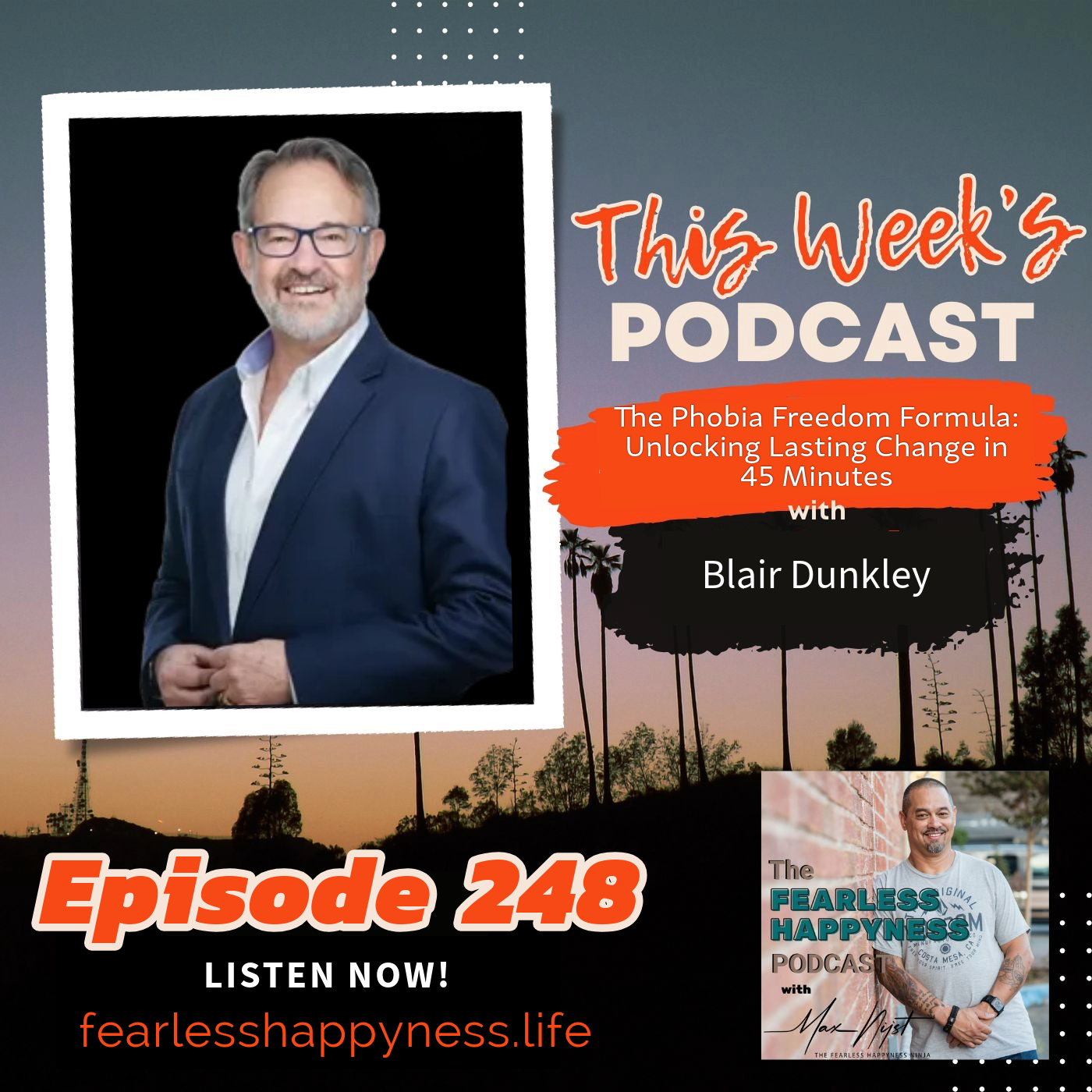
In this insightful interview, Blair Dunkley shares his extensive research on overcoming fears, phobias, and anxieties through neuroscience-based mind models and innovative therapies. Discover practical strategies to rewire your brain, conquer trauma, and build resilience for a fearless life.
For More From Sober Coach/Substance Abuse Counselor Max Njist, visit MaxNijst.org
Max Nijst: Welcome to the Fearless Happiness Podcast, where we showcase phenomenal individuals who have overcome serious traumas, life obstacles, and challenges to find their own path to fearless happiness. Listen as Max Naist invites guests from all around the world to share their experiences and spread strength, hope, and faith. This is the Fearless Happiness Podcast. And this is Max Naist. Hi, good morning, good afternoon, or good evening wherever you are in this world. This is Max again with you coming from the Fearless Happiness Podcast. And yes, again, I am blessed. I have another amazing and special guest joining me, Blair Dunkley, all the way from Canada. But what I like to do, Blair, is have you introduce yourself to my audience, like who you are, what it is you do. And then you and I are gonna rock and roll. Well, thank you so much, Max. It's â A total pleasure to be here. And I â I know this is early, but hopefully if you guys stick around to the end, â I'll give a few gifts away. But you know what? I hope you guys give some gifts to Max, honestly, because he's doing, we were just chatting, and I'm impressed with his attitude, his energy, his connection, and his as building his podcast the way that he is. So please give it a five-star review. And help it get out there, okay. If you don't mind, hit that five-star like and and just put in some comments to boot. Anyway, for me, Blair Dunkley. â created a few companies in my lifetime. â Life Skills Colleges was a big one. I did that for 35 years. I started that based on research done here in Canada. â the government back in the day fent spent 42 million dollars in five years figuring out. 362 core competencies that people need in order to cope with life and problem solving. Unfortunately, the research was shut down a little bit early. I went on and did 17 and a half years ongoing research. And from that, a bunch of things fell out. But a big thing that fell out was the whole thing about the phobia freedom formula. So people with phobias, fears, anxieties. you know, PTSD, that sort of thing. â traditional methodologies that I found don't have don't necessarily deliver what's needed. So that that's a major part of my work â back in the day was to do that. So what I do is I help leverage people out of that in generally 45 minutes or less and â show them how to think differently. And it's all around these mind models that I developed. While I was at life skills colleges. So I'm a behavioral researcher and that's what I do. And I teach people how to think differently and leverage themselves as a result. Right. Cause you and I were talking before â the podcast here, and we were talking about mindset. And you're like, Yeah, there's there's mindset is not working for a lot of people, right? Because of true of these phobias or fears or the anxiety. â And I can attest to that, like someone very close to me. I know their anxiety certain events have happened in our life where their anxiety levels are right. So it's I watch it and I could see it coming on, right? Certain things that we do together. Well, if I wasn't there, they might have a panic attack, right? Right. And and but I've also seen this person that I care about very much put herself at what do they call that? Like, When they â they face that fear and do it anyway, like exposure therapy, as you would call it. That's that is exposure therapy. Yep. And â and there seem to be getting better. She's she still has her moments, but you know, there are moments where she it it does become overwhelming and she'll say, Can you go with me to the store? When there's a lot of people around. And I get it because I get anxious when there's a big crowd, like when when I feel like I'm in a confined space, even though Like back in the service, right? I had to learn how to be in confined spaces because I was on a ship. And when we were fighting fires in the engine room, I definitely not a lot of room down there, you know. And you and â and then when I got out fire service and all that and learned how to do things in, you know, that's how I overcame a lot of my fears was by doing things that I knew were gonna put me in those situations. â So here's one example, and then I'll let you take over. But like heights, I was afraid of heights. Like I, you know, what did I do? I went skydiving twice, once at 13,000 feet and one at 18,000 feet. So now it's not an issue. I've I just kind of put myself in that situation. One, it was because I'm an adrenaline junkie. I like I like that stuff, but I knew if I if I would have let my fear, I would have never tried it. If I would have let my fear take over, because then I would have saw like these, you know, I'm not going up there. No way. So in your research, right? Because you know and I know, Blair, that there's a lot of people, especially in this day and age, that are struggling with phobias, mental health issues like anxiety, depression, PTSD, right? Traumas that they've experienced in their lifetime and don't know how to get out of that. So, how do you help someone when they come to you and say, Blair? I don't understand what's going on with me, but I don't like doing that anymore. I don't I'm afraid. How do you help overcome that fear? Well, great question. You know, honestly, there are traditional psychologies, I mean, exposure therapy would be one of them. â cognitive behavioral therapy, bunch of other therapies, you know, all have some play, but the problem, especially with exposure therapy, is your brain is being Re-traumatized by being re-exposed. Now it depends in that split second of you doing your thing, and and you stated very clearly that you're an adrenaline junkie. So your fear of heights you were able to get over because you had a compensating part that was your adrenaline junkiness, if you wish. I don't know. That that part of you that wants to to experience that. So which is bigger in that moment? Which actually, from a neuroscience perspective, which has got more pull? Obviously, it was the adrenaline junkie part. And that's perfectly fine. It's great. The problem is that it doesn't necessarily work for everybody because they don't have a counterbalancing drive to get it done. And a lot of people Who go through emergent â sorry, â a therapy, â immersive therapies where you wind up going in there and repeating the same thing over and over again and hoping to just desensitize yourself from it. That whole model, â for some people, it's re-traumatizing. And that's been proven. Again, neuroscience has that. That's part of the thing. It doesn't work for everybody. And actually. It doesn't work for the majority of people. Some people it does, other people it just doesn't work. However, â the whole piece of the research that I did with phobia freedom formula, that was all researched based on neuroscience, â TFT, thought field therapy, and also the mind models. And I blended the three of them. Now I found this found this therapeutic model â partially â out there but it wasn't well received and wasn't really work and it was TFT Dr. Callahan â developed that so that part was there but he called it thought field therapy and it was before we really it was done in the 1980s. It works basically but the issue is is that it doesn't the the theory, the basic the the background of it is not linked into current neuroscience. So they didn't have that and his theory on it was all about thought perturbations and how you know your thinking worked and and energy systems and whatnot. And it didn't stand up well to criticism. However, neuroscience starts breaking things down and when you start recognizing his components Of what he had, you know, what fires together, wires together. Common aspect. â Dr. Herb. â I'm butchering his name. Apologies, but it's not Herbert it's Hubert. No. â sorry anyway, it's it's just popped out of my head, had it on the tip of my tongue and it left. So anyway, â this guy figured out and coined the term what fires together, wires together. And it's great for when you we start seeing the neuroscience that's there. And we also have another thing that's common in neuroscience is rapid repetition. When we do rapid repetition of anything, it tends to lock in our brain better. So parts of the thought field therapy had this what fires together, wires together. So if you have a thing in your mind. That you're irrationally afraid of. Like my ex-girlfriend and I, â she had a horrible fear of flying, absolutely horrible. It would take her like two Xanax and â you know, two double martinis to pour herself onto the plane, sort of thing. I know someone like that too. Yeah, well, you know what? She ain't the first, she won't be the last, right? But literally using Mind mod the mind models paired with the â the thought field therapy and neuroscience, I was able to literally permanently cure her in under 45 minutes. And it's permanent because what we're doing is we're taking some of that neuroscience stuff because we're using rapid repetition and what fires together, wires together, we gently open the phobia up in our mind. And then we do what fires together, wires together. We do a whole bunch of different actions and thinking, all while we've got this open, to scramble the connection between the thought of what's phobic getting on a plane or flying and crying, breaking down, shaking, stressing out, all of those other things. The physiological parts, well, we rewire. We literally rewire that. So It goes away. And we do multiple iterations so that the person literally monitors themselves, which comes back into the mind models, how you you interact with this, it needs to be a guided process. And so that you can monitor yourself and notice how it's how you are going, how you're changing. And as you change, your practitioner, your â phobia freedom formula practitioner starts breaking it down with you so that you become consciously aware of the thing that you just yeah, it's less. Well, what specifically caused it to be less? How did that do it? Or and then they see a look on your face and say, What's happening right now? What are you feeling right now? They describe it because usually that thing on their face is a smile. Right. And they barely notice the smile. But then they go, Yeah, I'm just not feeling the pressure. I I don't feel like crying. And before, when I was thinking about it earlier, when I sort of test them out first to make sure that the phobia is actually there for them, they they start almost crying and then I try and interrupt it and redirect them. Sometimes they break into tears, and just by thinking about it, they have a tough time coping with it. And I go, okay, that that's obviously. A â a phobia or fear or anxiety or PTSD or whatever it happens to be. And we break it throughout and break it down into things where we get them to track and notice. Then we do rapid repetition with that. And that starts stacking the brain's way of coping differently right now. So it rewires the neural pathways. That's it in a nutshell. But There's so much more to unpack here. â I I can only imagine, but what comes to mind for me, like what I do with clients, like say in our facility, right? That are it's difficult, but it's brand new, right? Because they come in, they're broken, right? They're going through detox and they're you know, been on the streets or whatever. And they always, you know, they'll come to me and say, Max, you know, I gotta change the way I think. And I said, Well, are you willing to do something? It's not going to be hard, but something different. So you can change the way you think, right? But you have to be consistent and you have to do it every day, right? Like you said, almost that it's that repetition. And I start them with a basic gratitude journal. Right. You and I know the more you put positive things, like from the time you wake up, like if that's the first thing you do, and then the last thing you do is put something positive in your brain. Neuroscience proves that it'll actually build new neural pathways in your brain. So you can look at the world and people and yourself in a more positive light, right? Exactly. I and so it sounds like that's kind of what you do with depending on the situation, obviously, but is to build those new neural pathways so they can overcome and get rid of the phobia or fear, right? By replacing them with new neural pathways, correct? That's but think about it. There is all everything that you think, say, and do. All comes and gets filtered through your brain one way or another. Okay. You can't move this thing here. You can't hear, you can't see, you can't feel without your brain being involved, right? To some degree. Right. Everything. It's it's yeah, it's part of everything. So how did this stuff that we were just thinking, seeing, hearing, feeling, even tasting, how did we learn to do all of that? Part of it is how we're built, but everything can be developed. But even ineffective things like being like, I don't know if you know this or not, but the pain and pleasure center are right next to each other in the brain. Right. So some people can literally learn how to, it's gonna sound weird, enjoy pain so it becomes pleasurable. Now that is not normal, but that is something that happens. Right, right, right. Secondly, way back in the day when I was doing my behavioral research, there were some â there was a study done of a young child who would enjoy touching and burning themselves. They weren't in an abusive family, but they would enjoy that because the pleasure and pain center. were merged in the brain. So pleasure and pain did not work like that. Now you can discern the difference or you can merge them. These are all learned behaviors. So you can quite literally learn how to separate your phobic response to the phobic stimuli. And that's what I reinforced. I didn't I can't claim to have cracked the code. I didn't crack it. â Dr. Callahan did, but I reinforced it and just got it so that it's highly pro â probabilistic that you've got about a 97% chance on fears, phobias, and anxieties that one session is all you'll need to permanently you know get rid of it. Now A lot of people go, how is that possible? Well, like I've I've given you a bit of the background, but there's more to it. But not not tons. It doesn't take forever. But PF PTSD, it also works on P PTSD, but it tends to be slightly more complicated with PTSD, but it's it's in the eighty plus percentile of effectiveness, which is still better than most stuff out there. Absolutely. It's better than most of the drugs they want to use or Right. Because I've I in my chosen profession, I have dealt with firemen officers, you know, veterans who have all experienced some form of PTSD, whether it's in the battlefield or on the job, you know, as first responders, you know, anywhere in the world, a first responder is gonna go through a traumatic event that's gonna just implant that in in their brain to where they, you know. â some of I know have been medically. Retired because their PTSD got so bad, right? As a fraction or a officer. But I want to go back a little bit, right? Because you just gave our audience and they're already probably going, Ooh, this is some really good. Like, I want to have to get a hold of Blair â and and have him help me get rid of my phobias because â I feel stuck, right? But go back a little bit and talk about some of your experiences, the challenges you faced that like shaped who you are and â absolutely. into this field because I know like for myself and some people around me, like we could definitely use right something like this, other than someone just saying, Max, you got to change your mindset. Right. Well, yeah, I've done that how many times over and over again and right. But like you said, the brain is a very powerful thing. It's it's only gonna do what it's been trained to do. And right, I know you gotta and there's probably people out there which we'll get to but you know Listen to what he's saying, everybody is it's it's not a magic pill, but there is a way to overcome your fears, phobias, anxieties, PTSD by rewire what he's talking about, really rewiring brain and you know getting I hate to say get over it, but moving forward from those things that hold you back. Well, yeah, and I want to say moving through it as opposed to over it, because it's not about over it, it's about Figuring out a different way to process the information in going through this. So that you like, okay, it's sort of like going down a road. You can go through this tunnel that you can't even see the end of it. Right. And you go terrorize yourself with that. Or you can take a unknown shortcut and drive over and around. Instead of going through it. And all of a sudden, it's done. And you're on the other side of it. And you never have to go back. Right. But see, that's some doing it like that, I think, is where like that saying, trust the process, right? When you trust your process and you get through it, not only are you going to become better for getting through it, right? You're going to learn something about yourself. And that just absolutely. Right. Like that's when I think the mindset is good. Right. Because then you go, wow, he helped me do this and I did it. Right. Now I know. Like now let's now they probably look at you Blair. Let's do the okay. I got the next one, Blair. Let's go. Well, sort of, but I'll I'll I'll course correct them because you said earlier on the whole discussion about mindset right off front. That was the whole thing. Like I said, I'm a I'm a mindset trained mindset facilitator. Okay. So I had a great mindset for four years until my dad went into a coma. And then my mindset broke. And I recall the doctors telling us two weeks after my dad â got out of open heart surgery and he was doing fine. But he was just about like a few hours, a few minutes actually, 15 minutes before he was going to be released from the ward, â the intensive care ward onto the the basic ward â in the hospital. For some reason he stopped breathing. And they gave him a drug to induce a coma, which he never came out of. So, with that, two weeks later they call us in, the family in, and say, Your dad has a 99% chance of never coming out of a coma. Well, that was I broke down. Like I went home, went in the shower that night, and just collapsed in the shower. Convulsively crying, just couldn't handle it. And I was already at Life Skills Colleges. And at that moment, I go, I gotta pull myself together because this does like I can't be showing up to work with you know 80% of her students potentially suicidal. And here I am, I'm going, I just about want to join them, you know. I'm I'm like fuck, pardon my language, but it was horrible. So that's bad though, too, you know. Yeah, it was. It just throws a the biggest wrench that anybody can think. Tell you, I went through I know exactly what you are talking about, where you just go, Well, this sucks. How am I gonna get through this now? Right. I because yeah, I'm and then you you start doing like I I don't know about you, but I was trained in how to manage these things and help other people manage them, these types of experiences. And one of the ways that I was using was mindset, but fortunately I was also trained. And taking training at the time to become a trainer of life skills coaches. I was already trained up and a coach, but I was being trained as a trainer. And so I had some skills. And I thought mindset was the best thing since life spread. And my mindset broke. And what I wound up doing was going out and literally going back to my trainer. And I'd ran myself through 90 minutes of exercises. That I'd run any one of my students through. And at the end of the day, she ran me through those exercises, which I'd already run through. And it came back exactly the same. I didn't change, I didn't shift. And she said to me, All the audacity in the freaking world, Blair, you just don't believe enough. Pardon my language here, but fuck you. And I left. Like, yeah, I was done. I was totally done. Like not good. Not good enough. Pardon me, but that was huge. Right. You know, I can't go into life skills colleges and say you don't believe enough to when 80% of my students are potentially suicidal. I might as well hand somebody a frickin' gun. Right. Like that's not reasonable. That also showed me very clearly that mindset is broken. Because you can't play blame a process that is supposed to help people in all situations of life. That's what your mindset is there for, to help you through everything and to build your success and everything else that goes along with that. Right. And then tell them that it's my problem. It's me. That's frickin' BS. I go, no way. I'm I'm This does not compute because life skills with life skills training did not do that. And I was able to use that on my clients, somewhat on myself, but not as completely as I would like, because it wasn't everything that I was looking for with life skills, as I said earlier. There's, you know, some gaps that we needed to fill in. And these were some of them. And that's where my behavioral research part kicked in. And I went after it. And I developed models that were able to mind models actually that were able to understand and quantify the issues and then move forward to providing action steps â to be able to get change happening. So every mind model is identifiable, named and labeled. It's repeatable. You can do it over and over again and get the similar result and duplicatable. And that's what I added to Callahan stuff, where it became so frickin' powerful blending that with neuroscience. Pardon me. Blending that with neuroscience was just an incredible, effective thing. Right. And I I well, you were your biggest experiment, right? When that happened. And that I mean, it drove you to go, there's gotta be, we're missing something, right? I have created this life skills college and I'm helping people, like you said, who are potentially suicidal, ready to call it quits. Now here I am going through it. And one of your facilitator tells you you don't believe enough, right? And â I would have killed. I would have killed to to get my belief back. And you know, but see, you know, because you've been through it when that belief gets shattered, like with your father. â I went through it like eight, nine years ago where I lost my sister, my brother, and my mother, right? Like for a moment, like a brief. Like, why why is my recovery important then? Because I just lost three important people to me. Why keep going? Right. Because the mindset at the time was like, of course, why me? Right. It wasn't about me, but it was why me? Why do I have to go through this? And right? What is the universe? Or for me, it's God. What is God trying to teach me about my mind and how I can right? And then, but I had those moments where I I sat still and go, Well, I'm here for a reason. And it's to help other people who are going through similar things in their recovery, right? As in a recovering addict or alcoholic to show them that I don't have to go backwards just because I had some difficult times, right? Like it's not a reason for me to go numb my feelings because they're uncomfortable, right? Which has led me here with you today. And like now I realize like to be a whole person, right? Authentic, we're gonna have our faults, of course. You know, we're not prepared, but. Having you here to say there are methods to help people grow through their challenges, right? Whether it's a phobia or an anxiety or a PTSD or trauma event gives me hope, right? Because without people like you that took the time, like you said, years and years and years of research to go, we can figure this out. Now you've done it, right? And now you help people. I mean, just being here with you gives me hope, right? Because I I know that feeling when you just shared that, you know, I I was actually feeling it because I remember when â like two weeks before my mother passed away, like she went into she fell asleep and never woke up, right? Like it was she she gave up. And you know what I mean? And I remember it was the day before Thanksgiving when I was with her last. My daughter was holding her hand, and I remember whisp kissing her on the forehead and whispering in her ear, look, go be with. Your your son, your daughter, it's time for you to go. Right. And of course, on Thanksgiving Day, I got the call that she went. But I I remember like you too. It's like I'm at a nice place eating dinner and I just want to scream. You know what I mean? Like, â But â I guess what I'm trying to get at is, you know, first, thank you for doing the research that you have done so that people now you are another â Glimmer of hope for for my audience out there who are struggling, whether it's addiction or some type of trauma or PTC, PTSD, or anxiety or depression they're going through. Now they have another resource to go, wow, I need to hit up Blair because I can't live this way any longer. Exactly. And â so thank you for that. But â what I was gonna ask you is right, because I've been at those times where I, you know, yeah, fuck you. Right. Like, I don't want to hear that shit. Right now, you're supposed to coddle me and say everything's gonna be okay. Right. And or whatever the case may be. And I'm like, or how dare you say that? Right. Like my sponsor or certain people, like, dude, you you I hate to it's a quality problem. And I used to hate when he said that. But I think now I know his wisdom was to think, okay, right. There was a time when I was sitting in a jail cell blair where I would wish I had some problems that I could help solve, right? Because But I can't move or go anywhere because I'm sitting there lost. You know what I mean? So when someone comes to you, and I'm sure you've seen it all, how do you like I want to say make them feel comfortable with going, okay, let's start this process? Because sometimes there is a fear of something new. Like, what if it doesn't, you know, you got sure you get the what if it doesn't work for me, Blair? You know, all the time. How do I go again? First of all. Don't trust me. Test me. Test this stuff. If you do mindset, mindset people will say, just believe in the process. I go, bullshit. Don't trust me. That if I'm telling you that, run away. Because I want people to prove me wrong, that it doesn't work for them. With mind models. Mind models, every one of the mind models that I did when I was at the college were tested to work 80% of the time. Mindset, proven scientific research. If you want, I'll give you the the a link to the paper, the â Sage Journal. â the Association of Psychological Science has an article in there done by a research team on mindset, where they state in the title even is mind I'm gonna butcher it so I'm not I don't have it memorized but it's more or less is mindset overrated the evidence appears â or the the promise appears larger than the evidence and the evidence was mindset at best works one percent of the time right now at worst It can slow you up in success in building out your life and moving yourself forward up to a negative 12%. So it can slow you down because you're trusting something that is uninherently unreliable. See, my mind models were tested to work 80% of the time the first time you actually did it after learning how to do it properly. Okay. Mindset, similar things. After you learn about mindset, it works one percent of the time. Right. And now people keep on coming back because they get pumped up at these mindset play coaches and whatnot, but then they realize it's not really working for me. It's not like and then they finally stopped going. But a lot of people would go back through every three, four, five months and get a new fix on getting pumped up again. And my stuff is one and done. Because it changes how you think. Not what you think. So that's the real key. It's change to change how you think. Absolutely what you think. Because we can think about things all day long. And if we don't change how we think about situations in our life, whether it's say financial stress or you know, watching your grandson play football, and all the other teams are so much bigger than him and hoping he doesn't get hurt, you know. And that's funny because I'll sit next to the mom and my wife and write. â no, he's gonna get hurt. Man, just just stop. You're gonna give off that energy. Just let him have fun. He's gonna tell you when he doesn't want to do it anymore, right? Exactly. And â so I'm glad you're here because now you've given us given us so much value and understanding that's what mindset is really about. I think now you just you just gave me the best definition. It's Right, not what it's what how you think about things and what you do with your mind and not just those are mind models. Mind models are all about they're models on how you think, but they're also every one of them is also how to behave it, how to live it, how to use it in your life. So it's testable. It's not my opinion. You can go out there and test it. A good example is effective versus ineffective. That's a mind model. Instead of saying, well, that's right, that's wrong, that's good, that's bad, that's all judgment. It's very subjective. But if you can go, well, is that effective? In other words, is that actually moving me towards where I want to get in my life? Or is that ineffective? Is that stopping me, slowing me down, or redirecting me away from where I want to go? And so if it's effective, you know when it's effective because it's externally verifiable. You've just, it's like If you're standing still and saying it would be effective, it would be effective for me to take a step forward, but you never do. Well, I'm sorry, that's not effective. That's you thinking about it being effective. You have to take the step forward. So if you don't do it, it just simply doesn't count. So do you have mind models for for that? Like for where someone says, Blair, I really want to change the way. My body looks, I want to exercise. And I tell myself every morning I'm gonna get up, but I don't do it. Like, is there a mind model for that to help someone look at exercise differently so that they go out and do it instead of just talking about well? You know, you you bring this up, and I don't mind sharing this if it's okay with you. Absolutely. I wrote a book. I'm gonna get into that next. Ultimate mind hacking. Okay, there are 23 ineffective mindsets, literally mindsets that are ineffective, like an entitled mindset, like a failure mindset, comparing yourself to others' mindset. Right. But for each of those 23, with just 16 of the mind models in my book, you can fix all 23 of those unhealthy mindsets and others. Because the mind models Are sort of like a recipe. You put it together. You start off with what I was talking to you about effective versus ineffective, external versus internal, and evaluation versus judgment. That group is called a stack. And that stack is called the three E's. That is the most reliable set of mind models. And that's what we send home with people who have gone through the phobia freedom formula. And so You know, that's huge for people to be able to wrap their head around so that they can understand how how do I consistently stay out of my phobia? Because if you go hunting for it, you can find it again in your brain. Okay. You obviously you know that, like the back of your hand, because you're going, Of course, I've been there, done that. Next. Okay. So fine. But how do you keep yourself out of that? Well The question everybody's probably having. Okay, Blair. Tell us how we stay out of that because a lot of us tend to go back and because that's where we're comfortable. Yeah. But that's also another mind model called relive versus remember. We want to relive it because it reinforces it, and our neural pathways are habituated. We have a habit pattern of reliving it. Okay. Well, think of every time. Drug like I used to work with drug and alcoholics, drug addicts and alcoholics all the time as well back at the college. And â you know, they got relatively high suicide rate, yada yada yada. So â the issue here is how do you help people stay out of that thinking? Well, the three E's works to if it's not too big of a deal, but if it's a bigger deal, you gotta go into remember versus relive. Remember. Is where we get to. We remember the time when that was, but it doesn't connect us to the emotional burden. Right. Whereas reliving, â man, I can feel myself like I was right there, you know, and you know, it's horrible. Well, the whole thing here is it's it's fish stories. You know about fish stories, they tend to grow every time you tell them. Right. Well, the reality is that is so true. Because the brain habituates and it becomes easier to recall each time. So it tends to grow the story. Right. Each time you t you retell it, you're reinforcing it. The same thing with phobias, fears, and anxieties. Each time you have it reinforces it. The pattern has to be scrambled for that to go away. And you still don't forget it. We're not going to brainwash you so you don't remember it. It's just that the result of that behavior, that fear, phobia, or anxiety, that terror of â my God, this is like a horrible thing, you don't go there because you're you're you just trained your your brain to go from fear to calm. Right. Because do do when you recall a situation in your life, does it panic you or do is it just a memory? Right. Yeah, it's just a memory. There is no associated fear with that. There is no sensation of I gotta run and hide because you remembered something. But when you're in a phobic response, or fear or anxiety, or even PTSD, you do behave that way. Right. So it's about breaking the pairing between the memory and the action. And so that you can actually just remember it and go, â I remember when I used to behave. We're it's like me, like I had a phobia of flying, of heights. Like big time with heights, glass elevators. And I got it in a glass elevator and like sweaty palms, you know, heart palpitating, knees weak. I had to turn around and and almost crawl to the to the door of the elevator and put my nose at the at the metal of the elevator so I couldn't see outside because I was so freaked out. You know, it's funny you mentioned that because â I was in Chicago and went to the Sears Tower, right? And I've I told you I skydived, right? But they had those things you can walk out. I wouldn't do it. I would look and I'm like, whoa, what if this thing breaks? I am not stepping on this thing. It was weird. Like my phobia or my fear kicked in where I told my friend, I'm doing it. I trust you. Go ahead. I'll take a picture. Yeah. See, that's what I can help you with. Those are the types of things that I can get that phobia out in 45 minutes or less. Because It's logical. Right. Because I'll tell you when we off-air of some of the phobias I have that I had like at one time no problem doing, but now all of a sudden it freaks me out to want to go do it. Like because well, before I got my my phobia of heights, I could mountain climb. Like, I mean, going up absolute steep cliff faces like this, and just being, you know, roped in in a harness, â going up no problem. I could do even free. Climbing a little bit, not I wasn't great at it, no bouldering, no, not too much, but enough to I could go up like 20 feet, 30 feet, even I think the highest one I ever did was about 40 feet on free, but each one was progressively less steep and better hand holds than everything else. But it didn't freak me out at all. I loved the challenge of it. So I mean, you can disassociate. The the reaction like that, â like I can see it in your face. I it's right there. You're looking not me, I'm not going out there. I hear you. Yeah, it's was crazy because I thought, you know, I skydive this should be easy. And I start walking and edging closer to it. I'm like, I'm not doing this, you know what I mean? Yeah. But â yeah, I definitely, you know, talk about your book a little. We got some more a little bit more time. Talk about or give. the audience an idea because I'm sure there I'm gonna get it. But so they understand what's in your book, what to look forward to, right? Because we need more people like you that help us actually change the way we think instead of you know, who I hate to say it, right? I see it with my grandkids. Like hide in a tablet or a phone and become thoughtless. You know what I mean? Like â I'm gonna stare at this street I I mean I get guilty of it during football season, right? I just want to watch football all the time or whatever. And I scroll, but but I thank God I do have like I see around me, I'm like, I don't want to be like that. Right. I want to change some things. Yes, I have to have my phone for work or whatever I gotta answer, but I don't want to be the mindless, you know, TikTok scroller or Facebook. Yep. I want to use them to actually highlight people like yourself that you know, we can our minds are Are greater than we think. And if we use them correctly and harness the power of our brains in a positive way, like success, it's only uphill from here or up. Exactly. I mean, but talk about your book, like what's in it, how it came about a little bit, and just so give the audience an idea of what to look forward to when they get your book. You betcha. So Ultimate Mind Hacking, this book here is one of two books that I have. And the second one is phobia freedom formula. But what's in here literally are 23 unhealthy mindsets. And I I rattled off some of them. Like, you know, jealous mindset, perfectionism, â low self-worth mindset, excuse mindset. Like, and there are mind models that I talk about in there that can literally give you, it's like a recipe book to how to work with your mind. And these are externally verifiable so that you can test these out and apply them to yourself to do that. And that's what the ultimate mind hacking is all about. And there's support with that as well. On if you go onto YouTube and â the Blair Dunkley experience every Tuesday night. In fact, later tonight, it is a Tuesday that we're doing this on. So it's every Tuesday night at 7 p.m. Mountain. I do a podcast, a live one, a group one. where we're on YouTube live on and do a zoom call where I literally have I don't know between eight and fifteen people show up any given night and we talk about the mind models and how to use them. And I've done it's also available on YouTube where there's a entire thing called the reboot series where I did I don't know 14 episodes With all the fundamental mind models that I do at almost every time to give people a baseline of that. So that everything in the reboot series you can take a look at. In fact, I've done three tonight, it's going to be number 358. So, and I do it every week, every Tuesday. So I've done it for over 358 weeks. I love it. So over six years. That's a lot of weeks, everybody. Wow. This has been a great time, Blair. I've had like I I know for me, I could sit here a couple more hours easy and discussing this stuff, but I do want to â get into the questions that I love to ask. So we're gonna start with fearless. And I know my lighting sucks today, but if you see, â we'll start with fearless. What does fearless, you know, having gone through what you've gone through and learned what you have learned, all the research, what does fearless mean to you, Blair? And how does that show up in your life on a daily basis? Well. For me, I've gone through a lot in the last six years. â believe it or not, I'm 70. I may not look it, but I am. You don't look it. No, thank you. Not look it, everybody. You'll see on the YouTube when it gets there and he does not look 70. There you go. Like I do, but like he does not look 70. Yeah, thank you. â but you know, divorced at sixty four. Okay. â Then going into COVID and I my business model. Well, my ex and I worked in the same â business that I built. â you know, results now was my creation back in the day, â building on getting â the mind models out there, doing things in business, helping people that way. â I liked rewiring the mind â as well. So we also had that business. She got results now, and I got. the â rewiring the mind. â you know, at the end of the day, â fearless then comes down to needing to be resilient. Cause a main part of being it's not being free from fear. Right. It's how we cope with fear. And I believe resilience and the ability to bounce back and go through things is essential. part of recovering from fearlessness or creating fearlessness. Besides another mind model that I have, fear, F E A R. It's future events appearing real. Yeah. I could tell you what it says for us in recovery. Which is which is â face everything and recover. Yeah, okay. Fuck everything and run. Yeah, exactly. â Yep. But no, I I had to coin it because the the fear my way, I did that over forty years ago now because it's actually how fear operates. I've been in life-threatening situations numerous times, and I can honestly say I wasn't afraid right in that moment. Right. I got afraid afterwards. Where I started shaking and every and broke down and everything else, but I wasn't afraid in the moment. And so it and that's not just me, that's like a few hundred people that I interviewed before I decided to put that acronym together. Is it accurate? I cannot find evidence of people actually being afraid in the moment. Now, if they go in their head and replay the scenario from where they are now, yeah, they can feel the fear that they think they would have felt, but When you capture them right after that moment, were they actually afraid then? No, they are afraid now because they project. Right. Because it's future events appearing real. So for me, that's a big part of how I shift myself because I keep myself in the present as best I can. And because the present is the only place I can change. So if I'm present, I can adapt, I can be resilient. I love it. I love it. You hear that, everybody? I hope you're paying attention. Well, that leads me into my next question, as you can see. I don't know if you can see it or not, but happiness. And I put a why in it for a reason. What does happiness mean to you, Blair? And how does that show up in your life today on a daily basis? By the way, is the why in happiness for you? â I always tell my guests, tell me your what your happiness means you, and I'll tell you if you nailed it or not. Okay, sure. So Happiness actually, I I wound up in I come a behavioral scientist, so I wound up researching what actually makes people happy and people without any conflict in their life. They're not happy. Like, you know, you hear this traditional thing of this person born with a silver spoon in their mouth, and they have everything. When they don't have challenges, they don't have anything to overcome. And therefore, they're not happy. And if we have constant challenges in our life and we're trying to get by every day, just on the edge of. non existence. You know, that we're not that happy. But some of the happiest people are not the richest people. They're people that have connections. They are connected between people. They have challenges, but they have they can they can take that moment out of their day and smell the roses, as it were. Just take that momentary thing. And that gives them a great deal of happiness and you know contentment. I was telling you my story, like divorce, then health challenges, prostate cancer, you know, got through COVID, â you know, where I couldn't work for quite a while, and then for two years, and then prostate cancer, and then the radiation that was used to cure my prostate cancer, â eroded my hip. â my hips both of them and i got a hip replacement basically 10 weeks ago so i'm on the other side of that so you know it's like one thing after another i too like my dad genetics open heart surgery in my 50s like lots of hits and i'm not looking at that as like all these horrible things these are things i've gone through right they're not terrible like but I look at them as just opportunities and things that I overcome and coming out the other side, I feel pretty good. In fact, I'm not done coming out the other side. I still have another hip to do, but I'm going so next. Right. You know, and I'm like 10 weeks and I'm I'm walking without a crutch the last three days. So and without actually my canes either. So crutches, canes parked back to walking with a little bit of limp, but I figure next week. Probably no limp. Right. Right. Go through physical therapy, get it all loosened up. It'll be like you've never had it, you know, a bad hip. It'll be back to normal. Yeah, exactly. See, and there, that's you kind of you kind of nailed it. What I mean by that is like you didn't let the outside things stop you from being those challenges, like I like to call them. I don't call them problems, right? Because they're actually opportunities to learn about yourself and about the things you're going through. But you took them and it you didn't let that stop you from being happy. You just like, okay, that's just another thing I gotta go through. I'll get through it and boom. Move on to the next one, right? Exactly. Right. And you know, that's why that's why I put the why. People understand that what you do and I do, like happiness comes from within. So, like I always say it my wife can't make me happy. My, you know, my work, my the money, all the money in the world can't make me happy. But I do say this, Blair. My grandkids make me very happy. They they bring me joy, right? So it is an outside source, but if you saw the cute granddaughters that I have and stuff, you'd be Yeah, I get it, Max. But â well, I'm already envious. My daughters â are not married, so we don't have any kids yet, grandkids. So love, I'm looking forward to that moment if that happens. â and when it does, you're gonna you'll and I have a talk. That'll be another mind model you can make for us grandpops, you know? Yeah, really. But â it's been an amazing time. I loved it. I could keep going, but I do want to ask you if my audience wants to get a hold of you, if they want to work with you, if they want to get your book and and just explore what you do, how do they get a hold of you? Well, there's two fundamental ways. The first way here, and I and first of all, again, I really got to thank you for the opportunity to jump on here. And we're at the end, and I promised you a little something. Actually, I'm gonna give you â a little something well, your listeners a little something, and then a way to get in touch with me. So â people, if you like this, support Max, you know, give him a five-star rating, please plug him. He's doing an amazing job supporting people, giving them hope and opportunity. So hey, fearless happiness podcast, â it deserves your like, your love. and a five star rating. So please. Thank you. Okay. So ways to get in touch with me. So you can do it literally with â if you want, I have a about a seven page booklet for phobia freedom formula that actually helps people understand not only the process but gives you examples of people â who've gone through it. like you know dr kavon who went through it and you know overcame imposter syndrome and you know that whole thing it's a big deal and so that needed to be handled. â Sadaf is another person who overcame cats and like a fear phobic response to cats ever since since she was a kid. And â and then Christy who for the life of her could not drive over Bridges over water. Didn't matter how high or low, bridges didn't bother her, but bridges over water completely different story. Did not work. And she couldn't understand it. Pure phobic response. So you can hear some of the quotes that they said of how they felt and behaved. But more importantly, some of the the the processes that I help people go through so they can understand it. And if that aligns with them, then they can, you know. Find a practition well, I'm training practitioners actually in that process. And or if you want to, you can just sign up. And but I'll send you the book and you'll have a link to be able to get a hold of me. Otherwise, if you just want to sort of follow me more and do other things, please go to blairdunkley.com. And it's just it's my name with a dot com. BlairDunkley.com. Go for it and You can find all of the things that I do. I train mind model method coaches. I train a phobia freedom formula coaches. I do phobias. I fix people. I do profiling sessions. We didn't get into that. But I I have the ability from my research to listen to people for between â you know, 10 and 30 seconds and then tell them all about themselves. Well, we're gonna bring you back for that just for we're gonna make that an episode. â really? Okay, great. I would love to bring you back because this is very interesting. And like we'll talk about it after the podcast, but I just want people to be aware of how they can get a hold of you. Because to me, you caught my attention. This has been a great time. And like I definitely want to learn more about you and your mind methods because I know, right? Like I'm always trying to learn new things and grow. And if I don't change certain things, then I'm gonna stay stuck. As you know, that's just what we do. With our minds, if we stay in the same cycle, then it just gonna it's like on a loop, right? It's just gonna repeat Absolutely. â LinkedIn and BlairDunkley.com. And so find me there and just put if for LinkedIn, if you don't mind, just put in the word freedom and I'll send you the freedom, the â sorry, â phobia freedom formula. Sorry, too many names in my head. Phobia freedom formula, I'll send you. out a the little pamphlet on that. Awesome. Do you take them up on this, everybody? Cause I am. Me and him are gonna have a little talk after here, but after the podcast. But like I said, Blair, this has been such a wonderful time. I've learned so much about you as a human. You're doing great work out there helping people overcome their stuffs. And to me, it's an honor to have you here and I'm grateful that you took me up on it. So thank you so much. But you're not off the hook just yet. I get to ask you my favorite question that I ask of all my guests. And it goes like this. So, Blair, what is the one piece of advice you could give my audience to help them grow as human beings and become better people? Wow. Stop judging yourself and start noticing how effective each of you are out there. Because we do not see generally the greatness within ourselves because we pay attention to our problems, to the things that are not working, to our mistakes. If you do one simple thing, and that is every single evening. Write down three things that you did effectively that day, and one thing you want to change. Do that for seven days and see what happens to your self-confidence and self-esteem. How you look at yourself will likely change. I love it. You heard that, everybody. Man, whoo, that was deep, right? But see. I love it, Blair, because you actually gave them something actionable that they can do. Any of us can do right away to change our minds. I'm not gonna say mindset because we already say to change our minds and make them better. So exactly. Thank you so much for being here. You heard them, everybody. If Blair made you think, if Blair taught you something, if Blair made you smile. And my famous, if Blair made you go, hmm, I like that. Please go to iTunes and leave a five-star review so more people can find the podcast. And again, good morning, good afternoon, or good evening, wherever you are in this world. This is Max from the Fearless Happiness Podcast. Until next time. Are you tired of being weighed down by life's traumas and struggles? Join the Fearless Happiness Lifestyle and let us guide you toward a brighter future. Explore our past podcast episodes and get a copy of the Fearless Happiness book to ignite your inner strength. If you or someone you love is battling addiction or facing challenges related to unresolved trauma, know that we are here for you. Visit maxnates.org, â A X. N-I-J-S-T.org and take the first steps toward finding your fearless happiness. Thank you for listening. This has been a production of Fearless Happiness.


