
 Apple Podcasts
 Spotify
 YouTube
  RSS Feed
 Violinist Whose Career Pivot At 32 Changed Everything For The Better with Alexandra Dotcheva | 249
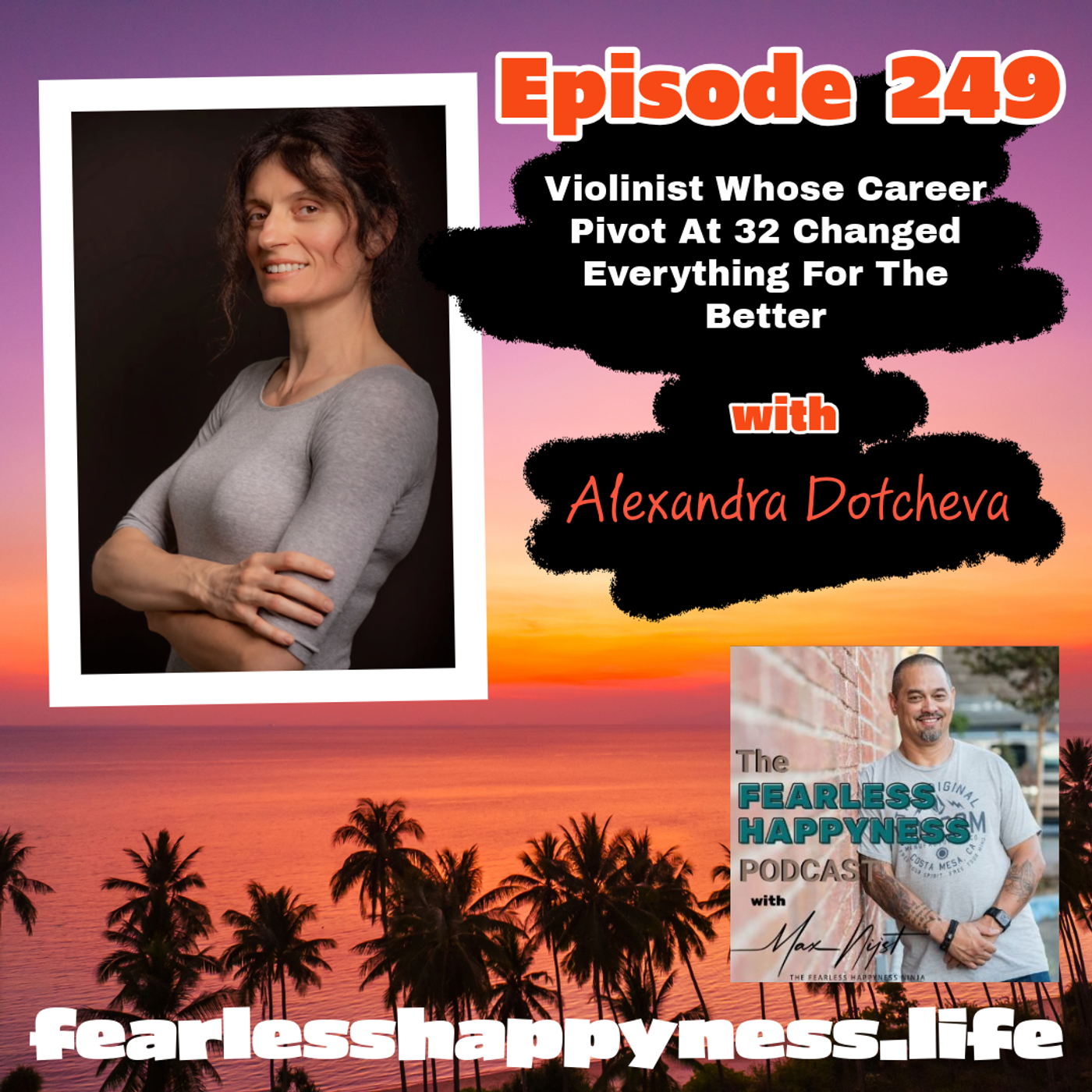
In this engaging conversation, Max and Alexandra Dotcheva explore her remarkable journey from a professional violinist to a holistic confidence coach, author, and investor. Alexandra shares her pivotal life changes, including her transition from music to nursing, and how her experiences shaped her coaching philosophy. They discuss the importance of functional medicine, the holistic approach to self-confidence, and the interconnectedness of health, finances, and relationships. Alexandra emphasizes the significance of perseverance, personal growth, and the mindset required to achieve happiness and success in life.
For more from Alexandra: http://holisticselfconfidence.com
For More From Sober Coach/Substance Abuse Counselor Max Njist, visit MaxNijst.org
Max Nijst: Welcome to the Fearless Happiness Podcast, where we showcase phenomenal individuals who have overcome serious traumas, life obstacles, and challenges to find their own path to fearless happiness. Listen as Max Naist invites guests from all around the world to share their experiences and spread strength, hope, and faith. This is the Fearless Happiness Podcast. And this is Max Naist. Everybody, good morning, good afternoon, or good evening. This is Max again coming to you from the Fearl Fearless Happiness Podcast. Can't even say my own podcast name today. Anyway, I'm here with Alexandra. But what I would like to do, so I don't butcher your name, Alexandra, is have you introduce yourself to my audience because you and I are gonna have a great time. â but what I like to do is have you s introduce yourself, who you are, what it is you do, and then you and I are gonna have some fun. Thank you, Max, for having me. Yeah, my last name. â my name is Alexandra Doleceva. Okay. I'm originally Bulgarian, so â some people might figure out I have a Slavic name, Doleceva. And I am an RN in the US, a holistic confidence coach, author, and â investor. Wow, that's a lot of stuff you do. All right. I like the author and, you know, coach and all that, but investing, that's where I need lots of help. But but I'm glad you're here, right? Because we're gonna not only talk about You know, the things you've been through in your life and those challenges that have shaped who you are. We'll talk about your book and then we can get into a little bit of what you do investment wise and how you help people with that and your coaching, of course. But what I like to do, Alexandra, is go back and talk about those challenges and struggles that have shaped who you are today and you know, put you into a position where you coach others now and and you wrote a book and stuff like that. That's what we want to know. What makes Alexandra tick? Well, lots of things. the schedule, a plan, goals, dreams, everything makes me tick if it has a good purpose of helping other people and enhancing my knowledge and understanding of the world every day. So what like what would you would say was a a pivotal point in your life like growing up where you said You know, things have to change and I'm gonna do things different than the way I you know, you know how people have moments where they tr w whether it's a trauma or just being young, you know, like what were some of those challenges you went through growing up? Of course. â so the nursing, investing, coaching, that was a very, very late stage in my life, â way after my thirties. â I'll be fifty next month. So I was a violinist for twenty nine years before all this other stuff started and â then the hyp financial crisis hit in two thousand eight and I had been playing my entire life. I had no scientific basis, nothing, no science base, no knowledge base, no investment base, absolutely nothing, just practicing violin between four walls for nine to ten hours a day on a regular basis. And when the crisis came and I was I had just graduated from a doctoral program and defended a doctoral dissertation with Louisiana State University. In two thousand seven. And then it became very clear that things needed to change because so many orchestras were bankrupting. And the orchestra when I was where I was in â employed at the time was also threatening bankruptcy, which actually happened three years later. After in twenty eleven. But that was the pivotal point when because I was a very scared violinist. I had tremendous issues with stage right from a young age, which â In spite of my advance in the United States as master's and doctoral degree I couldn't quite overcome. And that reflected â my audition performances when I was auditioning for orchestras, which was the most important part if you want to have some good employment and solid job and you know, rely on some income as a musician, unless you want to freelance your entire life. And so that was the pivotal point because I had no knowledge other than music, because Max, â when I was a child, I was in a specialized music school from the first through the twelfth grade and then eleven years in college combined bachelor's, master's and doctoral, violin and violin only. So at thirty-two I knew nothing about the world. I was living in my old bubble. And â that's when it became very clear that something everything had to change. And it was a huge, huge, huge early midlife crisis because at thirty-two you've practiced the violin for twenty-six years at the time and most people think about retirement. when they have been in a trade for twenty-six years and I was barely like nowhere, nowhere snear and no stability, nothing. So that was the pivotal point. What you know, when you I hear you So that's scary, right? When only if you only know one thing, right? And you've been practicing. And it sounds like even when you were young, right? That's all you go to school and then you study the violin all day long. Right. Like that's what sh your parents, what you want to do, right? And it's kind of, you know, for me it's weird, but it's not. And what I mean by that is like the the st when the economy collapsed in 2008, 2009, right? It to hear it affected like orchestras and the mu like it affected everybody. That's right. Right. And like you said at 32. See that's like so how it's kinda like in my stories when I got sober. At 32, right? Okay. Like for me, like you, that was a whole new like, what am I gonna do? Cause I've been doing I wouldn't say all bad things, but I wasn't doing good for myself. I wasn't doing good for my family, right? Because I was I was addicted to drugs and alcohol, and that's all I knew. And then 32 comes along, it's time to, you know, grow up and and not kill myself on the installment plan as I was taught, right? And And like you, I had that moment where it was like, What am I gonna do? Like I have no work history for the last nine or ten years 'cause I was, you know, in and out of jail. you know, living on the streets, hanging around the wrong the wrong people. And then like you, when you figured it out, I had had to have someone tell me, they go, Max, this is my sponsor. He says, I got you gotta change one thing. And I was like, â cool, that'll be easy. And he goes, Yeah, you think so? Yeah, I go, What is it? He goes, Everything. Like you know, I was like, â my gosh, what are you talking about? He goes, We'll do this together, but you have to change everything. The way you look at life, the way you do things, the people you talk to. Right? Because I can't like you know, if if we I'm just gonna say if we're doing things the wrong way and we stay in that, nothing's gonna change, right? Not that playing the violin. Cause I think people who can play musical instruments or sing. I mean my hats are off to you. That playing a musical instrument, especially the violin, like to me, I've seen, you know, from like what you play, and then I've seen people on like YouTube that take the violin, â an electric violin and play all different kinds of genres of music. I think to me it's amazing, right? Like the music that comes out of the music that you bring out of that instrument is amazing, right? So at thirty two, you're going, Okay, I gotta change. This is gonna be scary. What was like what was that like? Like what was your first direction that you turned to when music was out, you know, like for you out, right? Like I can't play in orchestras right now. I gotta change everything. What was that like for you? 'Cause that's scary for anyone. It was very scary. Yes. And I really wanted to feel useful to society. For a change because they say if you're very useful as a musician, but when you don't feel that way, yet you're not contributing enough and you don't have a realistic perspective of how the rest of the world actually lives. Right. Because you've been surrounded by musicians your entire life, starting with your parents and then classmates, colleagues, friends, everybody. So I realized that nursing was a profession that I could have a job with all over the world. There was a shortage. What I didn't realize is that when there is a profession with a sharp shortage for decades, that means it's a really hard profession. Which my mother tried to tell me because over the phone they just they they froze cold over the Skype when I told them I'm not going to be earning money with violin anymore. I'm going to nursing school, guys. â they were just h horrified. And they did try to tell me this is one of the hardest professions in the world. And I said, Yeah, I need some, you know, exposure to reality. And they said, You cannot expose yourself to that materiality. You're not ready for that. And I said, Guys, at some point I have to decide what I'm ready to do and I value your opinions, but that's it. It's happening. So being useful to society, being helpful to people. Plus I always, always loved biology as a child, only in the music school we studied very little biology and any any science whatsoever. So I knew I was completely unprepared that I had to study a lot. But I knew it was fascinating. And the other thing that was very attractive to nursing Max besides the â guaranteed job if you, you know, don't mess up royally, of course, â with patient safety and reals. â the fact that I could learn a new vocabulary and â something that's I felt I missed on when I was a child, that I could actually involve some real time to study science, that was pretty fascinating for me and of sounded very attractive at the time. Yeah, 'cause nursing, you're right, right. I mean, nothing more rewarding than nursing, right? Or being a doctor. It's p or Fireman or first responder, right? That kind of job is very rewarding, right? Because you get to help people every day. You get to help them at their most vulnerable times. You get to help them get better. Right. Are there sad portions to that job? Just like anything. Absolutely, right? But that had to be discouraging from your own family going, No, you shouldn't do that. You're not ready for that. But what I hear in your voice is like, watch me. I'm gonna make it work because I'm gonna. Right. Yeah. And the other thing was nobody knew me in the medical field and I knew nobody. So I knew that if I started completely from scratch, nobody would know about my performance anxiety. I could just start from scratch, build from there and build my reputation, trust in my colleagues and my patients, my clients. And that was invaluable because I was absolutely sick of everybody knowing about performance anxiety that came when I any time I came on stage to audition or perform something more other than the Performance with the orchestra. And it was a bad mental history that I had created. And â I in my book I describe this in a lot of detail in chapter one because that was very much self-created during my teenage years because I was a very socially awkward child. But then it didn't help growing up in my twenties. It really reflected badly on my profession, which I didn't know I would create such a monster by inflicting on myself this type of mindset at a young age. So in my 30s, mid and late thirties, I had to correct that. And it took about 10 years too. But the profession change tr helped tremendously, along with several other factors. And that's very good to know, right? Because you're right. Like we understand, I'm sure you understand now of going through all that, right? Like how much our subconscious mind plays a role in what we do every day, right? Cause when you would go through that, it just kept it it was like â A loop, right? Every time you get to the stage, the same thing would happen. You would get nervous, anxious. I mean, did you ever have panic attacks right before you went on stage? How bad was that? No, but I couldn't deliver more than like eighty percent of what I was actually capable of. And it was a wicked circle every time for years and years. And sometimes better, sometimes worse. But consistency wise I was very unsatisfied. â so â what but what I'm hearing is it that it kept you from giving a hundred percent every time because of that. Right. And then you get into nursing, right? And that had been cool because now you're like you said, this is a new beginning, a new start. Nobody knows anything about my music, right? They don't get they don't even right. They don't have to know about it, right? They're gonna know me as nurse Alexandra and I'm gonna be the best nurse possible. Well they came to concerts to the Syracuse Symphony Orchestra before we bankrupted and they saw me in the orchestra, they were shocked that's you Yes, that's me in the orchestra, that's my other life, you know. But forget about it, let's focus on nursing. So that happened too. But that was one of the funny moments a couple of times. Did you have any of those moments though when you were applying for jobs as a nurse where that anxiety and stuff would come up? Like the never in the same way. Wow. No, I never looked back. And I insisted that I was gonna change things mentally and I mean as far as the job endurance and adaptation to this job, that was a different story. That took longer time. But as far as interviews, I had nothing to lose. Absolutely nothing to lose. So when you don't have any reputation, you don't have anything to lose and you build from there. So â that was not a problem. Right. So you we as they say in neuroscience, right, you learned how to rewire your brain. That's right. To better yourself, but right, because your experience as a a musician, right, as a violinist â in that realm messed you up. Let's just say it messed you up because of the â the nervousness anxiety, right? And but it created a lot of self discipline because of the practicing routine. Right. Well that's what I'm gonna I was gonna get out, right? So you have the one part where you get nervous and anxious, right? But you also have from years of practicing You have that self-discipline. You know what it takes to to do something consistently and be good at it, right? How was that for you? Like, did you start because you know when we're in that mindset where we're struggling, right? It's all we're like, it seems like we keep a check mark of all the losses, right? Cause then right. So when you switch that your brain into better thinking, right? And how did you start instead of doing that, did you do check marks for wins? 'Cause I'm taught now like, right? Don't focus on the losses, even the little ones. Check you know, make sure you celebrate the little wins 'cause what'll happen is it just keeps rewiring your brain into going, I can do this, right? I'm not gonna quit, right? Well, that's right. See, I I transformed my violin practicing into studying all the thick textbooks for thirteen hours today because I was working three jobs at a time, part time of course. And s sometimes I studied until three AM because because I had no vocabulary in science base. I read all the thick textbooks three to four times from cover to cover before I even started these college prerequisite classes. So I was busy. There was no time to, you know, check losses or wins. I aced all the exams. So that was awesome. You know, that kept my faith in myself going. â but as far as wins and losses, I learned that way later because I was very pessimistic for decades, for well over two decades. And â appreciating the wins came p ten years after I first changed the profession. And I I I did change several other aspects of my life as well, with the investing and everything else, of course. But at first there was no such accountability. I just wanted to really day by day get out of the way everything that had to be done, that had been a lot of lot of tasks that had to be accomplished to change your profession, graduate and then learn a new profession. So of I just really wanted to create the trust in the people around me to allow me to stick around them and learn the craft. And I love that, right? Like what a what a inspiration you are, right? 'Cause you heard her, everybody. Like she read those bo and she's right. Those books are they're not like little reading and you're done. I mean they're Manuals. 'Cause I know when I was doing my EMT a lot of the pharmacology, biology stuff, there were like for you to go through that from cover to cover and make sure you're Between nine hundred and twelve hundred pages each of them and they really are big, big books with small font and thin pages and â my god. Small font and big words, right? That you have to Well, so that's my hat's off to you for that, right? Because that takes a lot of dedication. That that shows me Right, like the and this is what I'm talking about, everybody. If you're listening to Alexandra, that's grit right there. That is motivation, right? Not because she had to, it's because she wanted to. And she wanted to change one thing, and that was everything. And sometimes that's the level you have to get to, right? So now Alexandra's, you know, our inspiration because she's shown you can do it at any age, right? Even at 30 something, she changed her her direction of her life. So let's talk about. So now you're in the nursing profession. What 'cause I know you know what did you â specialize in? 'Cause I know like some f nurse friends of mine are into the like where the baby, what do they call that? When the neonatal yeah, the neonatal the L and D laboring delivery right. Some are friends of mine that are like like surgery assistants, you know what I mean? They kind of do that stuff. And then you got ER nurses that are their You know, in the trenches when things are coming in and happening quick, quick. What was your specialty? What was your favorite part of becoming a nurse? So I did a couple of things, of course. ICU at first, then some orthopaedic trauma nursing. And â for the last twelve years, thirteen years, I've been in home care. Because I woke up very quickly to the fact of how many nurses actually lived and what the conglomerates that devour hospital after hospital do to the nurses and to some extent to the doctors and the â inadequacy of patient care in the hospitals as far as actually taking proper care of each patient that you're assigned. So home care to me was a better opportunity to educate a patient one-on-one and help them get better if they were willing to listen. And also home care allowed for a better schedule as far as my other ambitions that later came on, the investing, the coaching and the â writing of books and all that. And plus â other things like the recreation, because see I was also a martial artist for twelve years and that was extremely important for me as far as self-confidence building and resilience and self-respect, all these wonderful things. But they take time. So in the way I made it work was first I wanted to see where I would be the best as a nurse with respect to what I can give to my patients. Because the hospital was not a satisfying experience with the way they â overlook what the research says that each floor nurse should have maximum three patients. Right. And they load them with six to ten patients. So you cannot reliably maintain a safe professional â standard for yourself or for your patients. So I didn't want to be part of that after I got enough experience, I got out of there because I'm like, this is really dangerous. And my integrity says you should be somewhere else. Okay. I mean I learned a lot. However You just need to find the best place â because again I was already had burnt â was burnt from the previous experience of knowing only one thing in my life. So I knew that nursing was great, but I needed to learn many other things that I should have been learning all these years, but I didn't. So I created a nursing environment for myself that would allow me additional time to learn the other things that I wanted to desperately learn to â progress with my life. I love it, right? Like they're you're showing your progression. So now obviously I'm gonna ask you what led to your coaching. Let's talk about that. Right. As you're as you're evolving into new things and you're seeing you're right, because in the hospital, it's like sometimes I don't understand how these nurses and doctors, right? You can see it in their eyes, they're tired, right? They're working twelve hour shifts. â because it's I liken it to the field I work in, in the addiction field, right? Like I think perfect amount of clients is six to eight, right? You can do and give the care it's in that arena, right? Cause you're but anymore when you're doing ten, twelve, fifteen, I've had seventeen, I've had it's like the care starts to go down because how are you supposed to keep up with that, right? Cutting corners, yep. But you you realize that for you and you got into home care 'cause that's a perfect, cause that's a lot of one on one time, right? With a with a patient that You know, depending on the on the day, right? Yes. But that's right. Talk about how that led to coaching for you. What was that aha moment where you go, â I wanna coach people to be better? S so the coaching went after I published the book. That when it came. See, usually people start coaching and then they write books to advertise. Mine was exactly exactly the opposite. I never intended to become a coach because people I kind of got tired of answering questions, okay, so how did you go from like musician To a very successful nurse, then a health maniac and a super successful real estate investor and options trader. So to answer all these questions, I did create this little system in my book because I had been following the same thing in all these aspects of life, to health, career, finances, spirituality, and â relationships. And I made the system, I wrote the book, and then people said, Well, you should be coaching that because the book is awesome, okay, 400 pages, but people want more than that. So then I got very heavily involved in functional medicine also because I wanna much more care about root causes of diseases and reversal of diseases than treating symptoms and managing system â symptoms like the â allopathic med medicine has been doing for decades. So that's one aspect I don't agree with, and again my integrity, â I don't want it compromised, so I learn more how to help people with root causes rather than managing s symptoms and keep maintaining them sick until they die, right? So that's that's not cool about contemporary medicine. And then we did have an experience in our house of my very, very loved one, my boyfriend. We reversed his type two diabetes in a matter of four months. And then we figured out after this, let's write this book, let's explain everything, what happened. And then we're gonna transfer to the financial aspect from the health aspect because it's the same thing. You gotta clear the things that prevent you from achieving what you want and then fill the space with the things that actually are beneficial. And this whole system works from health through finances, through career, through relationships, through spirituality. And once the book was published, then my â many of the hosts that were interviewing me because of the book marketing and publicity, they said, Why aren't you coaching? I said, Sure, I I'll create a coaching problem 'cause not a problem at all because I know what I'm talking about. And it's all based on experience, my results speak for themselves. And then the coaching program came into place. But that was after the investment experience and everything else. That was the natural consequence of all that. I love it though, how you've linked everything in that, you know, like health, the how you know, you can for work on this, finances, right? 'Cause I think you're right. If if I'm not healthy and making good decisions, then my finances I've proven it over and over in the past or like not good, right? Because I'm not spiritually fit. I'm not physically fit. You know what I mean? Like exactly, exactly. And what exactly. And what I've learned like from guests like yourselves who have gone through the rough times and then figured it out and and said like everything is it's like almost how I work with a client, right? Mind, body, and spirit, trying to get all that corrected before I could stay sober, if that means or and it's a ongoing process, if you you know it, because it's Yeah, it's not just a one time you fix everything and you it's an unformed experience. Right. Mm-hmm. And So okay, what I wanna ask is right, like 'cause you when you talked about type two and reversing your boyfriend's type two diabetes, right? You like my life when, ooh, I'm gonna have to get her book and I'm gonna have to ask her how that works, right? Because you know Western medicine wants to keep you sick. They just wanna give you medicine all the time. Right. And that's what I like about functional medicine that I've been, you know, learning from my guests who do that and reading about and It's kind of like the program where i it's not let's map let's not mask the problem anymore because that's it's just gonna be a band-aid. When you rip the band-aid off, the problem's still gonna be there. Right. And in the process for me in doing the twelve steps, it uncovered the root of why I drank and use, not just because I liked it. You know, you know what I mean? Because it turned into that. But talk about that. So in your coaching, right? Do you do that with your clients? Like ta touch on every area, or do they say, Alexander, I want to work on this area? And are you how do you work with them? So it's a holistic confidence building system. The title of the book is It Really Is Simple, a holistic approach to self-confidence. So I do I'm very selective with picking clients because I don't need clients, Max, right? I I really don't need clients. â but I select people who are so sick of their current existence and so motivated to really improve on everything when they realize that you can't ignore one aspect of your life and expect everything else to go well. Those are the students that I seek and that I connect with the best because yes, I mean you have to address everything if you don't if you don't want to struggle for the remaining twenty, thirty years. So we create this plan, long term plan. And I don't want them to need me for more than three months, honestly. I mean they can get access to me for years if they want to, but the program is twelve weeks. And I get them to a level where they're like so independent and with their thinking and everything that they're confident they can do it themselves. Now, of course, wealthy, successful people always have mentors. But if they want to seek other mentors, that's fantastic because you can learn different things from different mentors. I never want to make somebody dependent on me for years. That's completely repulsive to me. Now if the person wants it, That's one thing, but I don't create a business model that I'm gonna get you like a in a spider web and then you're, you know, dependent on me, on my knowledge and everything for forever. You need to be independent and spring back to life and fix all of these aspects with a little bit of direction, your own input and dedication. Okay. â so my boyfriend was not diabetic, he became pre-diabetic when he freaked out about it. Okay. And he was like 30 years emergency nurse and all that. But we just made a very simple diet change and it reversed everything. We've been doing this for over eight years now, whole food organic vegan diet, no compromises, no exceptions, no excuses, okay? Full integrity. And we don't get sick, you know, we don't have chronic diseases, we don't take pharmaceutical drugs, but his condition just improved drastically in just four months from one blood work to the next. â hypertension disappeared after fifteen years, high cholesterol, no normalized. He's like, â I'm staying on that day, well the hacker's staying and I'm staying with you. Because it was just that simple. But see people when they see something like that, like you say, okay if you just change one thing which is everything and it becomes overwhelming. â there are choices that you make that really carry through for years. And it's not just a temporary fix. It's a lifestyle. Like martial arts, like investing, like healthcare, like everything is a lifestyle. How many problems do you want to have? How what example do you want to give to the people who you're working with? Because see my patients when they say, Well are you vegan? Of course I'm vegan. I wouldn't recommend to you to do that if I weren't doing it myself. You wouldn't I wouldn't have credibility. That's the I'm basic. I I I'm laughing with you because that's the same thing, right? Are are you sober? I'm like, well, that would be kind of hypocritical if I was out drinking and doing drugs and telling you you need to do this to stay sober, right? Well, one, I wouldn't be here because I'd be off doing my thing, but I I get it, right? And I was just looking something up because â I love that, right? Like and that That has to be a good feeling knowing that you don't need clients. Like you can pick and choose who you work with, right? Because what you do works and you know it works. And â that leads me to, you know, and we'll get into your book a little more because I want people to understand totally what's in that book so they can go out and get it and stuff like that. Cause I know I will. â because it just doesn't cover right like new beginnings. It it sounds like it covers so many things. But the way you make it sound, it's like we'll start with the small thing and we'll just grow and keep growing it and keep growing it, right? Because you're right. Like when I got sober, like when he told me you gotta change one thing, like but like literally it was like we're gonna start one day at a time. You're gonna do this and then we'll do this and then we'll do this, right? 'Cause I'm like, Do I have to do all that in one day? I might as well go out and have a beer because I don't know if I could do it. â But that's why I love having guests like yourself, right? Because not only have you gone through it and been in the trenches yourself, right? You continue to practice what you preach. And right, let's so the audience understands a little bit more. What is functional medicine? Like we they they've probably heard it on my podcast 20 million times about you know finding the root of the problem, but I've never really stopped and asked. Ask my guest, like, can you explain what that means so the audience can go, â that's what that means? Well, integrated first functional medicine for one thing, we explain the functions of different systems that are interconnected with â several symptoms that usually have a root cause in one system that's affecting the other three or four systems. So if you track the problem appropriately with a timeline, with the events that happened in the patient's life. If you tackle the right problem, usually you solve that problem, it then knocks out the problems with all the other systems. But there are labs involved that are more thorough than the conventional doctors would order. And â this is why conventional medicine, because these poor conventional doctors, and I'm saying this without any sarcasm, but some of them have three hundred, five hundred, six hundred patients. They can't track all that stuff. And they're ordering labs that are very â address certain things to the superficial level, they track symptoms but not causes because you didn't order the right labs at the right time and you didn't listen to the patient's story, which is even more important. So certain labs tell you more to the story of the patient. And you need to know which ones to order so you don't overwhelm the patient because the insurance might say, â you don't need that lab, you know, he has such and such symptoms. And then you have to say, well yeah, but you know he's also having X, Y, and Z. And it's â when his doctor addressed these symptoms, it didn't solve his problem at all. So that's where you really wanna dig much deeper. You have to assess the patients every aspect of their lifestyle with honesty and integrity from the patient, but it's a client when you're doing â functional medicine. And I'm a coach, I'm not a prescribing provider, but I'm a coach. So I can't help I can work with their prescribing provider. And if they have a functional medicine doctor, even better because then we're completely on the same page. Okay. But it really looks at disease from much different perspective in terms of your holistic well-being, much as conventional medicine pretends to be doing that, but they really aren't. And â they want to give you a supplement, they want to give you things they don't track your lifestyle, their sleeping pattern and everything. They load you with these horrible medications with awful side effects. just to mask your symptoms and they're not solving the problem. So this is where functional medicine is has very, very strong potential. And â many people are already turning to that as a solution to multiple health problems because Max they have been to ten, fifteen, twenty doctors without any solution over the course of ten or fifteen years. And this is terrible. Terrible I mean they'll try anything. And â I never want anybody to get to that position. And this is why I'm a huge advocate for â prevention for prophylaxis and there is no prevention if you don't have an extremely clean diet, an excellent exercise routine, a daily detox regimen, and then everything else falls into place and â then you can address other aspects of your life properly because let's be honest, if you are want to invest but you don't have good health and if you don't have a lot of money but you still want to invest really badly Many things you will have to physically do yourself until you build the capital and the money to h hire people to do certain types of work for you. I mean, we have had days that we've been baiting apartments and houses for twelve hours a day with a 10 minute Apple break. Okay. So you have to have endurance, physical endurance, mental endurance to do these things. And that's just one simple example. I can give you many other examples. So things are so connected in your life with your health. finances in relationships. And relationships a whole different, you know, camel kind of worms whose influence you listen to and whose influence you don't take seriously. Okay. To other affects all of your other â decisions to the other aspects of your life. So this is why the book, you know, it it encompasses everything because you can't ignore one area if you want to succeed in the others. At least that was my experience and it continues to be to the present day. But see, this is where I have to agree with you, right? Because I've guests like yourself That have we've had the same conversation, right? And this is what my audience, I want them to understand, right? You have to put in the work, right? And if you're gonna change something, right, like I wish, to be honest with you, right? Because we talked about it before the podcast, you know, like the jets going by or me living behind Camp Pendleton and I can hear the cannons going off, right? I I wish the VA offered functional medicine. Right? Because they're so old fashioned with Western medicine and you know, I could tell a doctor till I'm blue in the face I don't want a pill and he's still gonna try to get me to take a pill. Okay, doesn't know anything else, Max. He can lose his license if he offers you herbal or plant plant based nutritional â remedy instead. They can lose their license. I I understand that, right? And what I wish is like there would I wish they would have an open mind and allow this stuff to come in, right? Because there is some good use for conventional Western medicine, right? Absolutely. And you can combine it, right? So but that's why we're grateful, right, if you're listening like I am, audience, right? For people like Alexandra that we can turn to when we get tired of that, right? Because that's what she teaches. And and if you want to do something different. Find a coach like Alexandra, right? Find a functional medicine doctor that can work together with her to change whatever's going on. And you and I'll talk after because I have one perfect example and I don't want to put her on the podcast, right, for everybody. But I have not that it's her fault because and here's like you said, it's it's this is where I agree with you because so she had a A long time ago she had a student stomp on her foot, right? Like that she was trying to get off a bus and he didn't mean to, but he had boots on and she had tennis shoes and damaged her foot, her toe, right? And it's on the top, right? 'Cause you know and I know a bunion is on the side of your foot that drives right. And the doctor had her stand on a pap I went with her and stand on a paper and said, â yeah, that's a bunion. Even though she said, I had my MRI sent to you. That doctor never looked at it. And he he tried to tell her it was a right. And then so she went back to her doctor recently and she the doctor goes, I'm so mad. And my wife's like, Why? He goes, That doctor never even opened that MRI and took a look at your foot. Your foot is damaged. She finally went, I believe you, your foot is damaged. Cause those doctors that she had referred them her to would all tell her her foot's fine. There's nothing wrong with it. There's nothing wrong with her ankle. Well, she's got a damaged ankle and she's got a damaged foot. Now they're finally, you know, after all these years of her pushing and not letting them go, You're gonna be fine, right? She said they finally looked at it and the doctor goes, I'm so sorry, you're right. Your foot we gotta fix this, right? So it if it feels wrong, it feels wrong. Plus the bunion never goes grows overnight. Bunyan takes years to form and yeah, that's just absurd. But I'm not surprised. I'm really not surprised, unfortunately. Everybody, I mean people are gonna watch the YouTube, you're gonna s see her in my face when we mention this and we're Yeah, that's just we're just so over that kind of but you know, where they don't listen, which you know, as a nurse, that's our job is to listen, you know, as my job as a counselor is to listen to the patient or the client and understand what they're trying to tell us and not tell them what we think they need to do, right? And but it's like I mean, so far this has been I knew this was gonna be an awesome conversation from our little chat on â to get you on here and stuff like that. â but what I wanna ask, right, we can get into this later, but talk about your little â your book a little bit more, like what people could expect, you know, and all those areas you talked about, like you touch on finances, you took on touch on spirituality, you touch on can you just give a little bit more on each area so they could know what to expect without giving it away, if you know what I mean. Right. So â I do discuss all the life aspects that I mentioned health, â spirituality, career, finances and relationships. But what's important is I do tell stories in this book because I really went from a profoundly unconfident individual to somebody who I'm I'm not afraid of anything right now. Okay. I can solve â I believe I can solve everything. I'm not afraid of problems. I don't like them, but I never put them off anymore like I used to. So a mindset change, a mindset training in all the life aspects. I am revealing the the eating routine that's I mean, nobody has disproved that this is the healthiest diet right now. And â I can tell you, Max, I've been a nurse for fifteen years and my boyfriend thirty two years. We are yet to meet a patient who is a whole food organic vegan. I mean w we just don't get sick as readily as everybody else. And I don't care what the other fat diets say or anything. But again, I have dedicated a lot of t quite a few chapters to health because I'm ob obviously biased. But I explain certain â processes in the body in relation to exercise. I explain a lot about exercising mentality because I connect this to my martial art experience because I had fantastic teachers who are national champions. And the mindset in martial arts that I have transferred to exercising and to nutrition and to health and then later on to the other disciplines like financial discipline and relationship discipline and spirituality discipline. This is all very â integral aspect of the book because with the specific examples I give and ways â to meditate to enhance your blood supply. So that's not only a spiritual aspect but also part of the health aspect and then how you â rewire your brain to plan depending on what problem you want to solve. â I'm giving example with financial solutions when you meditate and what types of music I prefer, for example, to listen in order to organize my brain to think numbers and then in other times to think something different depending on what I need to solve. But there is an arsenal of techniques and ideas. Okay. So it's ideas. â not everything in the book is completely new, but it is said differently and â I do have shared I have shared quite a few recipes from my â kitchen and we have I shared how I became an investor, my couple of my deals that I did, the first real estate investment deal, I have also shared how to get rid of bad credit card debt. I never had bad credit card debt, but I have had lots of people that I've taught how to get rid of multiple thousands of dollars of credit card debt that completely stole their development financially and in many other ways because it it impedes you. You don't have choices when you have bad credit card debt. You don't have buying power. Okay. So â financial discipline, â very detailed ways to â get rid of credit card debt if you want to invest successfully. So â it is designed so that people can become confident in all these aspects of their lives. It is a system. â some say it's very hard. I don't sugarcoat anything. I'm very â blunt, sometimes very unpleasant. We had arguments with my editor who said, Well, you're gonna alley. The reader said, No, no, this is not gonna be another book sugarcoated and wonderful, you know, you're so fantastic and it's not your fault. Yes, it is your fault. If you're where you are, it is your responsibility. This is how you can do it. I cannot tell you what to do, I can tell you what you can do, what I did, certainly, because it that helps. Great. And â in a nutshell, that's it. There are exercises for mind â set. There are also explorative, self-explorative exercises, types of fears that hold you back. â yeah. Why these fears exist, why they don't exist, how you fix that. But truthfully, if anything, if you apply eighty percent of what I have written in the book, you really won't need me as a coach at all because it's that detailed. And yes, your situation will be different, but you will be able to adapt your circumstances to you know the principles in this book if you want to change. It's not hard. It seems radical, but it's just so â how would you say that? â it makes sense. When it makes sense, even the radical thing seems like simple. And simple doesn't mean easy. But that's okay. Because if you ever want to change your life for the better, why would you expect it to be easy? If you want be proud of yourself in the end and in control of your life and nobody tells you what to do anymore, you don't have to work if you don't want to work. You can â you know thrive on your investments, you can start businesses, or you can just work because you love to work, but not because otherwise you won't be able to make ends meet. But to get there, you have to be healthy, in my humble opinion, because if you're not healthy, then you need money to sustain your disease. Okay. Right. You need to learn how to invest in cash flowing assets. That brings cash flow every month and allow you to have choices whether to work or not to work. Do I work full-time or part-time? Right. Do I start a business? Do I not start a business? Do I travel? It it's just wonderful, wonderful when you create choices for yourself. Right. You do it by yourself, and then nobody, nobody's opinion matters. And it's just it's that's the holistic self-confidence to me. And needless to say, the relationship choices are integral part of that success. Because you will have to limit a lot of your relationships if you want to focus on what you need to do and pick up your influences very carefully. Right. Well there's something to that saying and I just had that with a guest yesterday, right? You've heard it probably where it says you're a direct reflection of the five people you hang out most. Uhhuh. Right? 'Cause And true, right? When I was a drug addict, I hung out with nothing but drug addicts, right? Now that I'm sober, I hang out with nothing but sober people. Most you know what I mean? And now that I'm working on being a better human being and everything, right? I hang out with people who are a lot farther ahead in life, like in finances, health, right? So I could see how they do it. It's actually right. Right. Cause you know, like in martial arts, right? I used to study jujitsu and I knew I would get better. I learned from my they call him professor in Jiu Jitsu, right? Black belts are above. And and he'd always tell me, he goes, and I forget who he stole it from. He goes, but it's true, right? Hard work will be talent every time. And he goes, you know, so you gotta, you gotta learn the basics and you gotta get good at them, even great at them, because then it just changes everything for you when you you know what I mean? And you gotta work hard. And I loved it. Right, until I heard my back and the doctor said, No more. You twist wrong, you're gonna be â you know, you'll be paralyzed from the waist down. So I don't study as much, but I still carry those principles because I don't know, you know the Gracie family. I'm sure you heard I mean, look at Helio Gracie who who still would as they call it in jujitsu roll at ninety two years old. Yes. Right? Because he loved it so much and it was And to me, like martial arts, like you said, is such a it parallels life, right? Like you the better you get at that, right, the better life gets, right? Like the better you get at the basics of life. Like to me, it's just being kind to and loving to other people, helpful when you can, s be of service, the better your life gets, right? And then you just transfer the principles you learned in the dojo into the real dojo, which is life. Which is life, right? Yeah. And that's the same with my recovery, right? Like I as I stayed sober, I appreciated the guys that were hard on me that didn't sugarcoat anything. You know, and they would tell me, Max, if someone pat you on the butt and says life's gonna be good, run the other way. And I love what you said because that's what I was told in the program. It's easy or it's simple, but it's not easy. You're gonna have to work. And, you know, staying sober is a lifelong process, right? I can't just say, â I'm good on what I did five years ago. It's gonna keep me sober. Right? Because I don't know if you know anything about addiction. Our addictive minds forget all the hard stuff really quick and we go, â we can do it one more time. Right. You know, who knows? I may not be here with you today, but luckily I I surrounded myself with the right people. I continue to Congratulations. Congratulations, Max. This is huge. This is really, really huge. This is twenty three years in September is what I'll be clean and sober for twenty three years. And you know, I I I I don't like to take credit, but I had a lot of help, like you said, along the way, right? Like I did the things that people suggested. I finally got I understand that yes, I have to take care of myself and like eating right, right? 'Cause like my dad's side of the family, all my uncle dad died of a massive heart attack at fifty five. Right. I don't want it. I've already surpassed him because I'll be fifty eight this year, right? And I'm my doctor always tells me, You got the blood pressure of a twenty one year old. You're doing pretty good. Keep it up. Whatever you're doing. You're doing great, yes, sir. Right. But I am a type two diabetic trying to learn how to reverse that. So but I know that's a process like you said, I have to find and I'll ask you after like that one thing I gotta change and then work on that and and continue. but like I said, this has been an amazing Conversation. I knew it would be. I was looking forward to it. â but I'm gonna ask you the questions that I don't forget that I teasingly talk to you about before and we're gonna right because you're you're a big inspiration. You're one of my inspirations now. Listening to your story from musician to what you do now and right, not being afraid to make those changes at 32. So we're gonna talk about fearless, right? What does fearless mean to you, Alexandra? And how does that show up in your life on a daily basis? Fearl means, yes, I have changed a lot since I the previous live that I described. Fearl means you get slammed for the problem, you solve it. Inspire nobody's fearless. We all feel insecurities, anxiety, but you make anxiety your friend, you make it a motivating factor, and you solve the challenge, whatever it is, big or small, and you don't stop until you solve it to the best of your ability. That's fearless to me. I love it. 'Cause in that process, right, you become courageous because you've just solved your problem and even more confident. Right. And you know, as I well as I know, making those big changes, right? We're gonna fail. We're gonna fall on your face. But what what I've heard from you all interview long is no matter what, if I failed, I'm gonna learn from it. I got back up and I keep moving forward. Get up and brush yourself off, probably go, â yeah, I heard, but I keep going, right? I love it. So next. Next up, we're gonna talk about happiness. As you can see, I put a why in happiness. I did that on purpose. I saw that. Yeah, all right. It's not a misspelling. I did it on purpose, but knowing I put a why in happiness, what does happiness mean to you today? And how does that show up in your life on a day-to-day basis? To me, happiness is the fact that I didn't give up on my dreams when I became thirty-two, and I â finally dared to dream differently from what my parents and others dreamed for me. And the fact that I managed to bring it through a completion that I couldn't even imagine. I could now could I have done more? Of course. Of course, because you know extremely successful people, they never stop growing and learning. And I want to be â till the rest of my if I plan to live until hundred, I want to learn until hundred and one years old. Even past the grave, I want to keep learning. Okay. So I never stop. I â humility, very important. But â I'm very happy that I didn't give up. I'm very happy that I made that change at 32 because I knew back then, and that was one of the strongest motivating factors. That had I not made a change, I would have had regrets now. And I was right. So â this is happiness when you persevere through something that seems very difficult. And even if you didn't achieve it exactly as you wanted, because let's be honest, when you first start building something, you have no clue what you're doing, okay? Right. But when Things get hard and you persevere and you keep going and you see the other end and actually get the skill, get the understanding and c get the results. This is happiness. And no matter what the endeavor is, if you persevere and you overcome your own laziness and stupidity, you're a happy person. Right? I'm a work in progress because I still do I wouldn't say I'm the lazy side, but sometimes I do stupid things. And my wife would go, Yeah, he does. But anyway, I'm a work in progress, right? And I could admit that. But that's why You're here today because I didn't quit on myself and I kept going and I get to have these I like to call them my get tos, right? Like I get to have this awesome conversation with you today. â we get to talk about life, we get to talk about how you help others achieve their dream life, right? By following certain things and and that's how we do it, right? Is one person helping another. And â you know, like I said, this has been such a wonderful time. But if my audience wants to get a hold of you, Alexandra, how do they do that? â the best way is through the website. It's called holistic selfconfidence.com. No dashes, no dots, holistic selfconfidence.com. And â the book is there, my bio, coaching, â anything that they want to learn, my social media channels, outlets, everything they want. The website is the best way to start. That's really the easiest. And the book is available on the website. So actually the physical form, the â paperback is just on the website and in the US only. But the ebook, which is significantly less expensive, but it's the same exact book, â they can find on my website, on Amazon, on Barnes and Noble, Smashwords, and all of their distributors, and on Apple Books. So it's that much easier. Yeah, very accessible book. But the website is holistic selfconfidence.com. They're welcome to visit it any time and connect with me. I'm Pre-available, I respond quickly. So I love see that's awesome right there. You everybody, you heard her. That came straight from Alexandra's mouth. I respond quickly. Cause you and I know some people don't respond very quickly and sometimes I'm guilty of it, but because I'm in the middle of â trying to help with the crisis. But I always give back to people. Well, you heard her, everybody. This has been a great time. We've had such a great conversation. I've learned so much from you. â and like I said, I I've just this has been a wonderful time learning more about you and and learning that all of us have the capabilities of making change, no matter how old or when we decide to do it, if we just do it. And you have a book that will help us do it. So â but you're not quite off the hook, Alexandra. Now I ask my favorite question that I ask about my guests, and it goes like this. So, Alexandra, what is the one piece of advice you could give my audience to help them grow as human beings and become better people? Never use the uniqueness of your situation as an excuse not to change your life for the better. Because everybody who changed for the better was different from you and they did it. But many of the people who changed had many commonalities with you and they were successful. So you can do it too. And in my book, I Pretty much in every chapter I say, listen, I didn't know this, I didn't know this, I'm stopped to brag at advanced age for with my ignorance, but I'm just telling you that if I could do it, you can do it too. And the unique aspects of our situations cannot hold us back from creating better circumstances for ourselves. That's what I have learned and â I keep applying it every time I want to find an excuse for not changing something, I catch myself. Right. So if you the the sooner you catch yourself in this mental traps that we put because our brains and mindsets defend themselves against a change, a progressive change. Just don't don't allow that and keep going. Create a good plan. Be convinced in your goals and â don't listen to others. Just create your own goals. And that is hard. That is challenging. But if you sincerely believe in a goal that's uniquely yours, you will never give up on its completion, no matter what. I love it. I love it. You heard that, everybody. Wow, try to follow that one up. I bet you guys can't. But anyway, this is all I said. I've had such a good time, Alexander. And I know we could keep going because we could eat each topic of your book we could spend an hour on. Easy, right? Because there's so many and but like I said, this is thank you for being here and doing me the honor of being a guest. I'm so grateful that you took me up on it. So thank you first and foremost. Again, everybody, you heard her. You heard Alexandra if she made you think. If she taught you something, if she made you smile, and my famous, if she made you go, hmm, I like that. Please go to iTunes and leave a five-star review. And come join us here on the YouTube channel so you can actually see Alexandra and I have this awesome conversation. Come like and subscribe. And again, good morning, good afternoon, or good evening, wherever you are in this world. This is Max from the Fearless Happiness Podcast. Until next time. Are you tired of being weighed down by life's traumas and struggles? Join the Fearless Happiness Lifestyle and let us guide you toward a brighter future. Explore our past podcast episodes and get a copy of the Fearless Happiness book to ignite your inner strength. If you or someone you love is battling addiction or facing challenges related to unresolved trauma, know that we are here for you. Visit maxnates.org, M-A-X. N-I-J-S-T.or-G and take the first steps toward finding your fearless happiness. Thank you for listening. This has been a production of Fearless Happiness.


